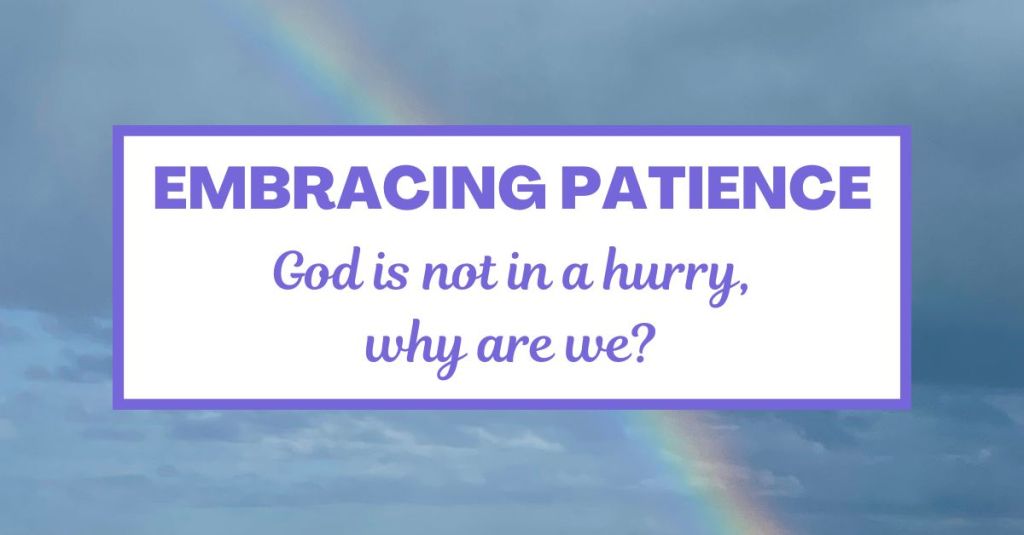
I must confess that patience has never been one of my virtues, so I was quite intrigued when I stumbled upon the surprisingly profound phrase, “God is not in a hurry, why are we?” My impatience impacts almost all areas of my life. I want things, and I want them now. Yet, this does not appear to be a trait that God shares.
Let’s start with the fruit of the spirit found in Galatians 5:22-23 (ESV): love, joy, peace, patience, kindness, goodness, faithfulness, gentleness, and self-control. When we are truly dwelling in God’s presence and are living a spirit filled life, there should be no room for the extreme frustration that comes with impatience.
It’s easy to question why God doesn’t intervene immediately in the world’s affairs. Why doesn’t God step in and do something about all the hate and violence? Why doesn’t God heal all the people lying in a hospital room, sick with some incurable disease? Why does God allow poverty? Perhaps, it boils down to the essence of patience. God knows that in the grand scheme of eternity, all will be set right in the blink of an eye. What is an 80 year lifetime compared to a billion years? Does this mean that God isn’t good? That he is indifferent or uncaring? 2 Peter 3:8-9 assures us otherwise.
But do not overlook this one fact, beloved, that with the Lord one day is as a thousand years, and a thousand years as one day. The Lord is not slow to fulfill his promise as some count slowness, but is patient toward you, not wishing that any should perish, but that all should reach repentance.
2 Peter 3:8-9 (ESV)
This verse reveals a God who deeply cares, one who desires a change in our ways. Fortunately or unfortunately, we have a God who did not make puppets to serve him. We are not Barbie dolls acting out some scene from a child’s imagination. We are made in God’s image, and that image includes the ability to discern good and evil and decide our own course of action. For better, or for worse, we have been given freedom of choice.
The truth is that all of our choices affect other people. Imagine a world where everyone chooses good, a world devoid of the need for police, lawyers, or judges. People would work for the bennefit of themselves, their families, and their neighbors. Maybe we wouldn’t even need money and everything would work on the principles of Gimmelwald’s Honesty Shop. Sounds like heaven, right?
Conversely, a few choosing to do wrong can cause a ripple effect. Theft causes poverty and anger, violence causes incapacity and mental illness, sexual sin causes jealousy and disease, and the list goes on. Let’s take the victim of a violent crime who then develops a severe mental illness as a result. Think of the impacts that the children of this person might have. Poverty, abuse, and neglect are only a few of the possibilities. Then this carries on to the next generation.
Given the length of time that has passed between Adam and Eve and us, there has been a lot of time for some pretty messed up things to happen and it is no wonder that the world is in the state that it is. A quick read of both Genesis and Judges should highlight just how messed up even people who follow God are. However, God continues to allow us to navigate this broken world, providing us the freedom to choose him, and as a result, make the world a better place.
Even so, our sin really troubles God. In Genesis, we see that at one point, God was so grieved that he chose mass extermination, only sparing Noah and his family. Fortunately, even though we are still just as sinful as we were then, God still chose to give us the rainbow so that we would always know that he would not destroy all of humanity through rain.
And the Lord regretted that he had made man on the earth, and it grieved him to his heart…And when the Lord smelled the pleasing aroma, the Lord said in his heart, “I will never again curse the ground because of man, for the intention of man’s heart is evil from his youth. Neither will I ever again strike down every living creature as I have done…When I bring clouds over the earth and the bow is seen in the clouds, I will remember my covenant that is between me and you and every living creature of all flesh. And the waters shall never again become a flood to destroy all flesh.
Genesis 6:6, 8:21, 9:14-15 (ESV)
God wants us to choose him, but he isn’t going to force us. Until we accept our righteous bodies and allow ourselves to be taken to heaven, we are stuck with all of the unfortunate consequences that result from other people’s sin. And since we are sinful ourselves, we also participate in it. Thankfully, God’s patience persists and he refrains from wiping us all out for our disobedience. Talk about patience!
The next time our kids do something really horrible, let’s think about how God treats us. Sometimes he corrects us, and sometimes he allows us to wallow in the consequences. Sometimes we change our ways, and sometimes we don’t. As a parent, this can be maddening!
God is not in a hurry, why are we?
Author Unknown
In contemplating the profound query posed by the original quote, “God is not in a hurry, why are we?” we are compelled to examine our perception of suffering and its role in salvation. While envisioning a world devoid of suffering often evokes a desire for immediate transformation and urgency, we must consider the eternal consequences. Our ability to endure temporary suffering during our brief earthly existence may hold the key to countless souls finding salvation instead of damnation. As we grapple with the relative brevity of our time on Earth against the backdrop of eternity, the call to embrace patience becomes paramount.
Let’s consider: How deeply do we truly love the rest of humanity, and are we willing to be as patient as God?
Reflection Questions
As you think about God’s patience and willingness to allow a lot of suffering in our world, consider the following questions:
- How does the author’s discussion of impatience relate to your own experiences?
- How can developing qualities like patience enhance your spiritual well-being?
- Does the article’s interpretation of 2 Peter 3:8-9 change how you see God’s patience?
- How does your freedom of choice impact your life and the world?
- How can your choices positively influence others and future generations?
- What role do you think enduring temporary suffering plays in finding salvation?
- How patient and loving are you towards humanity in your daily life?
- In what situations do you feel the need for immediate change, and how does patience play into this?
- What practical steps can you take to bring more patience into your daily routine?
- How does thinking about the shortness of life in the grand scheme of eternity affect your priorities?
Respond
Consider sharing your insights and experiences in the comments below!
Subscribe
If you enjoyed this post and wish to receive more Christian content, feel free to subscribe to my newsletters!
Related Resources
Visit the Joyful Moments in Christ homepage for all posts, or scroll through other blog posts related to patience and suffering:





English Standard Version (ESV): Scripture quotations marked (ESV) are taken from the ESV® Bible (The Holy Bible, English Standard Version®), © 2001 by Crossway, a publishing ministry of Good News Publishers. Used by permission. All rights reserved. The ESV text may not be quoted in any publication made available to the public by a Creative Commons license. The ESV may not be translated in whole or in part into any other language.

 Joyful Moments in Christ