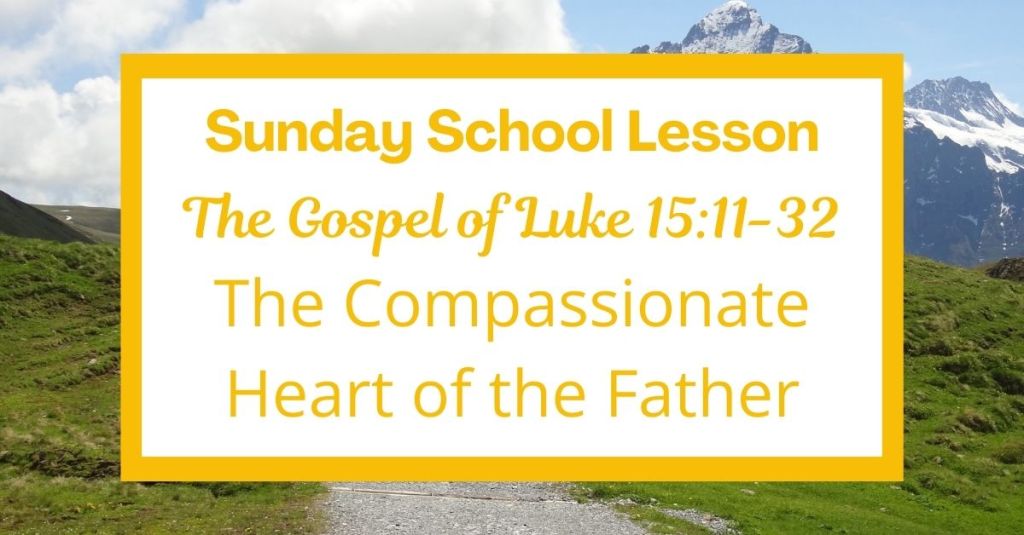
The Compassionate Heart of the Father
This Sunday School lesson is intended for upper elementary students. All lessons on this website are protected by copyright, but you can use them for free in small groups or Sunday School classes. You may share a link to this page, but please do not copy these pages and put them on other websites.
The Big Idea
Jesus shows us that God is a loving father who joyfully forgives and welcomes home anyone who turns back to him.
Lesson Objectives
- Students will learn that sin leads to brokenness and a need for repentance.
- Students will understand that God’s grace is a free gift that we cannot earn by our own hard work.
- Students will recognize that we should rejoice when others receive mercy instead of being jealous.
Class Setting Notes
- Recommended for upper elementary Sunday School.
- Lesson length: 45 to 60 minutes. Can be shortened or extended based on activities selected.
Opening Activity: The Welcome Banner
- Give the students a long piece of paper and some markers.
- Ask them to think of the best way to welcome a friend who has been gone for a very long time.
- Have them work together to decorate a big sign that says Welcome Home.
- Ask the students how they would feel if they were the ones walking through the door and seeing that sign.
This activity helps introduce the feeling of being loved and accepted even after a long time away.
Bible Reading
Ask the class to read Luke 15:11-32 aloud together or have one person read it.
- Very Easy: Easy-to-Read Version: Luke 15:11-32 (ERV)
- Very Easy: New International Reader’s Version: Luke 15:11-32 (NIRV)
- Easy: Good News Translation: Luke 15:11-32 (GNT)
- Medium: New Living Translation: Luke 15:11-32 (NLT)
- Hard: New International Version: Luke 15:11-32 (NIV)
- Very Hard: English Standard Version: Luke 15:11-32 (ESV)
Additional Reading: Choosing the Right Bible Translation
Suggested prompts:
As the class reads aloud, consider asking some of these prompts:
- Notice how the younger son wants his money right away instead of waiting for his father to give it to him later.
- Think about how sad and hungry the son must have felt while he was sitting with the pigs.
- Watch what happens as soon as the father sees his son walking toward the house.
- Pay attention to the special gifts the father gives his son to show he is still a member of the family.
- Listen to the complaints of the older brother and how the father answers him with kindness.
Teacher Background Notes
- In ancient times, asking for an inheritance while a father was still alive was like saying you wished he was dead.
- Pigs were considered unclean animals to the people of Israel, so the son’s job showed he had hit the very bottom of life.
- Middle Eastern men in that culture usually did not run in public, so the father running to his son showed he was willing to look foolish to show his love.
- The ring and the shoes were symbols that the son was a free member of the household and not a servant.
- The older brother represents those who think they deserve God’s love because they follow all the rules, while missing the heart of grace.
Theological Insights
- All people have turned away from God like the younger son, but God is the one who initiates reconciliation.
- True repentance begins when a person realizes their sin against God and their need for his mercy.
- The father’s love is a picture of the gospel, where we are treated better than we deserve because of the goodness of God.
- Salvation is not based on our own merit or work, as shown by the father’s response to both the sinful son and the angry son.
- The joy of God is found in bringing what was dead back to life through the power of forgiveness.
Discussion Questions
Understanding the Text
- Why did the younger son decide to go back home after he lost all his money?
- What was the son planning to say to his father when he arrived?
- How did the father show he had already forgiven his son before the son even spoke?
- Why did the older brother refuse to go into the party?
Personal Reflection and Application
- Have you ever felt like you had to be perfect for God to love you? How does this story change that idea?
- Why is it sometimes hard to be happy for someone else when they get something they do not deserve?
- What are some ways we can remember that God is always ready to listen to us when we tell him we are sorry?
- How can we show the love of the father to people in our lives who have made big mistakes?
Suggested Activities
The Senses of the Story
- Bring in small samples of items from the story, like a piece of fancy cloth for the robe or a small piece of bread.
- Have students close their eyes and touch the items while you read the passage again.
- Ask them to describe the difference between the rough pig food and the soft robe.
This activity helps students connect with the physical details of the son’s journey from misery to joy.
The Heart of Forgiveness Art
- Have students draw a large heart and divide it into two sides.
- On one side, have them draw things that represent being lost, and on the other, things that represent being found.
- In the middle, have them write the word Grace in large letters.
This activity allows students to visualize the transformation that happens when we turn to God.
Role Play: The Father’s Words
- Pair students up and have one play the father and the other play the older brother.
- Have them practice saying the father’s words from verse 32 about why they had to celebrate.
- Switch roles so everyone gets a chance to speak the words of the father.
This activity helps students internalize the message of rejoicing over others.
Memory Verse

Closing Prayer
Father,
Thank you for your great mercy that welcomes us home. Help us to trust in your love and to be joyful when you show your grace to others.
In Jesus’ name we pray. Amen.


The ESL Version
I also create materials for adult English Language Learners (ELLs) and ESL students. You can find my ELL Bible Study based on Luke 15:11-32 here:
Subscribe
If you enjoyed this post and wish to receive more Christian content, consider subscribing to my newsletters!
Related Resources
Visit the Joyful Moments in Christ homepage for all posts, or scroll through other blog posts related to Sunday School:

Something went wrong. Please refresh the page and/or try again.
English Standard Version (ESV): Unless otherwise noted, scripture quotations are from the ESV® Bible (The Holy Bible, English Standard Version®), © 2001 by Crossway, a publishing ministry of Good News Publishers. Used by permission. All rights reserved. The ESV text may not be quoted in any publication made available to the public by a Creative Commons license. The ESV may not be translated in whole or in part into any other language.