Choosing Kindness on the Sabbath
This Sunday School lesson is intended for upper elementary students. All lessons on this website are protected by copyright, but you can use them for free in small groups or Sunday School classes. You may share a link to this page, but please do not copy these pages and put them on other websites.
The Big Idea
Jesus teaches us that showing mercy and helping those in need is the true way to honor God on the Sabbath.
Lesson Objectives
- Students will learn that Jesus has the power to heal and a heart full of compassion for those who suffer.
- Students will understand that the Sabbath is a gift from God intended for rest, worship, and doing good.
- Students will recognize that we should not let the opinions of others stop us from doing what is right and kind.
Class Setting Notes
- Recommended for upper elementary Sunday School.
- Lesson length: 45 to 60 minutes. Can be shortened or extended based on activities selected.
Opening Activity: The Emergency Rescue
- Ask the students to imagine they are sitting down for a very special, quiet rest.
- Suddenly, tell them that a puppy has fallen into a hole and needs help right away.
- Ask the students if they would stay in their chairs to keep resting or if they would get up to help.
- Discuss why helping the puppy is more important than the rule of staying still.
This activity helps introduce the idea that mercy and helping others are more important than following a rule about resting in the wrong way.
Bible Reading
Ask the class to read Luke 14:1-6 aloud together or have one person read it.
- Very Easy: Easy-to-Read Version: Luke 14:1-6 (ERV)
- Very Easy: New International Reader’s Version: Luke 14:1-6 (NIRV)
- Easy: Good News Translation: Luke 14:1-6 (GNT)
- Medium: New Living Translation: Luke 14:1-6 (NLT)
- Hard: New International Version: Luke 14:1-6 (NIV)
- Very Hard: English Standard Version: Luke 14:1-6 (ESV)
Additional Reading: Choosing the Right Bible Translation
Suggested prompts:
As the class reads aloud, consider asking some of these prompts:
- Notice how the people were watching Jesus closely to see if he would make a mistake.
- Think about how the sick man must have felt standing in front of all those important leaders.
- Watch what happens when Jesus asks a simple question about what the law allows.
- Pay attention to the fact that the Pharisees stayed quiet because they did not want to agree with his mercy.
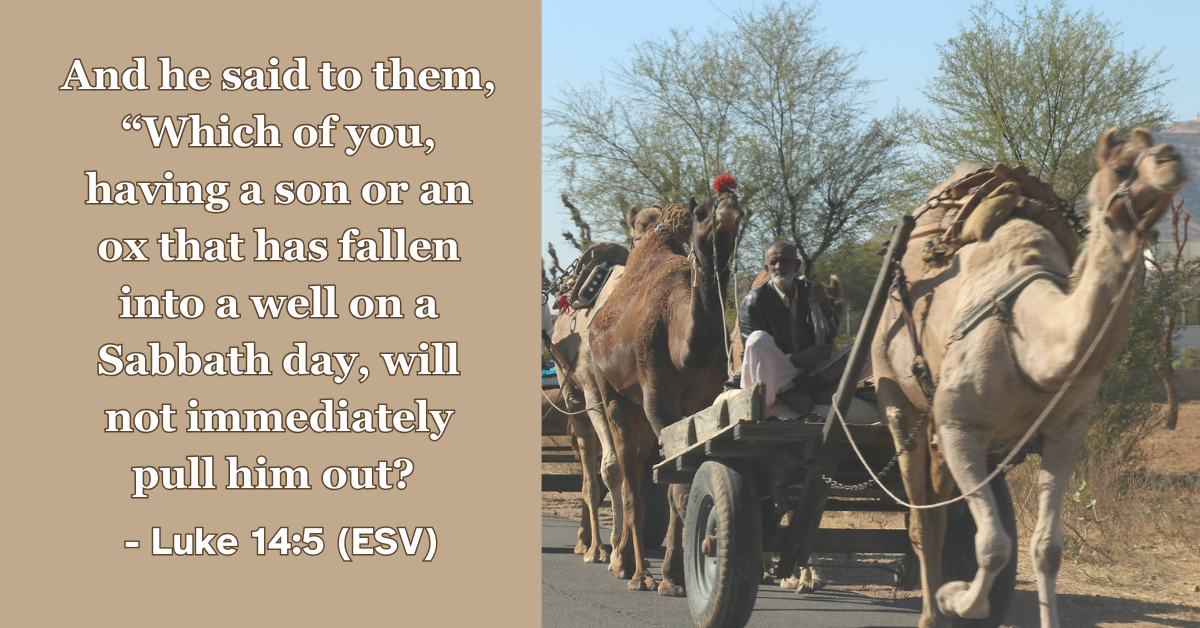
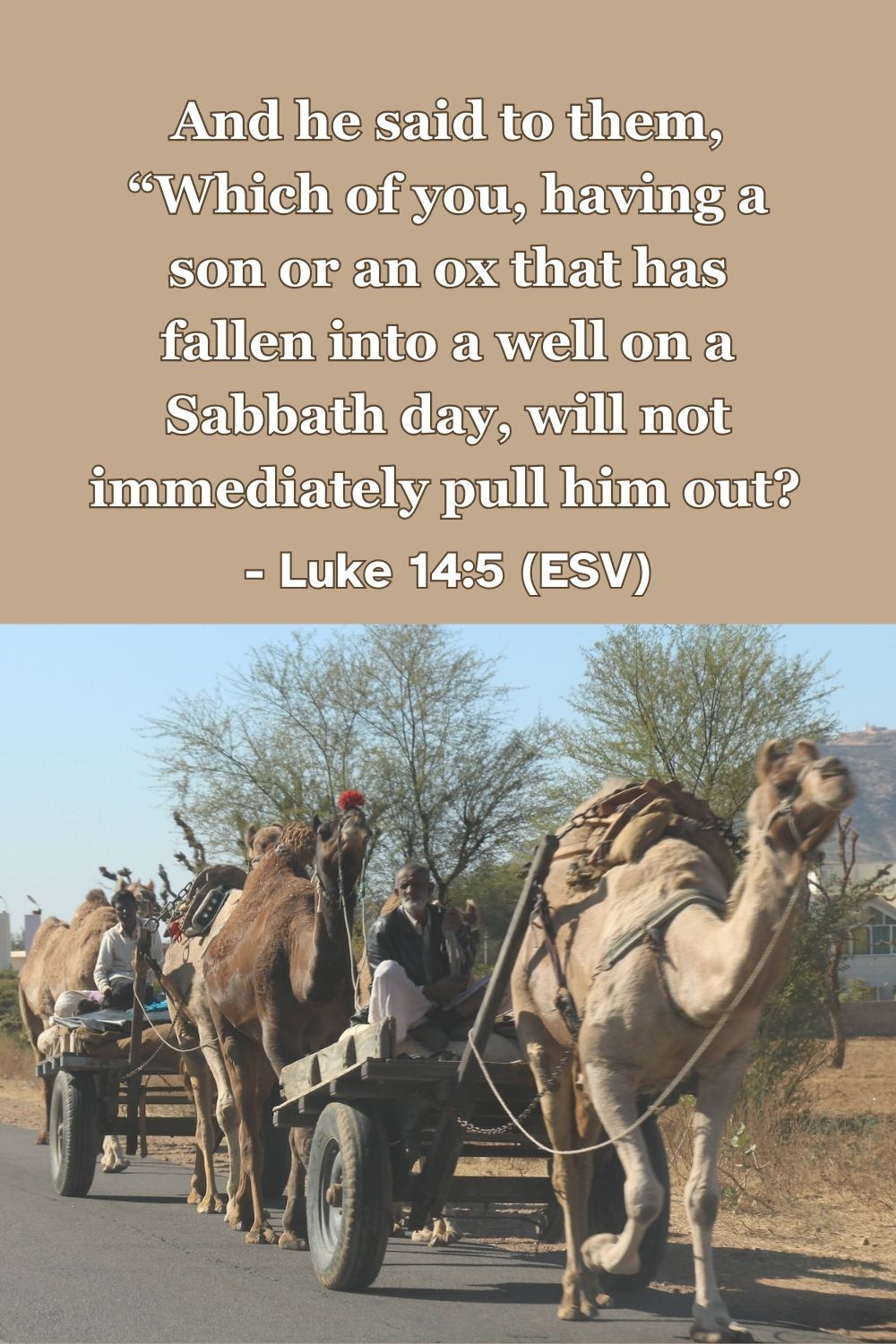
- Listen for the example Jesus gives about a son or an ox falling into a well.
Teacher Background Notes
- The Pharisees were a religious group that added many extra rules to God’s law to try and stay holy, but they often missed the heart of the law.
- The Sabbath was the seventh day of the week, set apart by God at creation as a day of rest and holy worship.
- The disease the man had involved his body swelling with fluid, which was a very painful and visible condition.
- In Jewish culture, eating a meal together was a sign of friendship, but the Pharisees often invited Jesus just to test him.
- Jesus was not breaking God’s law by healing; he was showing that the law was made for the benefit of people.
Theological Insights
- God is the author of the Sabbath, and he intends for it to be a day where we reflect his goodness to others.
- Jesus is the Lord of the Sabbath who has the authority to define how we should spend our time.
- Human tradition should never be placed above the command of God to love our neighbors as ourselves.
- The silence of the Pharisees shows that a heart hardened by pride cannot understand the beauty of God’s grace.
- Every act of healing performed by Jesus is a sign that his kingdom is coming to fix everything that is broken in the world.
Discussion Questions
Understanding the Text
- Who invited Jesus to a meal on the Sabbath day?
- What did Jesus ask the experts in the law before he healed the man?
- What did the Pharisees do when Jesus asked them if it was right to heal?
- What would a Pharisee do if his own son fell into a well on a day of rest?
Personal Reflection and Application
- Why is it sometimes hard to do the right thing when you know people are watching you closely?
- How can we make sure that our Sunday rest includes showing the love of God to people who are hurting?
- What are some ways that we might act like the Pharisees by caring more about rules than about people?
- Is there someone in your life right now who needs help or kindness that you can provide this week?
Suggested Activities
The Well Rescue Relay
- Place a bucket at one end of the room and small stuffed animals at the other.
- Have students race to rescue the animals and bring them back to safety.
- After the game, talk about how happy we feel when someone is saved from a dangerous spot.
This activity illustrates the point Jesus made about the urgency of helping someone in trouble.
Heart vs. Rules Chart
- Draw a large heart on one side of a poster and a list of rules on the other.
- Ask students to list things that belong in each, like kindness and mercy for the heart, and cleaning or resting for the rules.
- Discuss how the heart should be the reason why we follow God’s rules.
This activity helps students distinguish between outward obedience and inward love for God.
Sabbath Kindness Cards
- Give each student a blank card and markers.
- Have them write a kind note to someone in the church who is sick or elderly.
- Encourage them to deliver the card after the service.
This activity puts the teaching of Jesus into immediate practice by using the Sabbath to encourage others.
Memory Verse
Closing Prayer
Father,
Thank you for the rest you give us and for the example of Jesus. Help us to have hearts that are quick to show mercy and eyes that see the needs of others.
In Jesus’ name we pray. Amen.
The ESL Version
I also create materials for adult English Language Learners (ELLs) and ESL students. You can find my ELL Bible Study based on Luke 14:1-6 here:
Subscribe
If you enjoyed this post and wish to receive more Christian content, consider subscribing to my newsletters!
Related Resources
Visit the Joyful Moments in Christ homepage for all posts, or scroll through other blog posts related to Sunday School:



Something went wrong. Please refresh the page and/or try again.
English Standard Version (ESV): Unless otherwise noted, scripture quotations are from the ESV® Bible (The Holy Bible, English Standard Version®), © 2001 by Crossway, a publishing ministry of Good News Publishers. Used by permission. All rights reserved. The ESV text may not be quoted in any publication made available to the public by a Creative Commons license. The ESV may not be translated in whole or in part into any other language.