
After five chapters of reminding the Galatians of the true source of salvation and the freedom that comes through Christ, Paul closes his letter with a final word of wisdom for living out that freedom. His message is practical, deeply pastoral, and meant for each of us. He reminds us that the Christian life is not an individual pursuit, but a shared journey shaped by humility, compassion, and perseverance. What we believe about grace must shape how we treat one another.
Before we dive into Galatians 6, it is worth pausing and reviewing what Paul means by “freedom in Christ.” This freedom is not merely the absence of rules, but is the liberation from the burden of self-righteousness and the chains of sin that once enslaved us. It is the freedom to live not for ourselves, but for God and others. However, freedom is not license to sin. True freedom expresses itself in love, obedience, and the careful stewardship of our influence in the lives of others. Paul’s words remind us that salvation changes not only our relationship with God, but also our interactions with those around us.
This emphasis is critical because the Galatians had been tempted to turn back to legalism, measuring spiritual maturity by outward conformity rather than heart transformation. For Paul, the mark of a Spirit-filled life is not ritual observance, but a life that reflects God’s love, humility, and mercy. As we read his closing words, we see a pastoral concern for both the individual and the community, illustrating that personal faith and corporate discipleship are inseparable.
Restoring and Supporting One Another
Galatians 6 offers a glimpse into what a Spirit-filled community looks like. It is not marked by perfection, but by love that restores, patience that endures, and faith that bears fruit. In this final chapter, Paul helps us see what it truly means to walk in step with the Spirit day by day.

In our own context, it is easy to idealize community. We imagine it as a place where everyone is mature, sinless, and loving. Reality is far different. Communities are filled with imperfect people, each struggling with their own weaknesses and blind spots. Paul reminds us that the Spirit’s work transforms ordinary Christians into vessels of restoration and support. Walking in the Spirit does not make us immune to failure, but it does equip us to act with wisdom, gentleness, and perseverance when we encounter the failures of others.
The moment we choose salvation, we do not instantly become perfect. Sin remains a reality, even in the lives of deeply professing Christians. Paul knew this and called the Galatians to approach these realities with gentleness and humility. We are called to the same standard. When a brother or sister stumbles, our goal is not judgment or condemnation, but restoration. Correction should come from a heart of love, seeking to guide rather than to punish.
Restoration is not a single act, but is a process that often requires multiple conversations, ongoing encouragement, and patient listening. Genuine restoration considers the heart as much as behavior, recognizing that sin often stems from deeper struggles like fear, pride, unmet needs, or deception. Approaching restoration with gentleness allows the Spirit to work in the heart of the person, creating openness to change, rather than defensiveness.
We are reminded here that the Christian community is a delicate balance of accountability and grace. Restoration is not a casual suggestion. It is a responsibility, and it requires wisdom, prayer, and patience. In practice this could like like meeting with someone privately to speak truth in love, offering prayer for their restoration, or supporting them in making amends where sin has caused harm. The focus is always on repair and reconciliation, not humiliation.
We also must “keep watch on ourselves.” Accountability is not one-way. Being aware of our own temptations helps prevent pride and hypocrisy. We cannot faithfully guide others if we are ignoring our own faults. Spiritual leaders, mentors, and even peers must continually examine their own hearts to avoid becoming stumbling blocks. Reflection and prayer are essential in this process, as humility and self-awareness allow us to guide others from a place of dependence on God rather than self-reliance.

Paul immediately follows this with a call to empathy and action. To “bear one another’s burdens” means to share in the weight of both spiritual and practical struggles that others carry. Sin often produces consequences that extend beyond the individual. Families, communities, and innocent bystanders may all feel the effects of wrongdoing.
Bearing another’s burden does not mean taking on responsibility for someone else’s sin, but it does involve a willingness to enter into their struggle with compassion, patience, and practical help. This might mean offering encouragement when someone is struggling spiritually, helping with tangible needs such as groceries or transportation, or sitting in prayerful solidarity during times of emotional or relational pain. The call is not to avoid discomfort, but to participate in the life of the community in a way that demonstrates Christ’s love.
For example, the ripple effects of a parent’s addiction may affect children, spouses, and even coworkers. When someone falls into financial or relational ruin, others may suffer alongside them. In these cases, Christians are called to intervene with compassion, offering guidance, support, and encouragement. We cannot ignore the suffering that surrounds us, nor can we assume someone else will handle it.
Beyond human-caused burdens, life itself imposes challenges that no one wants to face. Illness, natural disaster, poverty, and social injustice can overwhelm even the strongest Christian. Bearing these burdens might include visiting the sick, helping rebuild after a disaster, providing mentorship, or simply offering presence and prayer. These acts of service are reflections of Christ’s love and demonstrate the practical outworking of the gospel in daily life. Each act of support, no matter how small, contributes to the overall health of the body of Christ.
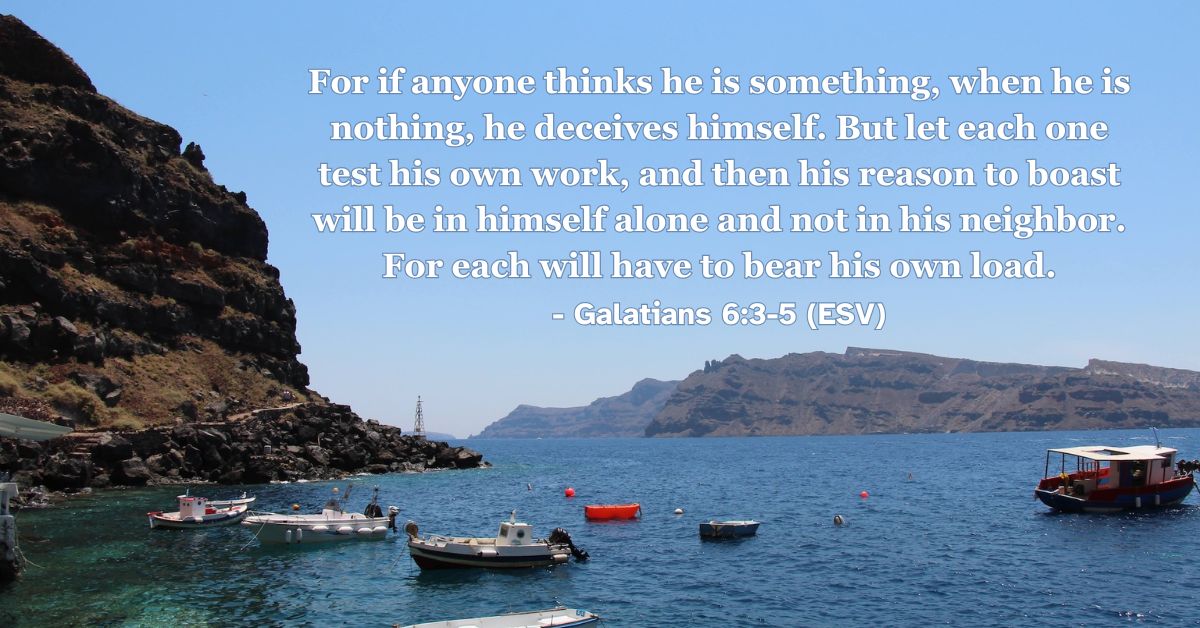
As we bear the burdens of others, there is a subtle temptation to pride. Helping others can lead us to overestimate our own strength or righteousness. Paul warns that such thinking is deceptive. All of us rely on God’s grace, and any boasting that diminishes others or exalts ourselves is misplaced.
Self-examination is essential. Evaluating our actions, motives, and responses helps ensure that our service is pure and that we are not substituting human admiration for God’s approval. Each of us carries personal responsibilities, and we must tend to our own spiritual growth and obedience while aiding others. Spiritual maturity is not measured by how much we help others, but by how faithfully and humbly we allow the Spirit to guide our service.
Self-reflection also guards against envy or comparison. Seeing others grow or succeed may trigger subtle resentment if we are not rooted in humility. Paul’s call reminds us that true satisfaction comes from faithfully doing our work for God’s glory, not from the recognition of others.

Gratitude and generosity strengthen the community of faith. Those who teach, mentor, or disciple others invest immense time and energy. When their guidance bears fruit, it is both proper and loving to honor them. Sharing material resources, encouragement, or simply verbal affirmation can motivate continued ministry and nurture mutual respect.
This principle reminds us that Christian life is reciprocal. We are not just receivers of wisdom and care, but participants in a cycle of support. Recognition and generosity toward spiritual leaders reinforce the health of the body of Christ, modeling the very love and humility Paul calls us to display. Financial support, hospitality, and encouragement create a culture where teaching and mentorship thrive, ensuring that both teachers and learners are nourished.
Sowing to the Spirit
Paul shifts to a principle familiar in Scripture: sowing and reaping. Every choice, thought, and action plants a seed. Seeds sown in selfishness, pride, or sin produce destruction. Seeds sown in love, obedience, and prayer produce eternal fruit.
This principle emphasizes intentionality. Life is not a series of random acts, but a continuous cultivation of habits and priorities. Each decision shapes character and influences others. Even small acts of kindness or diligence can produce a harvest beyond what we imagine. Conversely, neglect, anger, or greed may yield unseen harm. Paul challenges us to consider the long-term fruit of our spiritual lives, reminding us that God observes and rewards faithful stewardship.
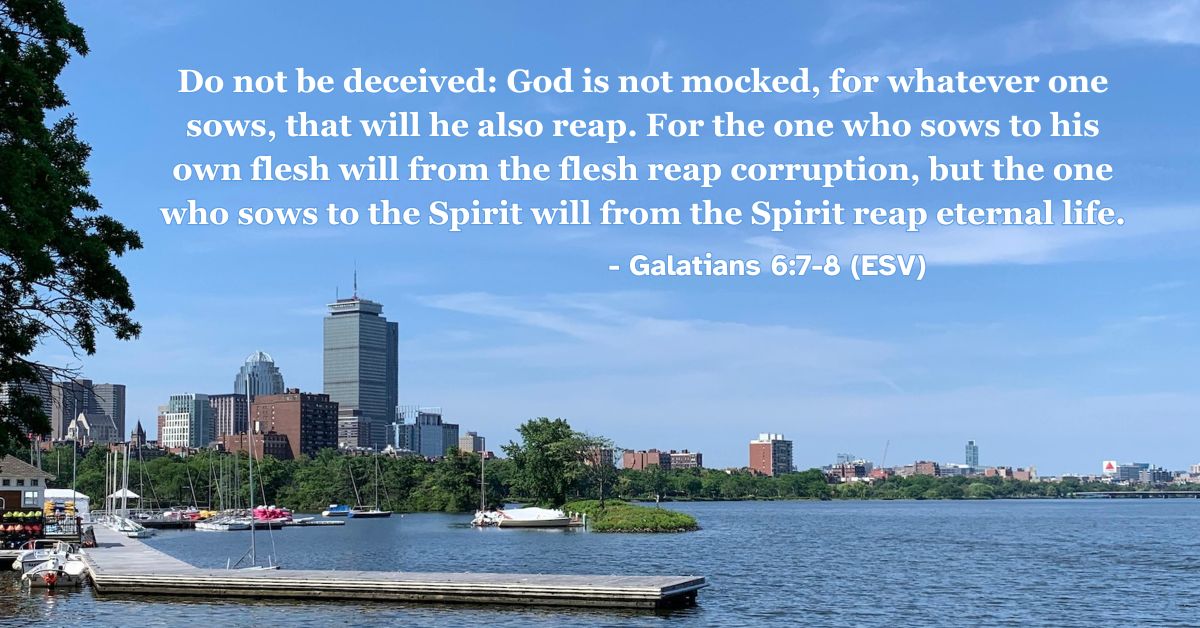
This is a call for constant self-awareness. The devil’s deception can be subtle. We may believe we are acting righteously, while secretly serving our own desires. Rooting our decisions in the Bible, seeking counsel from mature believers, and submitting to the Spirit’s guidance ensures that the seeds we sow yield lasting life.
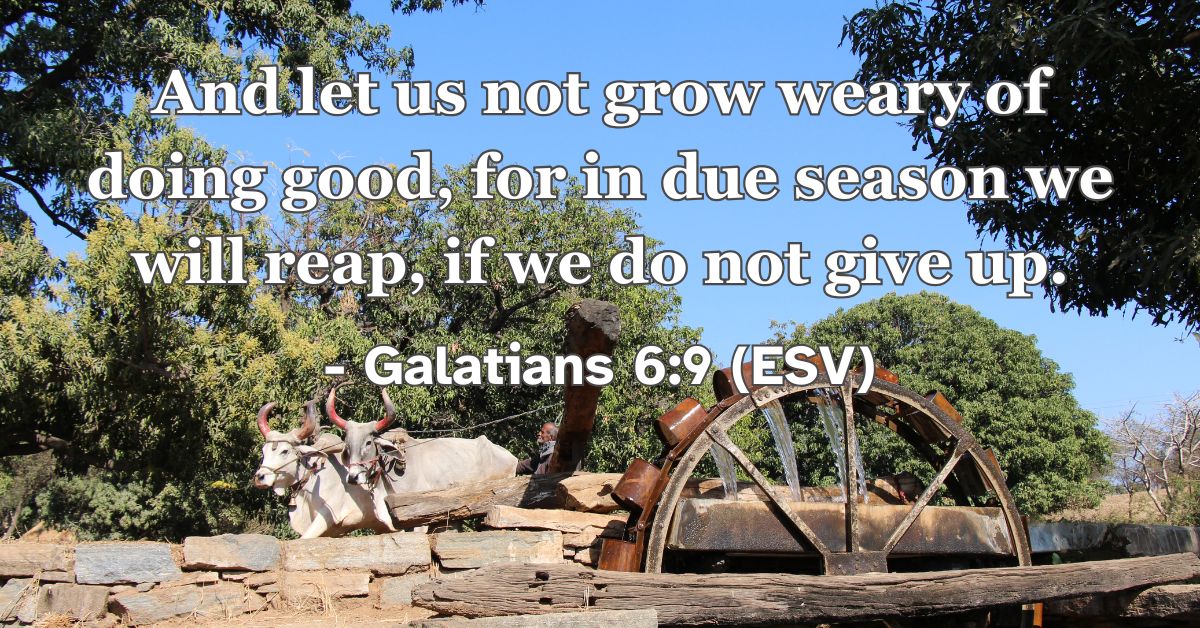
Of course, faithful service can be quite demanding and exhausting. The reality is that doing good is not always glamorous or immediately rewarding. Often, acts of love and obedience go unnoticed, or the results seem small compared to the effort invested. Paul encourages perseverance in the face of discouragement. The promise of a harvest “in due season” reminds us that God’s timing is perfect and that he sees and rewards faithfulness, even when human eyes do not.
This verse also addresses the danger of spiritual fatigue. It is easy for a Christian to become discouraged by repeated failures, both in their own life and in the lives of those they are trying to help. Sometimes we are tempted to think, “My efforts make no difference,” or “Why bother when no one appreciates it?” Paul reassures us that every act of obedience, no matter how small, contributes to God’s kingdom and will bear eternal fruit.
Moreover, perseverance shapes character. The process of faithfully doing good cultivates patience, endurance, and reliance on God’s strength. Through these challenges, we are refined and learn to trust not in our own abilities, but in the Holy Spirit’s sustaining power. In the broader context of Galatians, this call to perseverance is a reminder that freedom in Christ is not a free pass to indifference, but is the empowerment to serve faithfully, even in difficulty.

Christian service is intentional and sometimes needs more prioritization than we might hope. While we are called to love all, our first responsibility is toward the family of faith. Supporting fellow Christians fosters unity, discipleship, and mutual growth. When we invest in our church community, we strengthen the bonds that make the gospel visible to the world.
This does not mean neglecting the needs of outsiders, but Paul does emphasize the principle of proximity and responsibility. Those who share our faith are often in the closest circles of accountability and spiritual partnership. Acts of service in this context have the power to encourage, restore, and mentor other believers in ways that ripple outward to the larger community. By prioritizing the household of faith, we model Christ’s love, create safe spaces for growth, and maintain a visible witness of unity in the church that will only strengthen the claims of those sent out as missionaries.
Practical applications today might include helping a fellow Christian navigate a financial challenge, providing childcare for a parent in need, mentoring a younger member in spiritual disciplines, or offering encouragement and prayer to someone struggling with temptation. These acts of service reflect the love of Christ in concrete ways and demonstrate that Christian freedom is expressed not in independence, but in sacrificial love for others.
See with what large letters I am writing to you with my own hand. It is those who want to make a good showing in the flesh who would force you to be circumcised, and only in order that they may not be persecuted for the cross of Christ. For even those who are circumcised do not themselves keep the law, but they desire to have you circumcised that they may boast in your flesh.
Galatians 6:11-13 (ESV)
At this point, Paul transitions to his final personal remarks. He underscores the seriousness of the letter by noting that he wrote this portion himself. Some in the Galatian community were promoting circumcision as a requirement, seeking a higher spiritual status or trying to avoid persecution. Paul exposes their motives, showing that their true intent was self-interest, not spiritual benefit.
This section serves as a warning about the ways religious practices can be misused. It reminds us that even outwardly faithful actions, if driven by pride or personal gain, fail to produce true righteousness. Paul contrasts this with the genuine transformation brought by the Spirit, emphasizing that obedience to God must flow from a heart aligned with Christ rather than from external pressures or human approval.
By reflecting on this, we are encouraged to examine our own motives. Are our actions motivated by the desire to please God, or to earn praise from others? Do we serve out of love or out of habit, obligation, or fear of judgment? Paul’s example invites a deep and honest assessment of the heart, reminding us that true freedom is found in Spirit-led obedience rather than external conformity.

Paul claims that the cross is the only reason for boasting, symbolizing freedom from sin, liberation from worldly values, and victory through Christ’s sacrifice. To boast in the cross is to reject self-righteousness and pride, acknowledging that all spiritual benefit comes through grace. The cross is not just a symbol of suffering; it is the ultimate expression of God’s love and the source of true transformation for all who believe.
Boasting in the cross also reorients priorities. Worldly achievements, human recognition, and material possessions pale in comparison to the eternal significance of Christ’s sacrifice. For Paul, this reorientation meant a total detachment from worldly standards of success. In our own lives, it is easy to measure worth by achievement, recognition, or approval. Paul’s example challenges us to recalibrate our hearts so that our identity is rooted in Christ, not in the shifting values of the world.
Moreover, boasting in the cross reminds us that freedom in Christ is costly yet empowering. We are freed from sin and guilt, but this freedom calls us to live intentionally in love and obedience. The cross is the benchmark by which we measure faithfulness, humility, and spiritual devotion.
For neither circumcision counts for anything, nor uncircumcision, but a new creation.
Galatians 6:15 (ESV)
What matters most is transformation in Christ. When we choose a life of faith, we are made new, defined not by human regulations but by the Spirit’s work. The old distinctions, which once divided communities and determined status, no longer hold significance. The defining characteristic of the Christian life is a renewal where we become a new creation empowered to reflect God’s character.
This new creation is not merely symbolic, but manifests in behavior, thought, and relationships. The Spirit transforms our hearts, shaping desires, attitudes, and priorities. We are freed from the tyranny of legalism, from measuring righteousness by external conformity, and empowered to live in authentic obedience to God. Each of us, regardless of background, status, or past failures, has access to this transformative power.
And as for all who walk by this rule, peace and mercy be upon them, and upon the Israel of God.
Galatians 6:16 (ESV)
Paul pronounces a blessing on those who live according to these truths. Peace and mercy are markers of God’s favor, flowing to those who embrace the gospel fully. Walking in the Spirit produces inner assurance, relational harmony, and resilience in the face of trials. The blessing also serves as encouragement: living by these principles is not only right but fruitful, resulting in tangible benefits both spiritually and relationally.
Peace here is not merely the absence of conflict; it is the wholeness and security that come from being aligned with God’s will. Mercy flows both to the individual and the community, as a life guided by grace becomes a channel of grace for others. Paul’s blessing is both pastoral and prophetic, a reminder that God rewards faithfulness in tangible ways, shaping communities that reflect his kingdom.
From now on let no one cause me trouble, for I bear on my body the marks of Jesus.
Galatians 6:17 (ESV)
At the end of his letter, Paul acknowledges the cost of faithful ministry. He bears physical and spiritual scars for Christ, demonstrating that following Jesus often entails struggle and suffering. However, he was a firm believer that these marks were sources of honor, reminders of faithful obedience, and evidence of a life fully surrendered to God.
Paul’s experience encourages us to view hardship through the lens of faith. Trials, persecution, and personal sacrifice are not meaningless, but are part of the process of conforming to Christ’s image. The “marks of Jesus” testify to a life committed to God’s mission, encouraging others to endure faithfully despite challenges.
The grace of our Lord Jesus Christ be with your spirit, brothers. Amen.
Galatians 6:18 (ESV)
Paul concludes with a blessing of grace. Grace sustains, renews, and empowers us, anchoring both our salvation and our ongoing sanctification. Every step of obedience, every act of service, and every moment of endurance is rooted in God’s unmerited favor. As we surrender to God, we should follow Paul’s example by embracing the marks of Jesus, bearing what must be borne, and delighting in the restoration that comes through a Spirit-led life.
This final benediction underscores the central theme of Galatians: life in Christ is defined by grace, not human effort. Grace is the foundation for community, restoration, and personal growth. It reminds us that we are not alone in our journey. The Spirit equips, strengthens, and empowers each of us to live faithfully, humbly, and lovingly.
Reflection Questions
- How can you restore someone in a spirit of gentleness without pride or harshness?
- Which burdens might God be calling you to help carry within your community or family?
- Where do you see the temptation to “sow to the flesh” in your own life?
- How does the promise of reaping in due season encourage perseverance in doing good?
- In what ways can you practice boasting only in the cross in your words and actions this week?
- How can you cultivate humility and personal accountability while serving others?
- What practical steps can you take to ensure your support strengthens your church community?
Reflective Prayer
Consider using these verses to pray using the ACTS method: Adoration, Confession, Thankfulness, and Supplication:
- Adoration: Praise God. Do these verses bring any specific characteristics of God to mind?
- Confession: Tell God that you are sorry for specific sins. Do these verses bring any specific sins to mind?
- Thankfulness: Show gratitude towards God. Does anything from these verses inspire gratitude?
- Supplication: Make requests for yourself and for others. Does anything from these verses inspire a prayer?
If helpful, you can use a prayer journal template.





Subscribe
If you enjoyed this post and wish to receive more Christian content, feel free to subscribe to my newsletters!
Related Resources
Visit the Joyful Moments in Christ homepage for all posts, or scroll through other blog posts related to grace and community:







Something went wrong. Please refresh the page and/or try again.
English Standard Version (ESV): Unless otherwise noted, scripture quotations are from the ESV® Bible (The Holy Bible, English Standard Version®), © 2001 by Crossway, a publishing ministry of Good News Publishers. Used by permission. All rights reserved. The ESV text may not be quoted in any publication made available to the public by a Creative Commons license. The ESV may not be translated in whole or in part into any other language.



 Joyful Moments in Christ