
Rooted in Identity
The book of Galatians is all about the need for Jesus as our Savior and the love and service that should flow from this decision to make him our king. In the first chapter, Paul expresses his astonishment that the Galatians would abandon this message in favor of other messages. Paul tells them that he was once one of these people, violently trying to convince others that the only way to salvation was to follow the exact letter of the Mosaic law.
This letter begins by associating both Paul and the Galatian church with Jesus. First Paul associates himself as a man who was made an apostle directly through Jesus Christ.
Paul, an apostle—not from men nor through man, but through Jesus Christ and God the Father, who raised him from the dead—and all the brothers who are with me.
Galatians 1:1-2 (ESV)
To the churches of Galatia:
Grace to you and peace from God our Father and the Lord Jesus Christ, who gave himself for our sins to deliver us from the present evil age, according to the will of our God and Father, to whom be the glory forever and ever. Amen.
To the churches of Galatia:
Since this identity is deemed most important, before Paul says anything corrective, before he dives into rebuke or exhortation, he grounds everything in who they belong to:

Returning to the Basics
There are moments in life when it becomes necessary to go back to the basics. A sports team in a losing streak needs to remember how to pass the ball. A married couple in conflict might need to recall why they fell in love in the first place. A Christian drifting from bold faith must remember what the gospel actually is. That is what Paul is doing here. He reminds them that the gospel is not a vague spiritual sentiment, but is about a real Savior who gave himself for our sins to deliver us. It is about the God who raised Jesus from the dead. It is about grace and peace, not anxiety and performance. It is about glory belonging to God forever, not to us for how well we behave. It is about identity rooted not in what we achieve but in who we belong to.
Once that foundation is laid, Paul moves straight to his main concern:

There is a mixture of fatherly disappointment and holy fire in Paul’s words. He is not calmly writing a theological essay, but is truly stunned! He is baffled that anyone who has tasted the grace of Christ could so quickly walk away in favor of something inferior. Notice that Paul does not say they are deserting a belief system, but says they are deserting a person. They are deserting the one who called them! That is what makes wandering from the gospel so tragic. It is not just that someone is choosing the wrong ideology, but that someone is walking away from Jesus.
A person who knows Christ should be able to distinguish the difference between what they first heard and new messages that are coming in. Unfortunately, there are many who call themselves Christians who have never read their Bible. It is only when we read our Bibles that we gain the knowledge that allows for distinction in these new messages. This is why it is so important for every Christian to know their Bible well! There are so many messages that bombard us from the culture we live in that sometimes it is hard to know what is of Christ and what is not. Fortunately, God has given us enough Scripture that can help us make this distinction. The more we dwell in the Bible, the more we can spot the discrepancies.
And discrepancies will come!
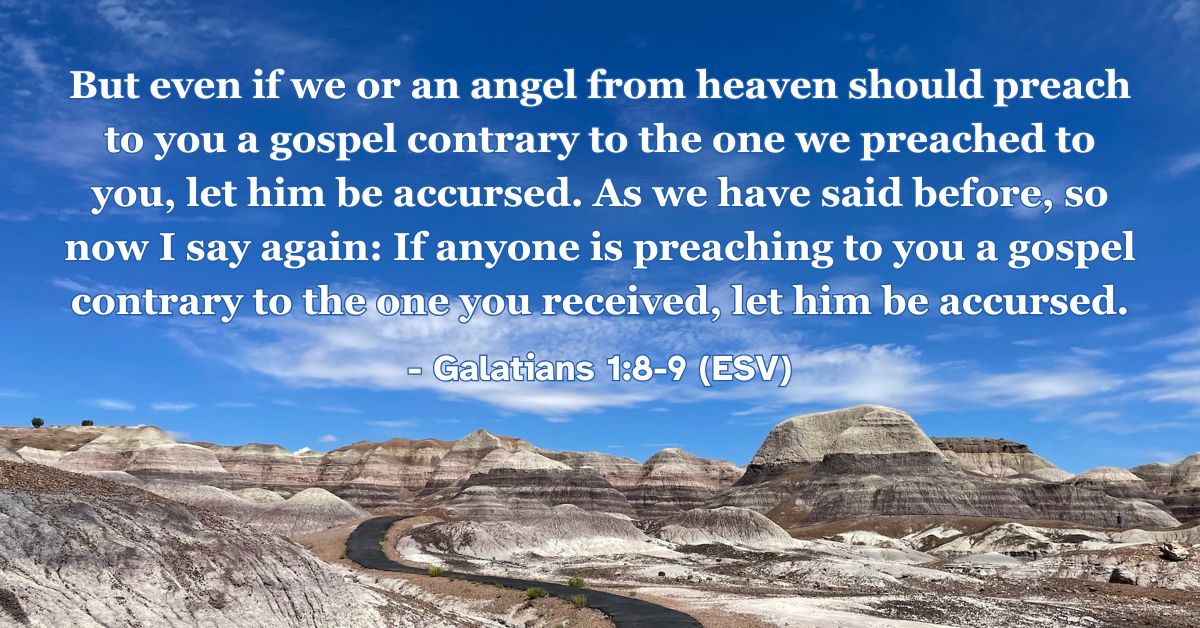
Paul has a very strong message for those who decide to deviate from the original gospel message: “Let him be accursed!” This is serious business! If you have been in the church very long, you will know that churches have split over various interpretations and questions over the authenticity of the Bible. Many churches say that Paul’s words cannot be trusted or that certain passages were meant only for a particular moment in history. However, while some cultural and ceremonial elements of Scripture certainly belong to a specific context, the core message of salvation through Christ is not temporary, it is not regional, it is not flexible, but it is eternal and universal. It is the beating heart of the Christian faith!
If we cannot trust the words that the early church trusted, what can we trust? If we treat Scripture as a buffet, taking what we like and pushing away what feels heavy, we will eventually find that we are starving. A pick-and-choose gospel will not sustain a weary soul. It might offer momentary comfort, but it has no power to save. In any case, Paul’s verses in Galatians 1 are directed at the message of salvation through Jesus, so let us limit the rest of this reflection to this particular topic.
Paul makes it clear that anyone who is preaching anything other than salvation through belief in the death and resurrection of Jesus, expressed through a life of joyful obedience to him, is not preaching the true gospel. There may be sermons filled with positive affirmations, moral pep talks, or spiritual-sounding language, but if Jesus is not at the center as Savior and King, it is not the gospel.
Paul tells the Galatians that he is not saying all of this because he wants to win a popularity contest:

This is a good verse to tape on your refrigerator, or your car dashboard, or wherever you look when you are tempted to care more about public opinion than eternal truth. Paul knew that the gospel is not always popular. News flash: it never has been. People want to be told they are basically good, but the gospel tells us we are sinners in need of rescue. People want to be told they can find peace within themselves, but the gospel tells us peace comes only through Christ. People want to be told they can keep control of their lives, but the gospel tells us to die to ourselves and follow Jesus. Paul would rather offend people than offend his Savior!
Paul’s Life as a Testimony
At this point, Paul goes into the reasons why his claims about the gospel are true. He does not ground his authority in a seminary degree, and he does not say he wrote a best-selling scroll, but he says he met Jesus.

Paul had a personal and direct encounter with Jesus! We can read all about it in Acts 9. While he was breathing out murderous threats against the church, Jesus made an appearance and gave Paul a strong rebuke. Fortunately, Paul’s zeal for the truth caused him to do a complete turnabout and he became one of the most influential Christians who ever lived.
Additional Reading: Blog posts related to Acts 9
Paul gives a quick summary of his conversion and subsequent actions:
For you have heard of my former life in Judaism, how I persecuted the church of God violently and tried to destroy it. And I was advancing in Judaism beyond many of my own age among my people, so extremely zealous was I for the traditions of my fathers. But when he who had set me apart before I was born, and who called me by his grace, was pleased to reveal his Son to me, in order that I might preach him among the Gentiles, I did not immediately consult with anyone; nor did I go up to Jerusalem to those who were apostles before me, but I went away into Arabia, and returned again to Damascus.
Galatians 1:13-17 (ESV)
Then after three years I went up to Jerusalem to visit Cephas and remained with him fifteen days. But I saw none of the other apostles except James the Lord’s brother. (In what I am writing to you, before God, I do not lie!) Then I went into the regions of Syria and Cilicia. And I was still unknown in person to the churches of Judea that are in Christ. They only were hearing it said, “He who used to persecute us is now preaching the faith he once tried to destroy.” And they glorified God because of me.
There are three beautiful truths in this part of Paul’s testimony:
- No one is beyond the reach of Christ. If Christ can turn a violent church-persecutor into a joyful church-planter, he can redeem anyone. Do not write people off and do not assume someone is too stubborn or too far gone. The grace that knocked Paul off his horse is still at work.
- Salvation is not based on lineage or achievement. Paul was advancing in Judaism beyond many of his peers, yet that meant nothing in terms of salvation. God did not save him because he saw potential in Paul, but because God was pleased to reveal his Son. It was grace from beginning to end.
- When someone is truly transformed by the gospel, the result is glory to God. Notice what the churches said when they heard about Paul’s conversion. They did not say, “Wow, Paul finally figured it out.” They did not give a standing ovation to his personal determination, but they glorified God. True gospel fruit does not draw attention to the person who changed. Instead, it draws attention to the God who changed them.
This is what joy looks like in the Christian life. It is not the fleeting happiness that depends on good circumstances or personal success, but the steady gladness that comes from knowing God is at work. Joy flourishes when we stop trying to build our own spiritual résumé and start marveling at the grace that saved us. Joy grows when we learn to say, “To God be the glory, forever and ever. Amen.”
When Paul ends this section of his letter, he is not merely defending his résumé, but is defending the gospel. He is pleading with the Galatians, and by extension with us, to hold fast to the true message. It is not the message of religious duty or the message of cultural affirmation. It is not the message of vague spirituality, but the message of Christ crucified and risen, inviting sinners into forgiveness, freedom, and fellowship.
So what do we do with all of this?
- We must know the gospel deeply. We should not stop with summary form or vague language, but must know the details of why we need salvation, what Christ has done, and what it means to follow him. We should be able to explain the gospel to a child and defend it before a skeptic. That does not mean we need a degree, but that we need familiarity. Read your Bible often, read it with curiosity, read the Gospels until you know how Jesus speaks, read Romans until your pride melts and your gratitude rises, and read Galatians until you can spot a false gospel from a mile away!
- We must be alert to the counterfeit gospels around us. They are everywhere! Some counterfeits sound religious, telling us we must follow a strict set of rules to be accepted by God. Others sound secular, telling us that God accepts everyone and that sin is not real. Some focus on prosperity, some focus on self-esteem, and some focus on politics. All of them share one trait: they minimize or replace Christ, telling us to find salvation somewhere other than in Jesus’ finished work on the cross.
- We must examine our own hearts for distortion. It is easy to assume we are holding to the true gospel simply because we belong to a good church or read the right books. However, distortion often creeps in quietly. First, we start believing that God is more pleased with us when we have good days than when we have bad ones. Then we start thinking our identity in Christ is secure when we are fruitful and shaky when we are struggling. From there, we start judging others more harshly than we judge ourselves. These are not tiny issues, but are signs that we are drifting back toward a works-based mindset. Christ did not save us so we could walk on eggshells.
- We must rejoice in grace. Paul’s life was a living testimony that the gospel is not about our performance, but about Christ’s power. If you belong to Jesus, your past failures do not define you, your present battles do not disqualify you, and your future cannot separate you from his love. That is not a license to sin, but is fuel to love and strength for endurance. It is the kind of news that should make us sing out loud in the car when no one is watching.
- We must share the gospel boldly and kindly. Paul preached to the same people he once persecuted. The churches of Judea who once feared him now glorified God because of him. Who in your life needs to hear the gospel from you? Who have you written off as too far gone? Who have you assumed is already fine without Christ? Let Paul’s story challenge your assumptions. The gospel is not a private treasure to lock in a box, but is good news meant to be shared.
As we go out this week, let’s remember that Galatians 1 is not just ancient history, but is a mirror for our own moment. The temptation to drift from the true gospel is alive and well, the pressure to please people is still strong, and the danger of distortion is still real. Despite this, the joy of clinging to Christ is still available! If Paul could look at his own life and say that others glorified God because of him, let’s find a way to make it so the same could be said of us, not because we are impressive, but because Christ is clearly seen.
Reflection Questions
As you reflect on this chapter, consider the following:
- How well do you know the true gospel message? Could you explain it clearly to someone in need?
- What cultural messages are most tempting for you to blend with the gospel?
- Do you ever find yourself slipping into a “performance-based” mindset with God? How can Galatians 1 realign your heart?
- Who in your life have you assumed is too far gone for God to change? How might Paul’s story reshape your view?
- When others observe your life, do they glorify God because of you, or do they simply admire you? What would it look like for your life to point more clearly to Christ?
Reflective Prayer
Consider using these verses to pray using the ACTS method: Adoration, Confession, Thankfulness, and Supplication:
- Adoration: Praise God. Do these verses bring any specific characteristics of God to mind?
- Confession: Tell God that you are sorry for specific sins. Do these verses bring any specific sins to mind?
- Thankfulness: Show gratitude towards God. Does anything from these verses inspire gratitude?
- Supplication: Make requests for yourself and for others. Does anything from these verses inspire a prayer?
If helpful, you can use a prayer journal template.





Subscribe
If you enjoyed this post and wish to receive more Christian content, feel free to subscribe to my newsletters!
Related Resources
Visit the Joyful Moments in Christ homepage for all posts, or scroll through other blog posts related to the gospel message and false teachings:






Something went wrong. Please refresh the page and/or try again.
English Standard Version (ESV): Unless otherwise noted, scripture quotations are from the ESV® Bible (The Holy Bible, English Standard Version®), © 2001 by Crossway, a publishing ministry of Good News Publishers. Used by permission. All rights reserved. The ESV text may not be quoted in any publication made available to the public by a Creative Commons license. The ESV may not be translated in whole or in part into any other language.


 Joyful Moments in Christ