
A Grateful Conclusion
As Paul closes his letter to the Philippians, his tone is warm, personal, and deeply grateful. Though he spent much of this epistle encouraging the church to remain unified, rejoice in all circumstances, and fix their eyes on Christ, he ends by directly acknowledging the care and generosity they have shown him. These final verses serve as both a thank you and a teaching moment about contentment, partnership, and the sufficiency of Christ.
A Revived Concern
Paul begins by expressing how deeply moved he is by the Philippians’ revived concern for him:
I rejoiced in the Lord greatly that now at length you have revived your concern for me. You were indeed concerned for me, but you had no opportunity.
Philippians 4:10 (ESV)
This is more than a polite thank you note. Paul understands that the Philippians’ desire to help had never faded, but that circumstances had simply prevented them from acting on it for a time. When the opportunity finally arose again, they eagerly stepped in. It’s a reminder that generosity often requires both a willing heart and the right circumstances. Their support wasn’t accidental or transactional. It was the overflow of genuine Christian love.
Learning Contentment
But notice how quickly Paul moves from acknowledging their kindness to addressing something deeper. He makes it clear that while their generosity meant a lot to him, his sense of well-being was never dependent on their gifts:
Not that I am speaking of being in need, for I have learned in whatever situation I am to be content.
Philippians 4:11 (ESV)
This is one of the most countercultural statements Paul makes, one of the most difficult for us to internalize. Contentment, in our culture, is often seen as something that follows favorable circumstances. We believe we’ll be content when we have financial stability, good health, fulfilling relationships, and recognition for our work. But Paul insists he has learned to be content regardless of his situation. The key word here is learned. It didn’t come naturally, even to Paul. It was something acquired over time, through hardship and abundance, through shipwrecks and shelter, through chains and freedom.
The Secret of Contentment
He continues:
I know how to be brought low, and I know how to abound. In any and every circumstance, I have learned the secret of facing plenty and hunger, abundance and need.
Philippians 4:12 (ESV)
Paul had experienced both ends of life’s spectrum. He wasn’t speaking theoretically. As someone who had known prosperity as a respected Pharisee and then deprivation as a persecuted apostle, Paul’s perspective carried weight. He had been the guest of wealthy converts like Lydia and also left for dead outside city walls. Through all of it, he discovered a steady, unshakable peace that wasn’t tied to his surroundings.
And what was his secret?
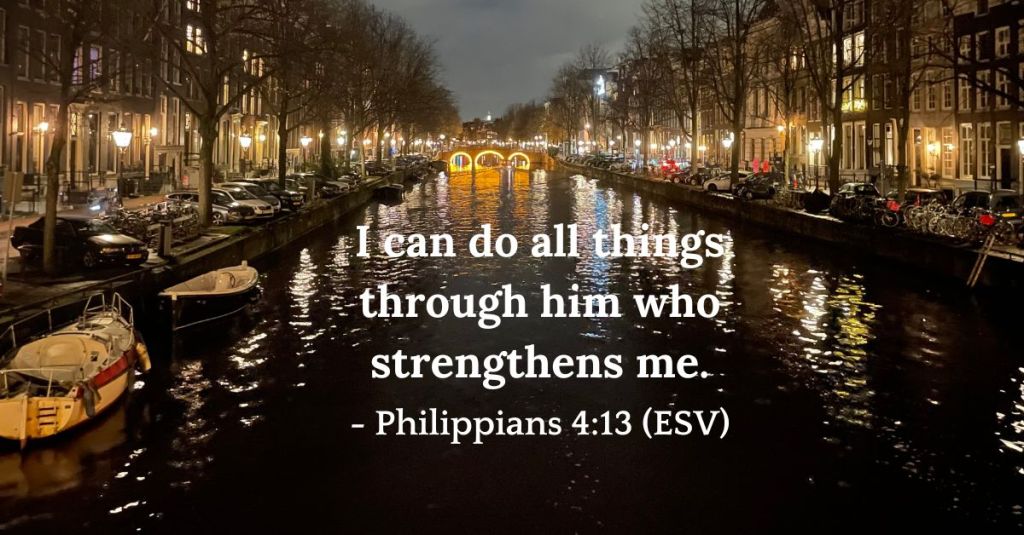
This verse is often quoted out of context as a motivational slogan, almost as if it is about winning trophies, landing jobs, or achieving personal goals. But within the flow of Paul’s letter, it’s not about triumph in the worldly sense. It’s about enduring both hardship and prosperity without losing your anchor in Christ. Paul is saying that the source of his contentment, his strength to navigate every season of life, is Jesus. Not self-reliance. Not wealth. Not status. Jesus alone.
The Value of Kindness
Still, Paul wants to be clear: the Philippians’ kindness wasn’t unappreciated.
Yet it was kind of you to share my trouble.
Philippians 4:14 (ESV)
Even though Paul was content no matter what, he recognized the value of their practical care. This strikes a good balance for us to remember in our own relationships. Being spiritually content doesn’t mean we stop noticing or appreciating acts of kindness. Paul wasn’t a stoic or an emotionless figure. He welcomed the companionship and encouragement of others, while not depending on them for his peace.
He then reminds them of their long history of generosity:
And you Philippians yourselves know that in the beginning of the gospel, when I left Macedonia, no church entered into partnership with me in giving and receiving, except you only. Even in Thessalonica you sent me help for my needs once and again.
Philippians 4:15-16 (ESV)
This wasn’t a one-time transaction but an ongoing relationship. The Philippians had a history of supporting Paul’s ministry, often supporting him when other churches did not. They saw themselves not merely as donors but as ministry partners. They understood that supporting the spread of the gospel was part of their calling, and Paul deeply valued that partnership.
Fruit That Increases
He also clarifies his motivation:
Not that I seek the gift, but I seek the fruit that increases to your credit.
Philippians 4:17 (ESV)
Paul wasn’t after their money. What delighted him wasn’t the material benefit but the spiritual growth their generosity revealed. Their willingness to give sacrificially was evidence of hearts transformed by the gospel. And in God’s economy, their generosity wasn’t just a help to Paul, but a blessing to themselves. It was an act of worship, and Paul frames it as such:
I have received full payment, and more. I am well supplied, having received from Epaphroditus the gifts you sent, a fragrant offering, a sacrifice acceptable and pleasing to God.
Philippians 4:18 (ESV)
What an image: their care packages and coins weren’t just logistical necessities for Paul’s survival, they also rose up to God like incense on an altar. Every act of sacrificial love, however ordinary it may seem, is seen and cherished by God.
A God Who Provides
Then Paul offers a promise in return:
And my God will supply every need of yours according to his riches in glory in Christ Jesus.
Philippians 4:19 (ESV)
This isn’t a prosperity gospel verse about guaranteed wealth or perfect health. Paul, after all, had just described enduring hunger, imprisonment, and persecution. What he promises is that God will meet their true needs, needs that are ultimately spiritual. God will provide sustaining grace, peace, strength, wisdom, and joy in the midst of any trial. This is the same God who met Paul in shipwrecks and beatings and who strengthened him to rejoice in prison. That God will not leave his people empty-handed.
It’s also worth noticing Paul’s phrasing: according to his riches in glory in Christ Jesus. God doesn’t give out of scarcity or limitation but according to the boundless riches of his glory. What he gives might not always be what we expect, but it will always be enough.
All Glory to God
Paul then closes with a doxology, shifting the focus from gifts and needs to the God who provides for both:
To our God and Father be glory forever and ever. Amen.
Philippians 4:20 (ESV)
As he so often does, Paul turns every conversation, even one about personal needs and practical matter, back to the praise of God. It’s a fitting end to a letter saturated with rejoicing, encouragement, and eternal perspective.
A Call to Learn Contentment
And so the question remains for us: how can we cultivate this kind of contentment? How do we find peace in both abundance and scarcity? How can we learn, as Paul did, to trust that God’s provision is always enough? How can we believe that is not necessarily what we want, but always what we most need?
It begins by recognizing that our truest needs aren’t physical or material, but spiritual. What we need most is the presence of God, the peace of Christ, and the sustaining strength of the Spirit. Like Paul, we learn this over time. Through seasons of abundance and lack, through answered prayers and silence, we are invited into deeper trust. And in that place, we find a contentment the world cannot offer.
Paul’s letter to the Philippians reminds us that Christian joy isn’t rooted in circumstances but in Christ himself. It’s a joy that abides in prisons and palaces alike. It’s a peace that holds steady in conflict, provision, loss, and gain. And it’s a generosity that flows from hearts transformed by grace.
May we, like the Philippians, learn to be content in whatever situation we find ourselves. May we partner in the work of the gospel with generosity and gladness. And may we cling to the promise that our God will supply every need of ours according to his riches in glory in Christ Jesus.
Amen.
Reflection Questions
- When have you experienced an opportunity to care for someone after a long delay, and how did it shape your relationship?
- What would it mean for you to learn contentment in your current season, whether you’re facing plenty or need?
- How might the reminder that Christ strengthens you in all circumstances reshape how you approach today’s challenges?
- When you give or receive practical help, how do you see it as part of your relationship with God, not just with other people?
- Where in your life do you most need to trust that God will supply what you truly need, even if it doesn’t look like what you expected?
Reflective Prayer
Consider using these verses to pray using the ACTS method: Adoration, Confession, Thankfulness, and Supplication:
- Adoration: Praise God. Do these verses bring any specific characteristics of God to mind?
- Confession: Tell God that you are sorry for specific sins. Do these verses bring any specific sins to mind?
- Thankfulness: Show gratitude towards God. Does anything from these verses inspire gratitude?
- Supplication: Make requests for yourself and for others. Does anything from these verses inspire a prayer?
If helpful, you can use a prayer journal template.

Subscribe
If you enjoyed this post and wish to receive more Christian content, feel free to subscribe to my newsletters!
Related Resources
Visit the Joyful Moments in Christ homepage for all posts, or scroll through other blog posts related to gratitude, contentment, and kindness:




Something went wrong. Please refresh the page and/or try again.
English Standard Version (ESV): Unless otherwise noted, scripture quotations are from the ESV® Bible (The Holy Bible, English Standard Version®), © 2001 by Crossway, a publishing ministry of Good News Publishers. Used by permission. All rights reserved. The ESV text may not be quoted in any publication made available to the public by a Creative Commons license. The ESV may not be translated in whole or in part into any other language.


 Joyful Moments in Christ