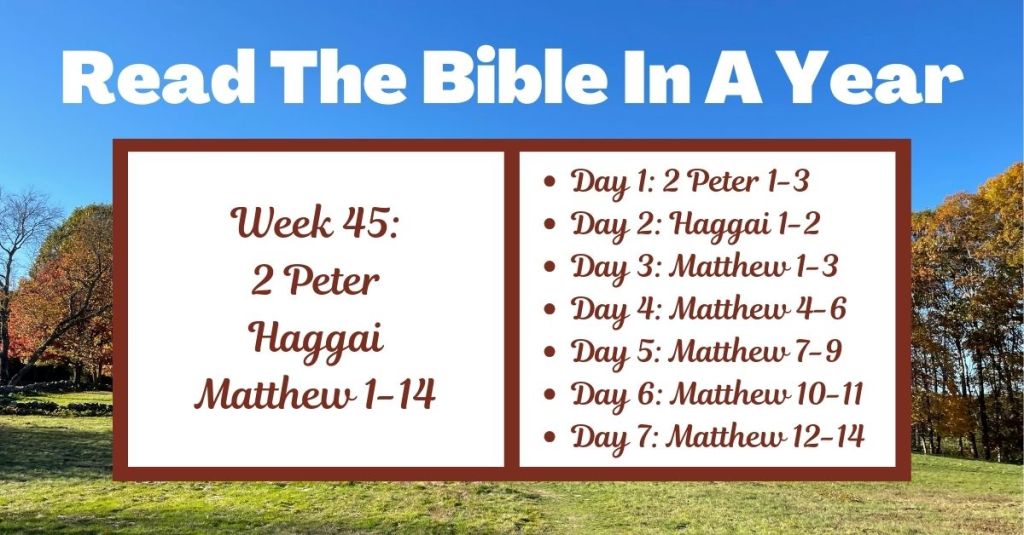
In week 45 of our journey to read the Bible in a year, we will read the entire books of 2 Peter and Haggai, as well as the first half of Matthew’s Gospel. 2 Peter emphasizes deepening knowledge of Jesus Christ and vigilance against false teachings, while Haggai focuses on rebuilding the Temple and renewal of commitment to God. In Matthew, Jesus is portrayed as the Messiah through teachings and miracles, calling readers to discipleship. These texts explore themes of knowledge, obedience, divine judgment, and Jesus’ identity.
2 Peter
The Second Epistle of Peter is found in the New Testament and is traditionally attributed to Peter the Apostle, although there are some debates about this. Likely composed in the late first century or early second century AD, it addresses a diverse audience of Christians, urging them to deepen their knowledge of Jesus Christ and to remain vigilant against false teachings.
At its core, 2 Peter emphasizes the importance of knowledge in the Christian life. The epistle underscores the necessity of understanding God, Jesus Christ, and the moral virtues that should guide believers. It warns against the influence of false teachers who propagate destructive doctrines and lead people away from the truth. Through these warnings, 2 Peter seeks to fortify the faith of its readers and equip them to discern between genuine Christian teaching and deceptive falsehoods.
Furthermore, 2 Peter delves into eschatological themes, discussing the anticipated return of Jesus Christ and the eventual judgment. It reaffirms the certainty of Christ’s second coming and underscores the need for believers to live in anticipation of this event. The epistle also touches on theological topics such as the authority of Scripture, the sovereignty of God, and the promise of a new creation. By addressing these theological and practical concerns, 2 Peter provides guidance and encouragement to early Christians navigating their faith amidst challenges and uncertainties.
Reflection Questions
After reading 2 Peter, consider the following reflection questions:
- How can we discern between genuine Christian teaching and deceptive falsehoods?
- Reflect on the significance of deepening our knowledge of Jesus Christ. How does this knowledge impact our faith and spiritual growth?
- Consider the certainty of Christ’s second coming. How does this hope influence our perspective on life and our priorities?
- How can we apply the lessons about the authority of Scripture and the sovereignty of God in our daily lives?
- Reflect on the call to moral virtues and ethical living. How can we cultivate these virtues in our interactions with others and our conduct in society?
Haggai
The Book of Haggai is one of the shorter prophetic books found in the Old Testament, only two brief chapters. It is named after its author, Haggai, who was a prophet during the period of the Jewish return from exile in Babylon.
Haggai’s prophecies are set in the context of the Jewish community’s efforts to rebuild the Temple in Jerusalem after their return from exile. The book primarily focuses on encouraging the people to prioritize the reconstruction of the Temple, which had been destroyed by the Babylonians. Haggai’s message emphasizes the importance of putting God first and seeking his glory through the restoration of the Temple.
The central theme of Haggai revolves around the concept of “the day of the Lord,” which refers to a time of divine judgment and intervention in human affairs. Haggai uses this concept to motivate the people to renew their commitment to God and his covenant. He assures them that if they faithfully rebuild the Temple and honor God, they will experience his blessings and favor. Ultimately, the Book of Haggai serves as a call to spiritual renewal and obedience to God’s will, urging the people to prioritize their relationship with God above all else.
Reflection Questions
After reading Haggai, consider the following reflection questions:
- In what ways do the messages of Haggai about prioritizing God’s glory resonate with our own priorities and pursuits in life?
- Reflect on the concept of “the day of the Lord.” How does this concept influence our understanding of divine judgment and intervention?
- Consider Haggai’s encouragement to the people to renew their commitment to God and his covenant. How can we apply this call to spiritual renewal in our own lives?
- Reflect on the blessings and favor promised by God to those who faithfully honor him. How does this assurance impact our trust in God’s providence?
- How can we prioritize our relationship with God above all else amidst the competing demands and distractions of the world?
Matthew 1-14
The Gospel of Matthew is a foundational text in the New Testament, traditionally attributed to the apostle Matthew, a former tax collector turned disciple of Jesus. It provides a comprehensive account of Jesus’ life, teachings, and ministry, aiming to portray him as the fulfillment of Old Testament prophecies and the long-awaited Messiah. Structured into five major sections, the Gospel begins with Jesus’ genealogy and miraculous birth, highlighting his lineage from King David and Abraham. It then proceeds to detail Jesus’ ministry, which includes teachings such as the Sermon on the Mount, parables, and numerous miracles demonstrating his authority over nature and illness.
Towards the end of Matthew’s Gospel, the narrative intensifies as Jesus journeys towards Jerusalem, where he predicts his impending death and resurrection. The events leading to his crucifixion, including his betrayal, trial, and crucifixion, are depicted in vivid detail. However, the Gospel doesn’t end with Jesus’ death; it culminates in his triumphant resurrection, demonstrating his victory over sin and death. The Gospel concludes with Jesus commissioning his disciples to spread his teachings to all nations, promising to be with them always.
Throughout the Gospel of Matthew, Jesus is presented as the ultimate embodiment of righteousness, love, and forgiveness. His teachings emphasize the importance of faith, repentance, and obedience to God’s will. Overall, the Gospel of Matthew serves not only as a historical account of Jesus’ life but also as a theological document proclaiming his identity as the Son of God and the Savior of humanity.
This week, we will read the first half of Matthew (chapters 1-14), which will primarily deal with themes of Jesus’ identity, authority, and ministry.
Reflection Questions
After reading Matthew 1-14, consider the following reflection questions:
- Reflect on the themes of Jesus’ identity and authority presented in the first half of Matthew’s Gospel. How do these themes shape our understanding of who Jesus is?
- Consider the significance of Jesus’ genealogy and miraculous birth in establishing his royal and divine credentials. How does this lineage connect Jesus to the promises of God?
- Reflect on the various miracles performed by Jesus in these chapters. How do these miracles reveal Jesus’ power and compassion?
- Consider the teachings of Jesus. How do these teachings challenge and inspire us to live lives of faith and obedience?
- Reflect on Jesus’ interactions with various individuals and groups. How do these encounters reveal Jesus’ character and mission, and what lessons can we learn from them about discipleship and following Christ?
Flexible Plan: Reading for Week 45
If you are following the flexible plan for reading the Bible in a year, here is your reading assignment. You can break up the reading however you like throughout the week!
- Passage 1: 2 Peter
- Passage 2: Haggai
- Passage 3: Matthew 1-14
Printable Resource: Bible in a Year Reading Plan: Weekly Assignments
7-Day Reading Assignment: Week 45
For those who prefer a more organized approach, the weekly assignment can be broken into seven sections:
- Day 1: 2 Peter 1-3
- Day 2: Haggai 1-2
- Day 3: Matthew 1-3
- Day 4: Matthew 4-6
- Day 5: Matthew 7-9
- Day 6: Matthew 10-11
- Day 7: Matthew 12-14
Printable Resource: Bible in a Year Reading Plan: Daily Assignments
5-Day Reading Assignment: Week 45
Or if you know that you are likely to miss a day or two of reading, the weekly assignment can be broken into five sections:
- Day 1: 2 Peter 1-3 & Haggai 1-2
- Day 2: Matthew 1-3
- Day 3: Matthew 4-7
- Day 4: Matthew 8-10
- Day 5: Matthew 11-14
Printable Resource: Bible in a Year Reading Plan: 5 Days/Week Assignments
Subscribe
If you enjoyed this post and wish to receive more Christian content, feel free to subscribe to my newsletters!
Related Resources
Visit the Joyful Moments in Christ homepage for all posts, or scroll through other blog posts related to reading the Bible in a year:


 Joyful Moments in Christ