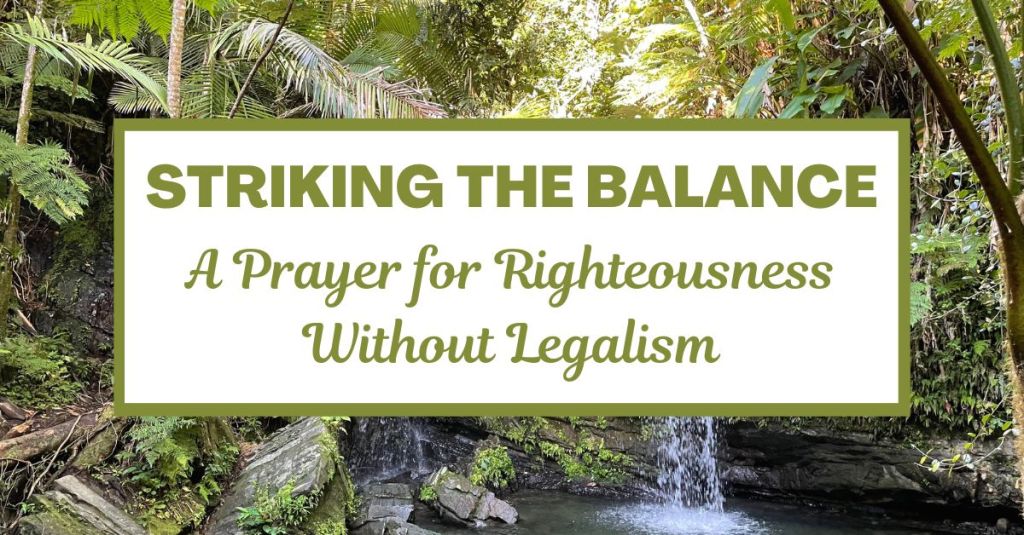
As we consider the idea that righteousness can exist independently of legalism, challenges arise when attempting to embody this concept. It is further complicated when we try to bring grace into the picture. Let’s go to the Lord in prayer to seek help and guidance as we navigate the avoidance of legalism and sin while trying balance righteousness and grace!
A Prayer
Dear Heavenly Father,
At times, we really struggle with distinguishing between righteousness and legalism. We know that you are a righteous God and that you value right living, but your example in the Gospels shows us that you care more about the heart of your commands (true righteousness) rather than the precise words (legalism). Throughout the books that describe your ministry, we frequently see the Pharisees erring on the side of legalism.
However, I fear that our modern society has swung the other way and is now erring on the side of grace and is too tolerant of sin. Romans 6:1-2 (ESV) tells us, “What shall we say then? Are we to continue in sin that grace may abound? By no means! How can we who died to sin still live in it?” We acknowledge the importance of both grace and righteousness, and we yearn to find the delicate equilibrium!
So often, my temptation is to strictly adhere to a set of rules, leaving no wiggle room. However, this approach can pose many challenges. If I ground my teenage son, would I really want to stop him from attending youth group? By sticking to the letter of my law, I would be depriving him of learning about you and forming Christian friendships. This is not the heart of my command!
Similarly, when we contemplate the ten commandments and other rules that you have made, I ask you to grant us insight into the heart of the commands, rather than focussing on strict adherence to the letter. The Pharisees looked at your law to do no work on the Sabbath, Exodus 20:8-11, and concluded that it was sinful for you to heal on the Sabbath. In Matthew 12:9-13, you tried to show them that the heart of your laws were more important than the exact semantics, and they became very angry.
Your example shows how hard to be completely precise in just a few words! How long would have Exodus 20 been if you had explained this particular law in full? The Pharisees misunderstood your heart, and it eventually led to your crucifixion. How many times do we follow their example? Your intention for the Sabbath was to ensure that we set aside time for you, make time to rest our bodies, and find occasion to interact with other believers.
However, you have shown that sometimes there needs to be exceptions. If my son fell into a fire on a Sunday, I would be very angry if I was not allowed to deal with this type of emergency and take him to an on-duty emergency room doctor to get appropriate medical care. To meet this need, some doctors and other medical staff need to work on Sundays, but they also need to understand the heart of your law and set aside time for you, rest, and community.
On the other hand, non-essential issues confuse me. How many Christians go out to a restaurant for Sunday brunch? I do it. Most of my friends do it. It is great to be able to spend time together as a family or with other Christians, however, is it really right that restaurant staff are working on Sundays? Even if they aren’t Christians, should we be participating in an optional activity that could take someone further and further away from you? And if the workers are Christian, is it even worse? I am at a loss. How do we balance the words of your commands with your heart for relationships and community without being legalistic? What is the right thing for me to do? Please give me clarity in the gray areas of life!
This intricate balance sometimes leads us down a slippery slope, where righteous living appears to be sacrificed in the battle against legalism. While it may seem acceptable to skip church for essential purposes, and we aren’t sure about non-essential purposes, another risk arises when people claim they can find spiritual fulfillment exclusively at home, neglecting church attendance and the communal aspect you designed for us in favor of self-care and individual spirituality. I believe that you want us to gather together for instruction, encouragement, and bonding with other Christians, but for many, this view is labeled as legalistic and outdated. Please show us your heart. Show us how to live righteously without being too legalistic or too forgiving.
We yearn for a revival, a resurgence of love for learning about you and the formation of authentic communities centered around this pursuit. May our hearts be aligned with yours and let us reflect the distinctiveness and attractiveness of your love, your grace, and your righteousness.
In Jesus name I pray. Amen.
Note: For those of you who consider this prayer to be legalistic in itself, I would encourage you to read two other posts to fully understand the heart of this prayer. Gray areas of life are very challenging to navigate and much of the time we have to try and interpret the heart of God, rather than focus too intently on the letter of God’s commands. The more complex the situation, the harder it is to have a black and white answer. This prayer was intended to reflect some of my back and forth that comes from trying to live a life of grace and holiness at the same time. There are no easy solutions!
- “It is Finished”: How Do We Live a Finished Life?
- Musings about Being Righteous Without Being Legalistic
Reflection Questions
Please consider the following reflection questions:
- How do you currently strike a balance between righteousness and grace in your daily decisions and interactions?
- Can you share a specific situation from your life where you grappled with distinguishing between legalism and true righteousness? What insights did you gain from that experience?
- Reflecting on the example of the Pharisees. In what ways have you observed or personally encountered situations where society tends to lean towards legalism or an overly permissive view of grace?
- Consider a recent decision you had to make that involved adhering to a specific rule or principle. How did you navigate focusing on the heart of the command rather than strict adherence to the letter in that instance?
- Take a moment to compose your own prayer about finding balance between righteousness and grace. If helpful, you can use a prayer journal template. Are there specific areas of your life that you feel need particular guidance?
- In practical terms, how have you incorporated seeking God’s guidance into your decision-making process when dealing with issues related to righteousness and grace?
- Reflect on the examples provided regarding essential and non-essential activities on Sundays. How do you approach participating in various activities that on the Sabbath? Share a specific instance if possible.
- Regarding communal aspects of faith, such as attending church, how do you personally balance your individual spirituality with the communal aspect of Christianity? Share any insights or practices you find helpful.
- What does a personal revival in your faith look like? Can you identify specific actions or changes you could make to contribute to a resurgence of love for learning about God and forming authentic Christian communities?
- In your interactions with others, how do you consciously reflect the distinctiveness and attractiveness of God’s love, grace, and righteousness? Share specific instances where you’ve seen this come to life.
Consider sharing your insights and experiences in the comments below!
Subscribe
If you enjoyed this post and wish to receive more Christian content, feel free to subscribe to my newsletters!
Related Resources
Visit the Joyful Moments in Christ homepage for all posts, or scroll through other blog posts related to righteousness, grace, forgiveness, and legalism:
Something went wrong. Please refresh the page and/or try again.
English Standard Version (ESV): Scripture quotations marked (ESV) are taken from the ESV® Bible (The Holy Bible, English Standard Version®), © 2001 by Crossway, a publishing ministry of Good News Publishers. Used by permission. All rights reserved. The ESV text may not be quoted in any publication made available to the public by a Creative Commons license. The ESV may not be translated in whole or in part into any other language.