
Reflections
After reading the final chapter of the book of Ruth, I am struck by the concept of how I apply diplomacy to get something important. Do I think through the problem and make a plan, or do I rush in and botch things with my words? Do I show how my solution to the problem benefits everyone, or do I selfishly only try to get what is best for me? Do I use methods that God would approve or disapprove? As I consider problems requiring diplomacy, this seems like a great Bible passage to get some tips!
At the beginning of the chapter, we see Boaz using shrewd diplomacy to arrange a marriage between himself and Ruth. From all of the events in second and third chapters, it has become clear that Boaz respects Ruth and that he wants to help her. The question is whether helping her by marrying her is too much. Looking at the way he handled the other matrimonial contender, it appears that his desire for her was more than simply an obligation of aid and he was willing to make careful plans to make sure that Ruth ended up with himself, rather than the other guy.
Respect that Leads to Desire
The best marriages are built on mutual respect, trust, and affection. The book of Ruth has indications that all of these are present in the marriage between Ruth and Boaz.
In the second chapter of Ruth, Boaz builds up his respect for Ruth’s character. When he sees her gleaning in his field, he asks his overseer about her, gets a favorable report about her behavior and work ethics in his field. He also learns that she is a woman that he has previously heard a favorable report about in regards to care for her mother-in-law and her choice to immigrate to a country that follows Judaism.
6 The servant who was set over the reapers answered, “It is the Moabite lady who came back with Naomi out of the country of Moab. 7 She said, ‘Please let me glean and gather after the reapers among the sheaves.’ So she came, and has continued even from the morning until now, except that she rested a little in the house.”
Ruth 2:6-7,11-12 (WEB)
11 Boaz answered her, “I have been told all about what you have done for your mother-in-law since the death of your husband, and how you have left your father, your mother, and the land of your birth, and have come to a people that you didn’t know before. 12 May Yahweh repay your work, and a full reward be given to you from Yahweh, the God of Israel, under whose wings you have come to take refuge.”
Boaz decides to tell Ruth about his respect for her and prays a beautiful blessing over her. This could be seen as a form of admiration for Ruth’s character and choices that she has made. Boaz decides to express his admiration in a practical way by instructing his workers to leave extra sheaves of grain out for Ruth to collect.
When she had risen up to glean, Boaz commanded his young men, saying, “Let her glean even among the sheaves, and don’t reproach her. Also pull out some for her from the bundles, and leave it. Let her glean, and don’t rebuke her.”
Ruth 2:15-16 (WEB)
When Naomi learns about Boaz’s kindness, she realizes that he might be willing to fulfill the role of a kinsman-redeemer and rescue Ruth and Naomi from poverty. You can read my thoughts on this in my posts about the third chapter of Ruth. In the end, Naomi instructs Ruth to go to Boaz in secret and propose marriage to him.
1 Naomi her mother-in-law said to her, “My daughter, shall I not seek rest for you, that it may be well with you? 2 Now isn’t Boaz our kinsman, with whose maidens you were? Behold, he will be winnowing barley tonight on the threshing floor. 3 Therefore wash yourself, anoint yourself, get dressed, and go down to the threshing floor; but don’t make yourself known to the man until he has finished eating and drinking. 4 It shall be, when he lies down, that you shall note the place where he is lying. Then you shall go in, uncover his feet, and lay down. Then he will tell you what to do.”
Ruth 3:1-4 (WEB)
While this sounds quite scandalous, further analysis shows that it is most likely instructions on how to propose marriage by calling on the kinsman-redeemer clause in the Bible.
Ruth dutifully follows her mother-in-law’s instructions, whether she wants to or not, and Boaz expresses more admiration and respect for the way she went about proposing marriage. He concludes his praise by telling Ruth that she has “noble character,” which he would not say if her actions truly were scandalous.
He said, “You are blessed by Yahweh, my daughter. You have shown more kindness in the latter end than at the beginning, because you didn’t follow young men, whether poor or rich. Now, my daughter, don’t be afraid. I will do to you all that you say; for all the city of my people knows that you are a worthy woman.
Ruth 3:10-11 (WEB)
There is only one small problem. If Boaz decides to fulfill the kinsman-redeemer role, there is another man who has first dibs. Since Boaz appears to be a man of honor, he decides that before he claims both the wife and property of Ruth’s deceased husband, that he must first go to this other man to see if he will marry Ruth.
Question: Is Boaz truly going to the other man because he is a man of honor, or is it an excuse to get out of marrying Ruth?
If we assume that Boaz is a man of honor, it is very likely that the respect and admiration that Boaz has for Ruth is starting to turn into trust and a desire to make Ruth his wife. If so, he will try to convince the other man to yield. If not, he will try to convince the other man to marry Ruth.
Shrewd Diplomacy
When we look at Boaz’s actions as he approaches this other man, the shrewd way in which he handles the matter shows that Boaz truly does want to marry Ruth and that this decision is more than just an obligation to a dead relative. My conclusion is that he is not trying to weasel out of the marriage.
2 Boaz took ten men of the elders of the city, and said, “Sit down here,” and they sat down. 3 He said to the near kinsman, “Naomi, who has come back out of the country of Moab, is selling the parcel of land, which was our brother Elimelech’s. 4 I thought I should tell you, saying, ‘Buy it before those who sit here, and before the elders of my people.’ If you will redeem it, redeem it; but if you will not redeem it, then tell me, that I may know. For there is no one to redeem it besides you; and I am after you.”
He said, “I will redeem it.”
Ruth 4:2-4 (WEB)
Boaz does a couple of smart things. First, he brings many respected witnesses, the town elders, to the discussion. Next, he presents Naomi’s financial problem and indicates that under kinsman-redeemer principles, the other man has the first right to purchase the land. While doing this, he makes sure that it is known that Boaz is the next kinsman-redeemer in line.
At this point, the other man gets excited about the possibility of increasing his holdings and accepts, but Boaz uses his shrewd diplomacy to suddenly make the land much less appealing. Boaz’s well laid plans that included a backup kinsman-redeemer suddenly gives the other man a face saving way out!
5 Then Boaz said, “On the day you buy the field from the hand of Naomi, you must buy it also from Ruth the Moabitess, the wife of the dead, to raise up the name of the dead on his inheritance.”
6 The near kinsman said, “I can’t redeem it for myself, lest I endanger my own inheritance. Take my right of redemption for yourself; for I can’t redeem it.”
Ruth 4:5-6 (WEB)
As it turns out, the main purpose of a kinsman-redeemer is to ensure that the land passes on to the original heirs. In this case, the land should have passed to Naomi’s son, who died, and then onto Naomi’s grandchild. If this other man wants the land, Boaz is telling him that marriage to Ruth is expected so that the land can be passed onto the children of that marriage.
If this man is unmarried, he may have had plans to marry someone else. And if he was married, Ruth would become a second wife and an additional burden. Rather than the children of his first marriage inheriting Naomi’s land, the land would go to an unwanted wife’s children. It’s a dilemma!
Once the man thinks about the implications, he gratefully allows Boaz to step in and solve the problem. Boaz honorably gets what he wants while allowing the other man to save face, gaining the respect of the town’s leaders. If Boaz had wanted to get out of the marriage, he could have played things differently and claimed it was the other man’s duty to marry Ruth and used the town elders to shame the other man into following through.
In the end, Boaz gained a wife of noble character who had great faith, loyalty, diligence, perseverance, and ethics. It is quite hard to find a spouse with these characteristics, so when the opportunity presented itself, he recognized Ruth’s worth and used honorable, yet shrewd diplomacy to take advantage of the situation.
Behold, I send you out as sheep among wolves. Therefore be wise as serpents and harmless as doves.
Matthew 10:16 (WEB)
As it turns out, Ruth continued to prove that Boaz’s decision was the right one. After Ruth gives birth to her first child, the townswomen praise God for giving Naomi such a wonderful daughter-in-law. They even say that having Ruth is better than seven sons, which is quite the compliment in a patriarchal society!
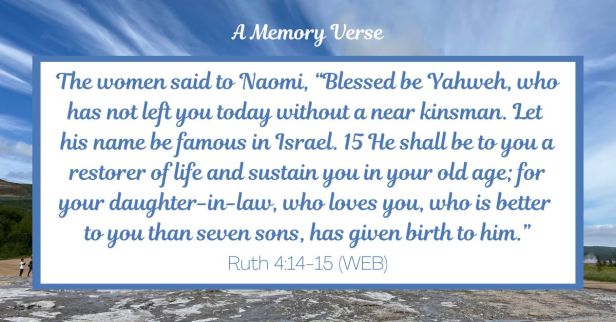
The chapter ends with a genealogy that leads from Ruth to Jesus. How did Ruth’s faith and character impact her children, grandchildren, and other people in the town? Would Mary and Joseph’s faith have been as strong if Ruth didn’t enter the family and pass her faith to others?
Response Activity
Consider the following questions:
- Think of a time when carefully plans for words and actions led to the outcome you desired. What preparation did you complete and why do you think it helped?
- Think of a time when you spoke or acted hastily and it led to a poor outcome. What could have you done differently?
- Consider whether the methods you used in the previous two questions were honorable and pleasing to God. How can you improve your methods to both get what you want and please God at the same time? If you can’t get both, which will you choose and why?
Read Matthew 10:16. Think of some more Bible passages that relate to making shrewd decisions while still pleasing God in the methods. Consider posting them in the comments.
Related Resources
Read: Ruth 4 – A Bible Study about Diplomacy and Redemption
Read: Ruth 4:14-15 – A Memory Verse with Reflection Questions
Read: A Prayer about Pleasing God During Diplomatic Negotiations
Visit the Joyful Moments in Christ homepage for all posts, or scroll through other blog posts related to the book of Ruth:




















 Joyful Moments in Christ