After studying the first 3 chapters of the book of Ruth, we come to the concluding chapter where Boaz uses his diplomatic skill to finagle a marriage to Ruth and their child becomes the grandfather of King David, who is an ancestor of Jesus. It is a beautiful story of redemption where Ruth is raised out of poverty and insignificance, honored by the people of the town, and given a prominent place in the line of Jesus!
Bible Study
Invoking Naomi’s Need for a Guardian-Redeemer
In the third chapter of the book of Ruth, Ruth invoked the guardian-redeemer clause in the Bible and proposed marriage to Boaz. While Boaz claimed to want to help rescue Ruth and Naomi from poverty, he informed Ruth that there was another man with a higher claim to the position of kinsman-redeemer and told her that if this other man failed to do his duty, Boaz would marry Ruth.
The fourth and final chapter of the book shows Boaz’s actions as he fulfilled his promise.
1 Now Boaz went up to the gate and sat down there. Behold, the near kinsman of whom Boaz spoke came by. Boaz said to him, “Come over here, friend, and sit down!” He came over, and sat down. 2 Boaz took ten men of the elders of the city, and said, “Sit down here,” and they sat down. 3 He said to the near kinsman, “Naomi, who has come back out of the country of Moab, is selling the parcel of land, which was our brother Elimelech’s. 4 I thought I should tell you, saying, ‘Buy it before those who sit here, and before the elders of my people.’ If you will redeem it, redeem it; but if you will not redeem it, then tell me, that I may know. For there is no one to redeem it besides you; and I am after you.”
He said, “I will redeem it.”
“I will redeem it,” he said.
Ruth 4:1-4 (WEB)
Discussion Question #1: What specific actions did Boaz take to set the scene for the discussion with the other guardian-redeemer?
Discussion Question #2: Do you think that Boaz genuinely wants to marry Ruth, or is he trying to find a way out?
It is clear that Boaz used the time between Ruth’s proposal of marriage and the time of this meeting to think about how to best present his case. First, he finds the other man and invites both this man and ten town elders to sit down and have a conversation. This sets the stage for a serious conversation that needs a serious resolution.
At this point, Boaz brings up the issue of Naomi’s poverty and raises the point that both this other man and himself are potential guardian-redeemers. My opinion is that if he was trying to get out of marrying Ruth, he would not have volunteered himself as a backup guardian-redeemer, but instead would have focused on the other man’s responsibility to fulfill the duty of rescuing Naomi.
Boaz starts by listing the key advantage of fulfilling the guardian-redeemer duty, namely access to additional land. When the other man hears that he could take possession of this land, he gets excited and makes a claim to the land.
Using Shrewd Diplomacy to Win a Case
But Boaz is not finished. After appealing to greed, he now tests the other man’s resolve by introducing a problem. The main point of acting as a guardian-redeemer is to keep the land in the name of the original family members who owned it. If this is the goal, Boaz tells the man that the land needs to eventually be passed to Naomi’s grandchild and that marriage to Ruth is a requirement to fulfill that duty.
5 Then Boaz said, “On the day you buy the field from the hand of Naomi, you must buy it also from Ruth the Moabitess, the wife of the dead, to raise up the name of the dead on his inheritance.”
6 The near kinsman said, “I can’t redeem it for myself, lest I endanger my own inheritance. Take my right of redemption for yourself; for I can’t redeem it.”
Ruth 4:5-6 (WEB)
Discussion Question #3: How do you feel about the guardian-redeemer’s obligation to marry Ruth? What do you think was going through the other man’s head as he considered the implications of marriage to Ruth? What do you think led him to decline the responsibility?
Discussion Question #4: Given that Boaz named himself as a backup guardian-redeemer, do you think it was honorable for this man to pass the duty on to Boaz? Do you think that this was the response that Boaz intended? Why or why not?
While it is impossible to know what was going through both Boaz’s and this other man’s heads, it appears to me like Boaz did want to marry Ruth. This other man likely had few interactions with Ruth and may not have been willing to take a risk on marriage to a foreign woman. Additionally, he may have been already married and may not have wanted to take a second wife. What kinds of problems could have that created? Knowing that he wouldn’t be able to pass the land onto descendants from his first marriage could have been a big detractor. Or he may have had someone else in mind for marriage, and wasn’t willing to give up the pursuit of this other woman. There are quite a few possibilities!
I also think that Boaz set the scene to provide a face-saving way for this man to decline. With respectable witnesses in attendance, everyone knew exactly what was said. By letting everyone present know that Boaz was willing to fulfill the duty of guardian-redeemer, the other man could refuse the responsibility without putting Naomi’s descendants in jeopardy. By using shrewd diplomacy, everyone left the meeting feeling happy that Naomi and her descendants would be cared for. Win-win!
Becoming a Guardian Redeemer
Now, we get insight into a strange Jewish custom. The deal is sealed by this other man giving Boaz one of his sandals. Strange! But Boaz joyfully exclaims that Ruth will become his wife and the elders pronounce a beautiful blessing on the marriage.
7 Now this was the custom in former time in Israel concerning redeeming and concerning exchanging, to confirm all things: a man took off his sandal, and gave it to his neighbor; and this was the way of formalizing transactions in Israel. 8 So the near kinsman said to Boaz, “Buy it for yourself,” then he took off his sandal.
9 Boaz said to the elders and to all the people, “You are witnesses today, that I have bought all that was Elimelech’s, and all that was Chilion’s and Mahlon’s, from the hand of Naomi. 10 Moreover, Ruth the Moabitess, the wife of Mahlon, I have purchased to be my wife, to raise up the name of the dead on his inheritance, that the name of the dead may not be cut off from among his brothers and from the gate of his place. You are witnesses today.”
11 All the people who were in the gate, and the elders, said, “We are witnesses. May Yahweh make the woman who has come into your house like Rachel and like Leah, which both built the house of Israel; and treat you worthily in Ephrathah, and be famous in Bethlehem. 12 Let your house be like the house of Perez, whom Tamar bore to Judah, of the offspring[a] which Yahweh will give you by this young woman.”
Ruth 4:7-12 (WEB)
Discussion Question #5: Why do you think there was the need for the sandal exchange in front of witnesses?
Land ownership is always a thorny issue. It is possible that Boaz felt that if he married Ruth without permission for this other man and the elders that there could be a land dispute later. This other man could change his mind and claim that Boaz cheated him out of the possession of Naomi’s land. By acting honorably and having the proceedings out in the open, with the exchange of the sandal as proof, there would be no way for this other man to later claim that Boaz stole the land from him.
Discussion Question #6: Why do you think the elders prayed a blessing that included many famous names from the Bible: Rachel, Leah, Perez, Tamar, and Judah?
Discussion Question #7: After reading the complete story of Boaz’s negotiations, do you think he acted honorably towards Ruth? The other man? God?
Discussion Question #8: Think of a time when you have had to reach agreement about something potentially life altering. How did you approach the problem? Were you successful? Were you honoring to both the other party and to God?
Redemption for Ruth and Naomi
Once the marriage is complete, the land is redeemed for future generations and both Naomi and Ruth are restored to a place of prominence in the community.
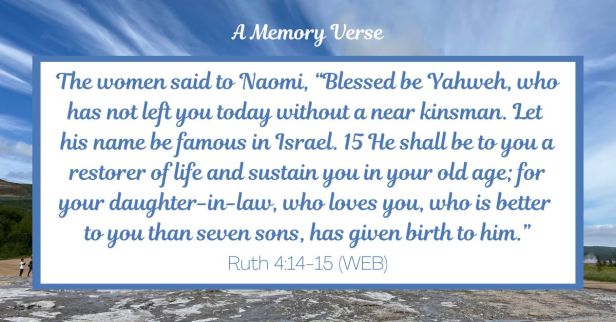
13 So Boaz took Ruth and she became his wife; and he went in to her, and Yahweh enabled her to conceive, and she bore a son. 14 The women said to Naomi, “Blessed be Yahweh, who has not left you today without a near kinsman. Let his name be famous in Israel. 15 He shall be to you a restorer of life and sustain you in your old age; for your daughter-in-law, who loves you, who is better to you than seven sons, has given birth to him.”
Ruth 4:13-15 (WEB)
Discussion Question #9: Why do you think the people of the town prayed this blessing over Naomi? What do the words imply about Ruth?
This is a beautiful blessing and a testament that Ruth really is the woman of noble character that Boaz proclaimed her to be in Ruth 3:11. Being a daughter-in-law that is more valuable than seven sons is very high praise in a patriarchal society!
The Line of David
The result of this marriage is a son named Obed. He is listed in the line of David, who is later listed in the line of Jesus.
16 Naomi took the child, laid him in her bosom, and became nurse to him. 17 The women, her neighbors, gave him a name, saying, “A son is born to Naomi”. They named him Obed. He is the father of Jesse, the father of David.
18 Now this is the history of the generations of Perez: Perez became the father of Hezron, 19 and Hezron became the father of Ram, and Ram became the father of Amminadab, 20 and Amminadab became the father of Nahshon, and Nahshon became the father of Salmon, 21 and Salmon became the father of Boaz, and Boaz became the father of Obed, 22 and Obed became the father of Jesse, and Jesse became the father of David.
Ruth 4:16-22 (WEB)
How wonderful is it that this faithful woman is listed in the line of Jesus? I always wonder how Ruth’s character and faith impacted her children, grandchildren, and the other people of the town. Would Mary and Joseph’s faith have been as strong if Boaz would have married a woman of lesser character and faith?
Discussion Question #10: What kind of character and faith do you want to pass onto your children, grandchildren, or those that you interact with regularly?
Downloads
Here are some printable discussion questions that you can use as part of a Bible Study on Ruth 4:
Respond
As you considered the themes of diplomacy and redemption, were there any Bible verses that came to mind? If so, add a comment at the end of this post!
Related Resources
Read: Ruth 1 – A Bible Study about Choosing God
Read: Ruth 2 – A Bible Study about Care and Compassion
Read: Ruth 3 – A Bible Study about Taking Action while Remaining Humble and Respectful
Read: Ruth 4:14-15 – A Memory Verse with Reflection Questions
Read: Musings about Shrewd Diplomacy
Read: A Prayer about Pleasing God During Diplomatic Negotiations
Visit the Joyful Moments in Christ homepage for all posts, or scroll through other blog posts related to the book of Ruth:

Something went wrong. Please refresh the page and/or try again.
English Standard Version (ESV): Unless otherwise noted, scripture quotations are from the ESV® Bible (The Holy Bible, English Standard Version®), © 2001 by Crossway, a publishing ministry of Good News Publishers. Used by permission. All rights reserved. The ESV text may not be quoted in any publication made available to the public by a Creative Commons license. The ESV may not be translated in whole or in part into any other language.