
Reflections
As I reflect on the first chapter of Ruth, the topic of discerning God’s will comes to mind. Elimelek and Naomi were clearly in a bad situation and appeared to be desperate to escape the famine. When they ventured into Moab, a land that worshiped a different god, they seemed to be leaving everyone they knew behind. Was this the will of God for them, or were they following their own devices? There is really no way to know, but it is interesting to ponder both sides of the question.
Let’s say that they were following God’s will. In this case, God may have wanted Elimelek and Naomi to share their faith with the Moabites so that Ruth could know the God of Israel, become a faithful follower, move to Judah, and pass her faith onto her children and grandchildren. Eventually, Jesus would be born from this line and would be shown to have very faithful parents. Would Mary and Joseph have had the same faith if Ruth hadn’t decided to move to Bethlehem?
On the other hand, Elimelek and Naomi didn’t appear to be traveling with other Israelites. Why not? If the famine was so bad, why weren’t other people fleeing with them? And if other Israelites did flee with them, where were they when Elimelek and his two sons died? Were Elimelek and Naomi just trying to take an easy way out?
The good news is that, God is a merciful God and loves to redeem our mistakes. If this was a mistake, it did lead to Ruth’s wonderful conversion of faith, which carried over to many generations of believers.
Continuing with the theme of following our own devices, Elimelek’s biggest mistake could have been bringing sons of marriageable age into a country that is lacking women of the same faith. Maybe he felt like the famine didn’t leave him with a choice, but why didn’t other Israelites make the same choice?
Of course, there are plenty of missionaries who bring their kids into situations where they are surrounded by non-Christians on all sides, but in this case it is usually because God has asked them to do this. Did Elimelek enter Moab with the idea that he could share his faith and convince some of the people to convert to Judaism? Did he think that this was a more noble pursuit than protecting his children from other gods?
In any case, after his death, both of Elimelek’s sons, Mahlon and Chilion, end up married to Moab women despite this verse in Deuteronomy:
You shall not make marriages with them. You shall not give your daughter to his son, nor shall you take his daughter for your son. For that would turn away your sons from following me, that they may serve other gods. So Yahweh’s anger would be kindled against you, and he would destroy you quickly.
Deuteronomy 7:3-4 (WEB)
Why did Mahlon and Chilion decide to marry Ruth and Orpah when they most likely knew this verse? If we assume that they were operating inside God’s will, the easy answer is that when the Old Testament uses what our modern ears hear as ethnic words, in Old Testament times they may have actually implied marriage to a person of a different faith rather than a different ethnicity. The heart of this verse seems to indicate that the problem is being led astray by other gods. If Ruth and Orpah committed to following the Israelite God, the marriages could have fit into the guidelines of the verse. This is further supported by fact that Bethlehem community blesses the marriage of Ruth and Boaz and indicate that the community understood that it is differing faiths, rather than differing ethnicities that is the problem.
All the people who were in the gate, and the elders, said, “We are witnesses. May Yahweh make the woman who has come into your house like Rachel and like Leah, which both built the house of Israel; and treat you worthily in Ephrathah, and be famous in Bethlehem. Let your house be like the house of Perez, whom Tamar bore to Judah, of the offspring which Yahweh will give you by this young woman.”
Ruth 4:11-12 (WEB)
We can confirm this idea by comparing verses in both the Old Testament and the New Testament. In the Old Testament, the number of converts to Judaism is rather small, but once Jesus enters the picture, this changes quite rapidly. After his death and resurrection, gentiles begin to convert to Christianity at an astonishing pace. A verse in Corinthians seems to make it even clearer that the problem in marriage is the differing faiths, not the differing ethnicities when it talks about being joined in marriage with an unbeliever.
Don’t be unequally yoked with unbelievers, for what fellowship do righteousness and iniquity have? Or what fellowship does light have with darkness?
2 Corinthians 6:14 (WEB)
If we play the other side, where Ruth and Orpah had not converted to Judaism before the marriage, Elimelek had quite a bit of power to forbid his sons to marry them. If Elimelek went to Moab with the idea that he could prevent his family from being led astray, this might be one step that he felt called to take. The problem is that while he can control the environment inside his home, he cannot control the environment outside. His sons were bound to be exposed to foreign gods and tempted by women who followed these gods.
It gets worse when Elimelek dies. Naomi would not have the same power to control her sons’ actions and they would be free to make their own choices in marriage. This resulted in marriages to Ruth and Orpah. Of course, these two women could have already been converts to the faith, but given Orpah’s later actions, there appears to be a reasonable chance that they were not.
There is little way to know the hearts of Mahlon and Chilion from these few pages in the Bible. Did they feel like they were making the best of a difficult situation by marrying converts to the faith, or were they impatient for a wife and unwilling to wait for God’s timing?
No matter the motivations, in the end, it is only Ruth who appears to be a true convert. Orpah chooses to return to her family and, most likely, her gods. Ruth shows true faith and expresses it eloquently in our memory verse from Ruth 1:16-17.
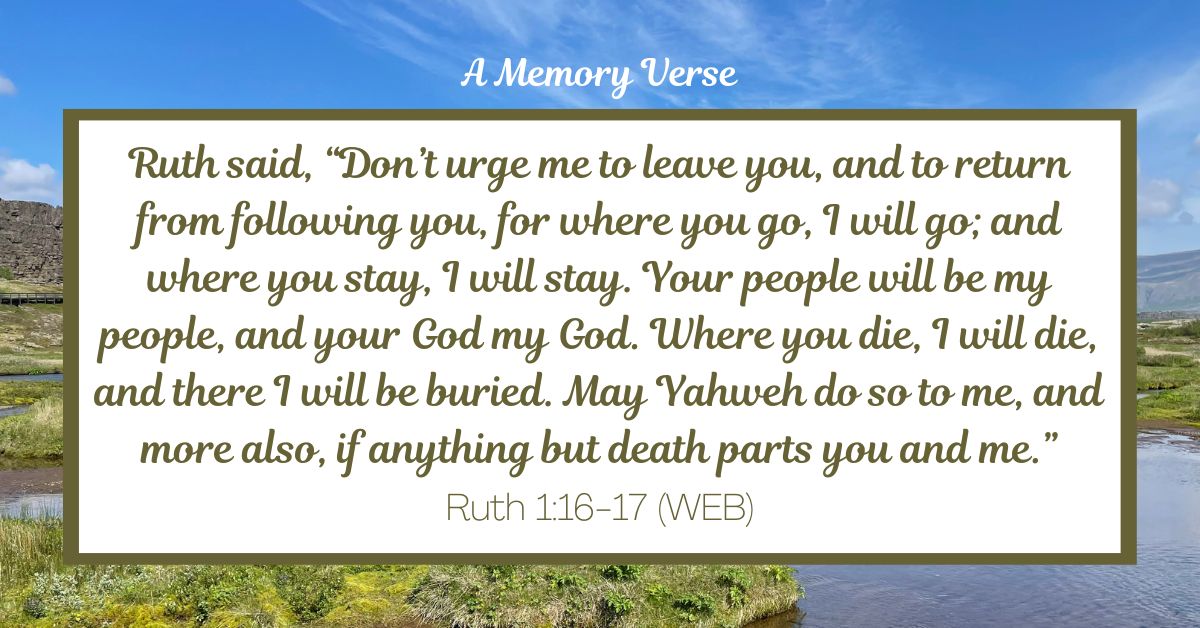
If God’s purpose was to bring Ruth back to Judah and provide a faithful ancestor to Jesus, it was quite successful! And if God was redeeming a mistake made by Elimelek and Naomi, it was still quite successful! Ruth proves her faith and dedication over and over throughout the book of Ruth.
Just like one poor decision in disobeying God can lead to many disastrous consequences, one conversion to God can lead to many wonderful consequences. I wonder how the people in Bethlehem changed as they interacted with Ruth? What might the town have looked like if Ruth didn’t encourage the other women of Bethlehem in their faith. Would Mary and Joseph have had the same level of devotion and trust in God if Ruth’s faith hadn’t been passed down from generation to generation?
There is no way to know the answer to these questions, but it does make me desire to both try to discern the will of God and to pass Ruth’s type of faith onto my children. I want my sons to marry women who have a deep faith in Jesus. How can I pass on my faith to my children and grandchildren so that they will show the world that Jesus triumphs over everything?
Read: Ruth 1 – A Bible Study about Choosing God
Reflection Questions
Consider writing the answers to a few of these questions into a journal.
For Christians
- Have you ever felt the Holy Spirit nudging you towards a particular action or decision? Did you decide to obey? What was the result?
- In which areas of your life are you operating inside God’s will? How can you continue this effort?
- In which areas of your life are you operating outside God’s will? What needs to change to bring your life in alignment to God’s will?
- How has your conversion to Christianity impacted those around you? Do you live as if you belong to Jesus?
For non-Christians
- Have you experienced a time in your life when you knew that a particular action was wrong? What led you to this belief?
- Have you experienced a time in your life when you knew that a particular decision was the right choice? Why did you feel this way?
- Reflect on the idea that the Christians believe that God gives insight into right and wrong choices through the Holy Spirit. Have you ever felt the Holy Spirit nudging you towards a particular action or decision? Did you decide to obey or disobey?
- Read the Bible verse below and reflect on whether you have ever felt yourself being led by the Holy Spirit, also known as the Spirit of God.
- “For as many as are led by the Spirit of God, these are children of God.” Romans 8:14 (WEB)
- What is keeping you from making a commitment to Jesus?
For Kids
- Which situations in your life have made it easier for you to make good decisions?
- Which situations in your life have tempted you to do things that you know are wrong?
- Romans 8:14 (WEB) says, “For as many as are led by the Spirit of God, these are children of God.” Have you ever felt the Holy Spirit nudging you towards a particular action or decision?
- How can your parents or another adult in your life help you to know whether a particular action or decision is what God wants for you?
Respond
As you consider the theme of discerning the will of God, are there any Bible verses that came to mind? If so, add a comment at the end of this post!
Related Resources
Read: Ruth 1 – A Bible Study about Choosing God
Read: Ruth 1:16-17 – A Memory Verse with Reflection Questions
Read: Ruth 1 – A Prayer about Discerning the Will of God
Visit the Joyful Moments in Christ homepage for all posts, or scroll through other blog posts related to the book of Ruth:




Something went wrong. Please refresh the page and/or try again.

 Joyful Moments in Christ