Jesus Teaches Us to Pray
This Sunday School lesson is intended for upper elementary students. All lessons on this website are protected by copyright, but you can use them for free in small groups or Sunday School classes. You may share a link to this page, but please do not copy these pages and put them on other websites.
The Big Idea
Jesus teaches his disciples to pray with confidence, knowing that God is a good Father who gives what his children need.
Lesson Objectives
- Students will learn the prayer Jesus taught his disciples.
- Students will understand that God is a loving Father who gives good gifts to his children.
- Students will see that Jesus calls his followers to pray with persistence and trust.
- Students will be encouraged to ask God for their daily needs and for the gift of the Holy Spirit.
Class Setting Notes
- Recommended for upper elementary Sunday School.
- Lesson length: 40-50 minutes. Can be shortened or extended based on activities selected.
Opening Activity
- Write the words “Ask, Seek, Knock” on the board.
- Invite the students to share examples of times they asked for something, looked for something, or knocked on a door.
- Briefly explain that in today’s lesson, Jesus tells us to pray with the same confidence, because God is a good Father who loves his children.
This activity helps introduce the theme of prayer as asking God with persistence and trust.
Bible Reading
Ask the class to read Luke 11:1-13 aloud together or have one person read it.
- Very Easy: Easy-to-Read Version: Luke 11:1-13 (ERV)
- Very Easy: New International Reader’s Version: Luke 11:1-13 (NIRV)
- Easy: Good News Translation: Luke 11:1-13 (GNT)
- Medium: New Living Translation: Luke 11:1-13 (NLT)
- Hard: New International Version: Luke 11:1-13 (NIV)
- Very Hard: English Standard Version: Luke 11:1-13 (ESV)
Additional Reading: Choosing the Right Bible Translation
Suggested prompts:
As the class reads aloud, consider asking some of these prompts:
- Listen for what the disciples asked Jesus to teach them.
- Notice what Jesus includes in the prayer he gives them.
- Pay attention to the story Jesus tells about a friend knocking at midnight.
- Think about what Jesus means when he says, “Ask, and it will be given to you.”
- Watch how Jesus explains the difference between earthly fathers and our heavenly Father.
Teacher Background Notes
- Rabbis often taught their disciples a set prayer. The disciples’ request shows their desire to learn from Jesus.
- The prayer Jesus gives is short and focused, showing dependence on God for daily needs, forgiveness, and protection.
- The parable of the midnight visitor highlights the value of persistence in prayer, not because God is reluctant, but because he delights to answer.
- Jesus contrasts flawed earthly fathers with the perfect goodness of God the Father. Even sinful parents give good gifts, but God gives the best gift, the gift of the Holy Spirit.
- Prayer is not a way to control God but a way to express our dependence on him as children of a loving Father.
Theological Insights
- God is our Father in heaven, and through Jesus we may approach him with confidence.
- Prayer is a privilege given to God’s children and is central to the Christian life.
- God answers prayer according to his wisdom, always giving what is good for his people.
- Jesus teaches persistence in prayer, not because God is unwilling, but because prayer shapes our faith and dependence on him.
- The greatest gift God gives is himself, through the indwelling Holy Spirit.
Discussion Questions
Understanding the Text
- What did the disciples ask Jesus to teach them?
- What important things are included in the prayer Jesus gave?
- What happened when the man kept knocking at his friend’s door at midnight?
- What three actions did Jesus tell his disciples to do in prayer?
- How does Jesus compare earthly fathers with our heavenly Father?
Personal Reflection and Application
- How does it change your view of prayer to know that God is a good Father?
- What is something you can ask God for this week?
- When you feel discouraged, how can persistence in prayer help?
- Who is someone you can pray for today?
Suggested Activities
Prayer Wall
- Provide slips of paper and markers.
- Ask students to write or draw something they want the class to pray about.
- Collect them and post them on a wall or board under the heading “Ask, Seek, Knock.”
This activity helps students express their prayers and see them as part of trusting God together.
Knock, Ask, Seek Game
- Choose three volunteers. One will knock, one will ask, and one will seek (search for a hidden object in the room).
- Afterward, discuss how each action shows persistence and effort, just as Jesus encourages us in prayer.
This activity helps students remember Jesus’ teaching through movement and play.
Learning the Lord’s Prayer Together
- Write the prayer from Luke 11:2-4 on the board or hand out copies.
- Read it aloud slowly together.
- Encourage the students to memorize it over the coming weeks.
This activity helps students learn the prayer Jesus gave as a model for their own prayers.
Memory Verses
And he said to them, “When you pray, say: “Father, hallowed be your name. Your kingdom come. Give us each day our daily bread, and forgive us our sins, for we ourselves forgive everyone who is indebted to us. And lead us not into temptation.”
Luke 11:2-4 (ESV)

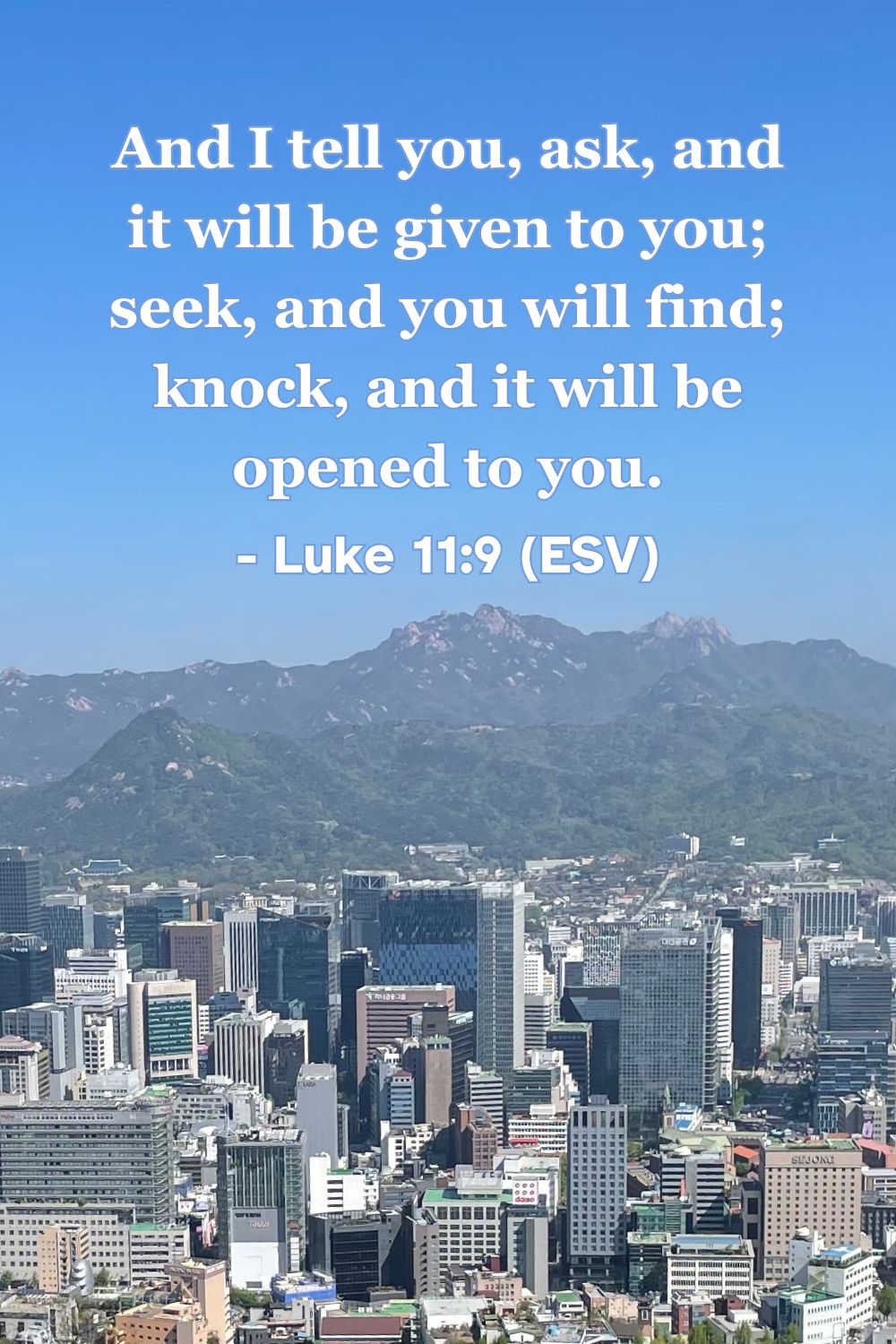
And I tell you, ask, and it will be given to you; seek, and you will find; knock, and it will be opened to you.
Luke 11:9 (ESV)
Closing Prayer
Father,
Thank you for teaching us to pray. Help us to trust you as our good Father, to keep asking, seeking, and knocking, and to be thankful for the gift of the Holy Spirit.
In Jesus’ name we pray. Amen.
The ESL Version
I also create materials for adult English Language Learners (ELLs) and ESL students. You can find my ELL Bible Study based on Luke 11:1-13 here:
Subscribe
If you enjoyed this post and wish to receive more Christian content, consider subscribing to my newsletters!
Related Resources
Visit the Joyful Moments in Christ homepage for all posts, or scroll through other blog posts related to Sunday School:
Something went wrong. Please refresh the page and/or try again.
English Standard Version (ESV): Unless otherwise noted, scripture quotations are from the ESV® Bible (The Holy Bible, English Standard Version®), © 2001 by Crossway, a publishing ministry of Good News Publishers. Used by permission. All rights reserved. The ESV text may not be quoted in any publication made available to the public by a Creative Commons license. The ESV may not be translated in whole or in part into any other language.
 Joyful Moments in Christ