
Sent Out with Good News
This Sunday School lesson is intended for upper elementary students. All lessons on this website are protected by copyright, but you can use them for free in small groups or Sunday School classes. You may share a link to this page, but please do not copy these pages and put them on other websites.
The Big Idea
Jesus sends his followers to proclaim the kingdom of God, and our greatest joy is knowing our names are written in heaven.
Lesson Objectives
- Students will learn that Jesus sent out the seventy-two to prepare the way for him.
- Students will understand that some people will listen to the good news and some will not.
- Students will see that God gives strength and protection to those who serve him.
- Students will recognize that our greatest joy is belonging to God, not in what we can do.
Class Setting Notes
- Recommended for upper elementary Sunday School.
- Lesson length: 40-50 minutes. Can be shortened or extended based on activities selected.
Opening Activity
- Give each student a piece of paper. Ask them to write or draw one piece of “good news” they have shared with someone (it can be big or small, like a good grade, a birthday party, or a fun trip).
- Invite a few to share with the class.
- Explain: Sharing good news is exciting, but nothing is greater than sharing the good news of Jesus.
This activity helps introduce the joy of being sent to share God’s message.
Bible Reading
Ask the class to read Luke 10:1-20 aloud together or have one person read it.
- Very Easy: Easy-to-Read Version: Luke 10:1-20 (ERV)
- Very Easy: New International Reader’s Version: Luke 10:1-20 (NIRV)
- Easy: Good News Translation: Luke 10:1-20 (GNT)
- Medium: New Living Translation: Luke 10:1-20 (NLT)
- Hard: New International Version: Luke 10:1-20 (NIV)
- Very Hard: English Standard Version: Luke 10:1-20 (ESV)
Additional Reading: Choosing the Right Bible Translation
Suggested prompts:
As the class reads aloud, consider asking some of these prompts:
- Listen for how many people Jesus sends out.
- Notice what instructions Jesus gives them about what to bring.
- Pay attention to what they are supposed to say when they enter a house.
- Watch what happens when people do not welcome the messengers.
- Think about why Jesus says to rejoice that our names are written in heaven.
Teacher Background Notes
- Jesus sent seventy-two disciples, in addition to the twelve, showing that the mission of proclaiming the kingdom extends beyond a small group of people.
- They were sent in pairs for encouragement, accountability, and safety.
- The command not to carry money or extra supplies reminded them to depend on God’s provision and the hospitality of others.
- Shaking off dust from a town symbolized a clear testimony that the people had rejected God’s kingdom.
- Jesus’ words about Chorazin, Bethsaida, and Capernaum show the seriousness of rejecting him even after witnessing his works.
- The vision of Satan falling like lightning points to Jesus’ authority over the powers of darkness.
- Jesus redirected the disciples’ joy from power over demons to the greater reality of their salvation.
Theological Insights
- Jesus sends his people to proclaim the kingdom of God with urgency and simplicity.
- God is sovereign over who receives or rejects the message, but the call to proclaim remains.
- Christ gives his followers spiritual authority and protection as they serve him.
- Salvation and eternal life with God are the greatest source of joy for believers.
- The mission of God’s kingdom continues through the church today.
Discussion Questions
Understanding the Text
- How many people did Jesus send out, and why did he send them in pairs?
- What did Jesus tell them not to bring with them?
- What were they supposed to say when they entered a house?
- What did Jesus say about towns that did not welcome the message?
- What did the seventy-two report when they came back?
- How did Jesus respond to their excitement?
Personal Reflection and Application
- Why do you think Jesus sent his followers without extra supplies?
- How do you feel when someone listens to you and believes what you say?
- What should we remember when people do not want to hear about Jesus?
- Why is it more important to rejoice that our names are written in heaven than to rejoice in what we can do?
Suggested Activities
Two by Two Relay
- Divide students into pairs.
- Set up a relay race where pairs must carry a small object together (like a ball on a towel) to the finish line.
- Afterward, talk about how it feels to work in pairs and why Jesus sent his disciples two by two.
This activity helps students see the value of teamwork in serving Jesus.
Dust Off Your Feet Demonstration
- Sprinkle a little flour or dust on a piece of paper.
- Have students gently shake the dust off their shoes onto the paper.
- Explain that this symbolized leaving behind the responsibility when people refused the message.
This activity helps children understand Jesus’ command about rejecting towns.
Heavenly Names Craft
- Give each student a card shaped like a cloud.
- Ask them to write their name on it and decorate it.
- Remind them that if they trust in Jesus, their names are written in heaven.
This activity helps students remember that salvation is our greatest joy.
Memory Verse
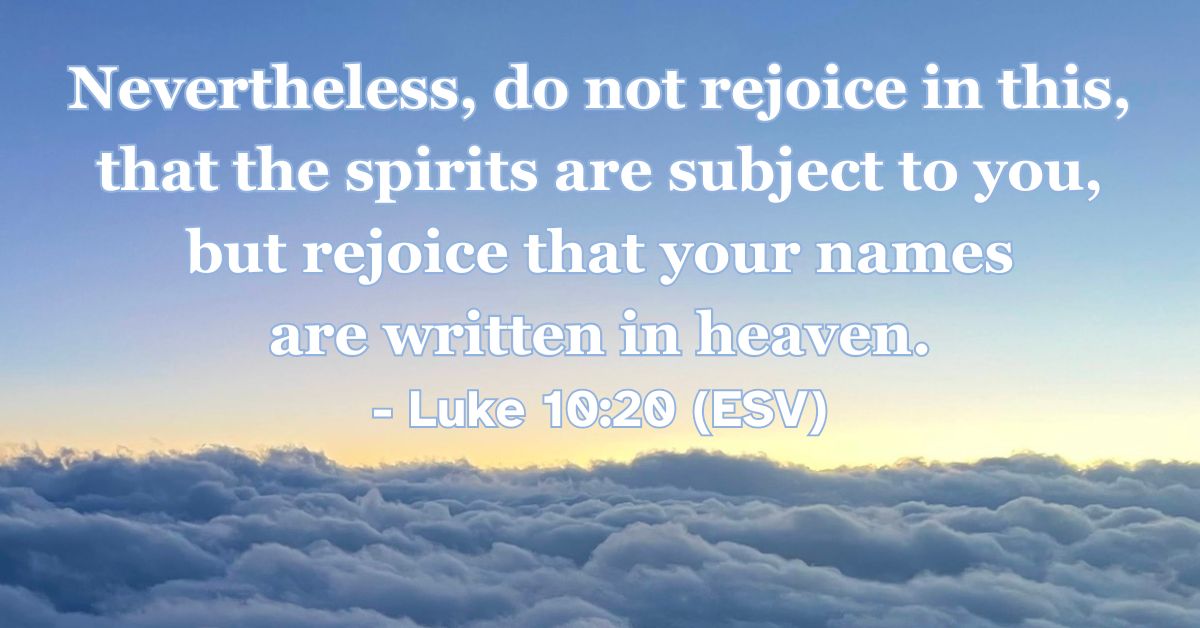
Nevertheless, do not rejoice in this, that the spirits are subject to you, but rejoice that your names are written in heaven.
Luke 10:20 (ESV)
Closing Prayer
Father,
Thank you for sending Jesus to bring the good news of your kingdom. Help us to be faithful in sharing this message with others. Remind us that our greatest joy is knowing our names are written in heaven.
In Jesus’ name we pray. Amen.

The ESL Version
I also create materials for adult English Language Learners (ELLs) and ESL students. You can find my ELL Bible Study based on Luke 10:1-20 here:
Subscribe
If you enjoyed this post and wish to receive more Christian content, consider subscribing to my newsletters!
Related Resources
Visit the Joyful Moments in Christ homepage for all posts, or scroll through other blog posts related to Sunday School:




Something went wrong. Please refresh the page and/or try again.
English Standard Version (ESV): Unless otherwise noted, scripture quotations are from the ESV® Bible (The Holy Bible, English Standard Version®), © 2001 by Crossway, a publishing ministry of Good News Publishers. Used by permission. All rights reserved. The ESV text may not be quoted in any publication made available to the public by a Creative Commons license. The ESV may not be translated in whole or in part into any other language.



 Joyful Moments in Christ