Responding with Love When Rejected
This Sunday School lesson is intended for upper elementary students. All lessons on this website are protected by copyright, but you can use them for free in small groups or Sunday School classes. You may share a link to this page, but please do not copy these pages and put them on other websites.
The Big Idea
Jesus teaches his followers to respond with love and patience instead of anger when others reject him.
Lesson Objectives
- Students will understand that Jesus chose to travel to Jerusalem, knowing the cross awaited him.
- Students will learn that rejection is a reality of following Jesus.
- Students will see that Jesus calls his followers to respond with gentleness, not revenge.
- Students will be encouraged to forgive and move on when treated unkindly.
Class Setting Notes
- Recommended for upper elementary Sunday School.
- Lesson length: 45-60 minutes. Can be shortened or extended based on activities selected.
Opening Activity
- On the board, write the words “Be Kind or Get Even.”
- Ask students to raise their hands if they have ever been treated unfairly or unkindly.
- Invite a few to share what they wanted to do in response.
- Ask: “Do you think Jesus would tell us to get even or to be kind? Why?”
This activity helps introduce the idea that Jesus calls us to love others even when they do not treat us well.
Bible Reading
Ask the class to read Luke 9:51-56 aloud together or have one person read it.
- Very Easy: Easy-to-Read Version: Luke 9:51-56 (ERV)
- Very Easy: New International Reader’s Version: Luke 9:51-56 (NIRV)
- Easy: Good News Translation: Luke 9:51-56 (GNT)
- Medium: New Living Translation: Luke 9:51-56 (NLT)
- Hard: New International Version: Luke 9:51-56 (NIV)
- Very Hard: English Standard Version: Luke 9:51-56 (ESV)
Additional Reading: Choosing the Right Bible Translation
Suggested prompts:
As the class reads aloud, consider asking some of these prompts:
- Notice why the Samaritan village refused to welcome Jesus.
- Pay attention to how James and John wanted to respond.
- Listen for how Jesus corrected them.
- Think about what Jesus’ response teaches us about following him.
- Watch how Jesus chose to move forward instead of fighting back.
Teacher Background Notes
- Luke marks this passage as the turning point when Jesus set his face toward Jerusalem, showing his resolve to go to the cross.
- Tensions between Jews and Samaritans were long-standing. The Samaritans’ rejection highlights how Jesus experienced opposition from many sides.
- James and John’s fiery response may have come from zeal for Jesus’ honor, but it revealed a misunderstanding of his mission.
- Jesus’ rebuke reminds us that his kingdom advances not by violence, but by grace and truth.
- This moment anticipates the greater rejection Jesus would endure in Jerusalem, yet he continued with determination and love.
Theological Insights
- Jesus deliberately chose the path to Jerusalem, showing his obedience to the Father’s plan of salvation.
- Rejection is part of the Christian life, but it never stops the mission of God’s kingdom.
- Jesus corrects his disciples when they confuse zeal with anger, teaching them that his way is marked by patience and mercy.
- The gospel calls believers to love enemies and trust God rather than seeking revenge.
Discussion Questions
Understanding the Text
- Where was Jesus planning to go, and why was that important?
- Why did the Samaritan village refuse to welcome him?
- How did James and John want to respond to the rejection?
- What did Jesus do instead?
- What does this teach us about the way Jesus’ kingdom works?
Personal Reflection and Application
- How do you usually feel when someone is unkind to you?
- Why do you think it is difficult to forgive instead of fighting back?
- Can you think of a time when you chose kindness instead of anger? What happened?
- How can you remember Jesus’ example the next time you face rejection or unkindness?
Suggested Activities
Role-Play Responses
- Present short scenarios where someone is unkind (e.g., being left out, teased, or treated unfairly).
- Have students act out two responses: one of anger and one of kindness.
- Discuss which response reflects Jesus’ teaching.
This activity helps students practice choosing Christlike responses when faced with unkindness.
Fire or Forgiveness
- Write “Fire” on one side of the board and “Forgiveness” on the other.
- Call out different situations (someone says something mean, a friend ignores you, a sibling breaks your toy).
- Have students point to which response Jesus would want.
This activity helps children think quickly about responding with forgiveness instead of anger.
Walking Away in Peace
- Give each student a slip of paper with a challenging situation written on it.
- Have them quietly think of how Jesus might want them to “walk away in peace.”
- Invite volunteers to share their ideas.
This activity helps students connect the story to real-life situations.
Memory Verse

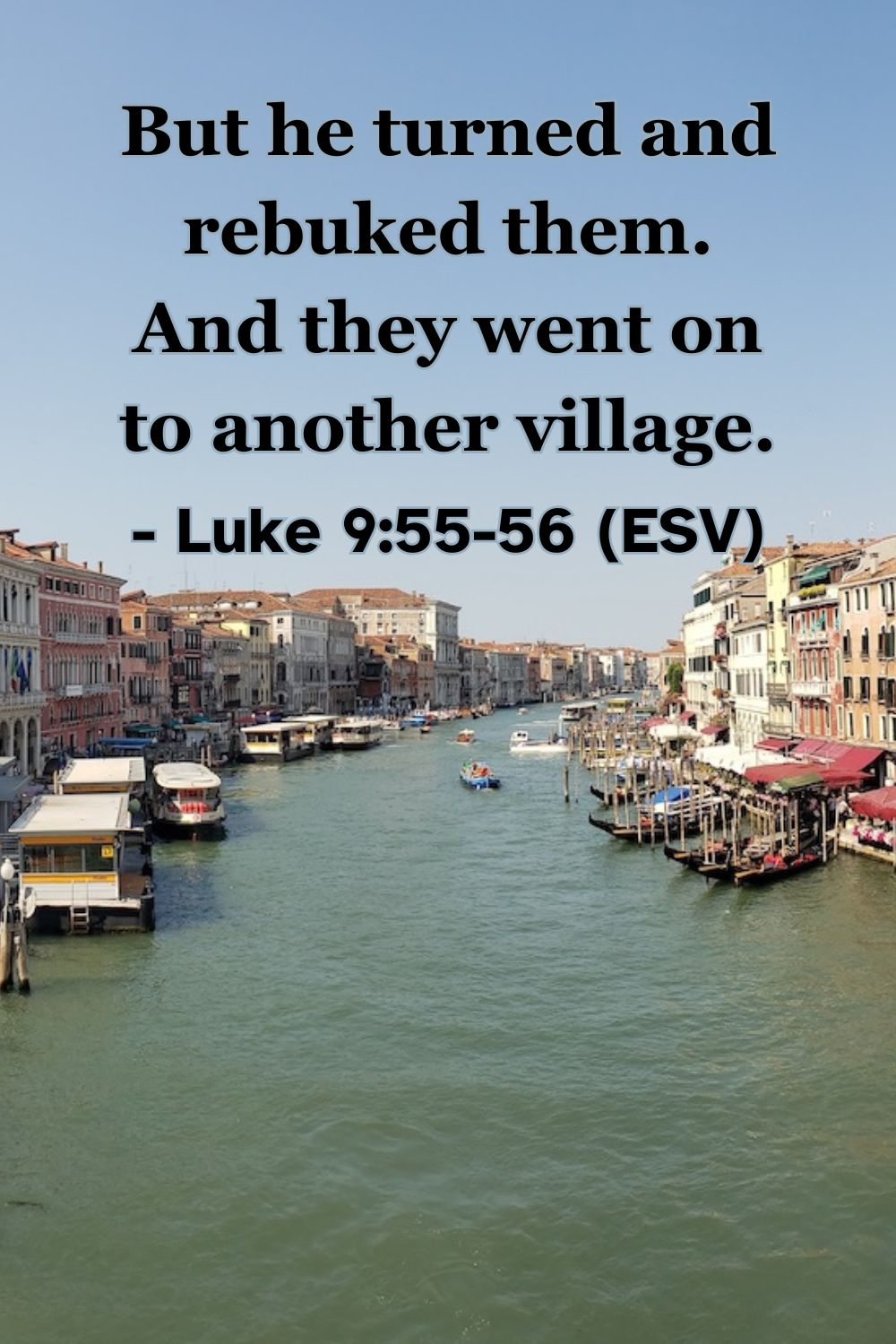
But he turned and rebuked them. And they went on to another village.
Luke 9:55-56 (ESV)
Closing Prayer
Father,
Thank you for showing us the patience and love of Jesus. Help us to forgive when people are unkind to us and to trust you instead of seeking revenge. Teach us to walk in the way of peace as Jesus did.
In Jesus’ name we pray. Amen.
The ESL Version
I also create materials for adult English Language Learners (ELLs) and ESL students. You can find my ELL Bible Study based on Luke 9:51-56 here:
Subscribe
If you enjoyed this post and wish to receive more Christian content, consider subscribing to my newsletters!
Related Resources
Visit the Joyful Moments in Christ homepage for all posts, or scroll through other blog posts related to Sunday School:

Something went wrong. Please refresh the page and/or try again.
English Standard Version (ESV): Unless otherwise noted, scripture quotations are from the ESV® Bible (The Holy Bible, English Standard Version®), © 2001 by Crossway, a publishing ministry of Good News Publishers. Used by permission. All rights reserved. The ESV text may not be quoted in any publication made available to the public by a Creative Commons license. The ESV may not be translated in whole or in part into any other language.

 Joyful Moments in Christ