As we navigate life, choices will present themselves. The question is whether we will heed the call of wisdom or the call of folly. This is not a choice made once in a lifetime, but one that meets us in the quiet of the morning and the chaos of the afternoon. It is a fundamental orientation of the soul. We must acknowledge that our natural inclination, left to itself, is to turn toward the shadows of folly. Yet, God in his infinite mercy does not leave us to our own devices without a witness. He is the Great Pursuer, and his primary tool in this pursuit is the voice of wisdom, a voice that is as persistent as it is clear.
God is Calling to Us
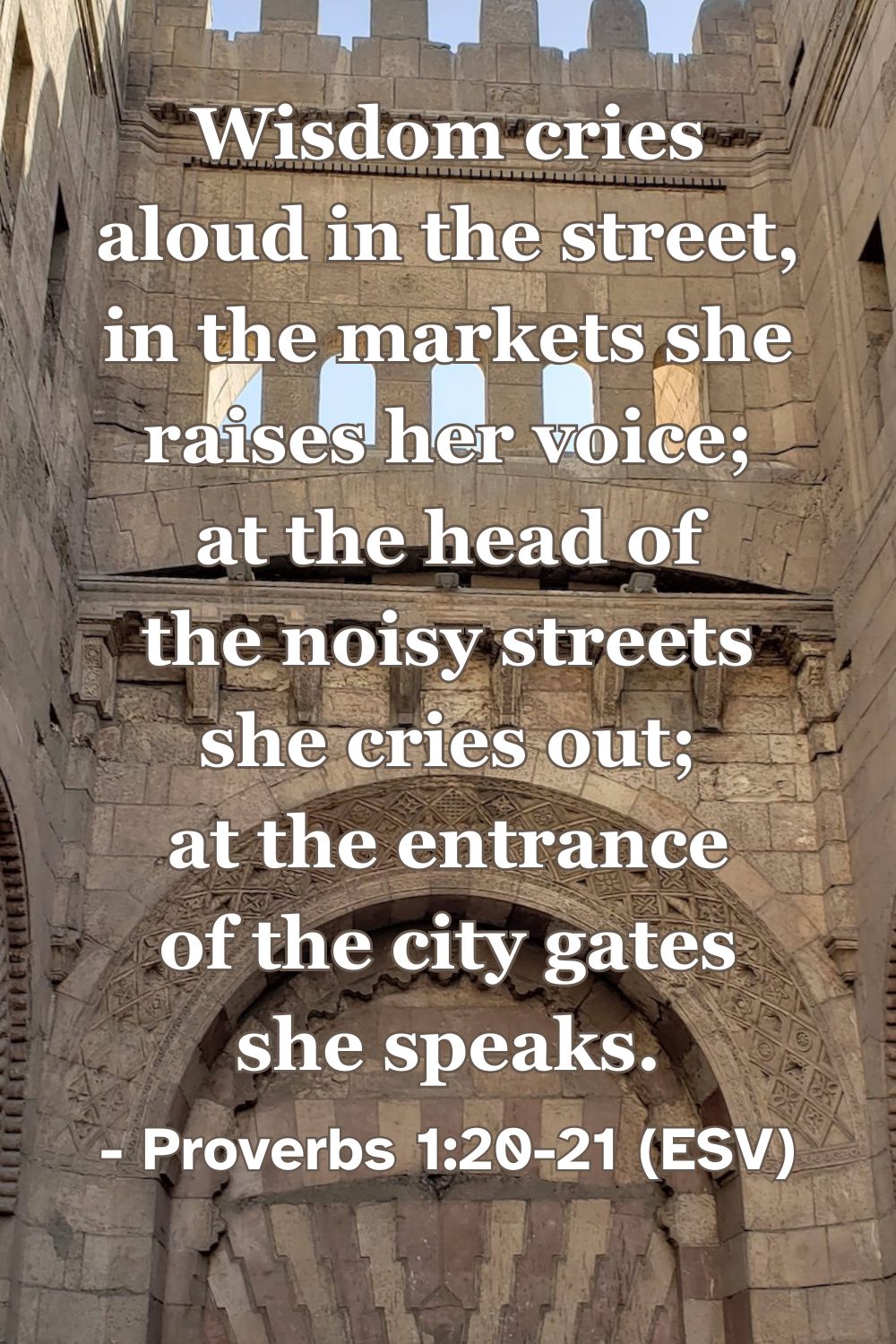
The Bible tells us that the voice of wisdom calls out to us. In Proverbs 1, wisdom is personified as a woman and we learn that God makes her voice known to us all. Whether we choose to believe in God or not, the Holy Spirit nudges us to listen. It is up to us to obey. We often mistakenly believe that spiritual truth is a hidden, esoteric secret reserved for the elite or the scholarly. We think we must climb a mountain to find God’s will. However, the text paints a very different picture. Wisdom is not whispering in a dark corner; she is shouting in the public square.
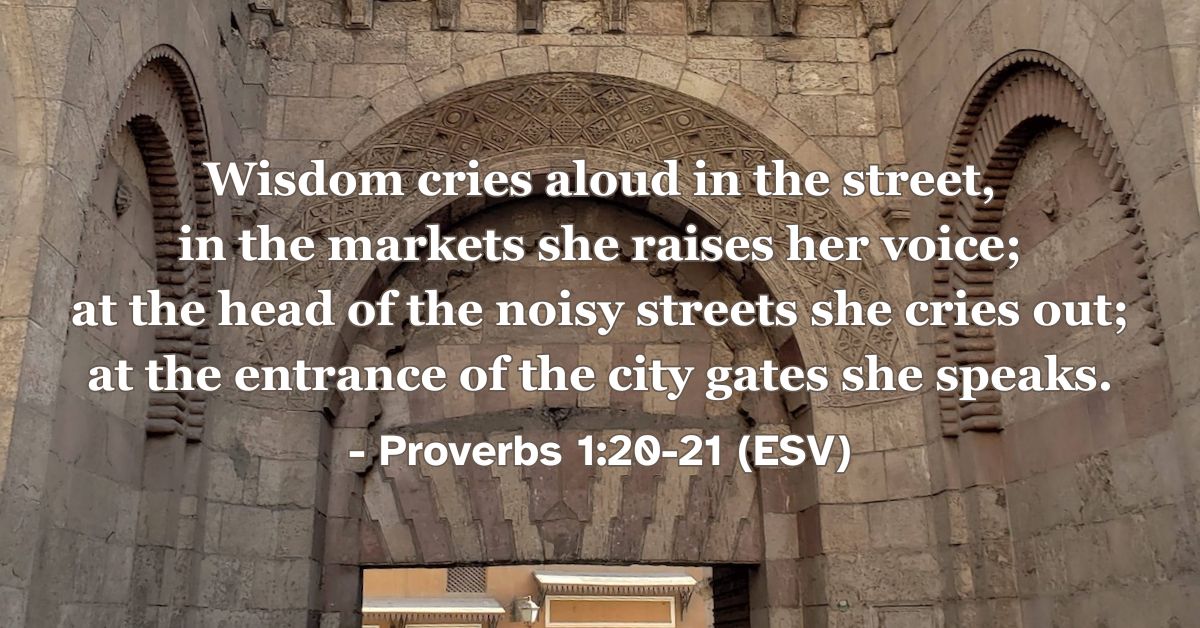
This imagery is vital for us to understand. The “street,” the “market,” and the “city gates” represent the places of commerce, justice, and daily social interaction. This tells us that God’s wisdom is incredibly practical and pervasive. It is meant to govern how we trade, how we speak to our neighbors, and how we govern our homes. The “noisy streets” are symbolic of the internal and external clamor that competes for our attention: the voices of ambition, the cries of our appetites, and the pressures of culture.
Amidst that din, the Holy Spirit ensures that wisdom’s cry is heard. No one can claim that God remained silent. He is shouting through the conscience, through the order of creation, and most powerfully through the preaching of his word. To ignore this cry is not a passive mistake; it is an active closing of the ears to a public proclamation.
Why We Turn Away
Unfortunately, many of us choose to disobey. For a multitude of reasons we choose to go our own way. We see the ways of the world as delightful and we choose to ignore the knowledge that God is trying to impart on us. We often scoff at his wisdom and turn towards folly. This turning away is rarely a matter of simple intellectual disagreement. Rather, it is an issue of the heart’s affections. We do not just choose folly; we “love” it. We do not just stumble into sin; we “delight” in the act of rebellion itself.

Our problem is not merely a lack of information; it is that every part of our being, including our desires, is naturally resistant to his light. The “simple” person isn’t just someone who lacks facts; they are someone who is settled in their ignorance and finds a false sense of peace there. The “scoffer” is someone who has moved beyond simple ignorance into active arrogance, finding joy in mocking the things of God.
This delight is a hollow joy, a cheap substitute for the true joy found in Christ, yet we cling to it because it allows us to remain the masters of our own small worlds. We hate knowledge because true knowledge reveals our need for a savior and our total inability to save ourselves. We prefer the darkness of our own understanding because the light of wisdom requires us to lay down our pride and acknowledge his absolute rule over our lives.
The Gift of a New Start
However, Proverbs 1:23 tells us that God is always ready to correct us. If we choose to accept that correction, he will pour his Spirit onto us and fill our minds with the knowledge of wisdom. This is the pivot point of the entire passage. It reveals the heart of a Father who would rather see his children repent than perish. Reproof is often painful; it is the surgical strike against our ego. Yet, for the believer, this reproof is the gateway to the most profound spiritual intimacy imaginable.
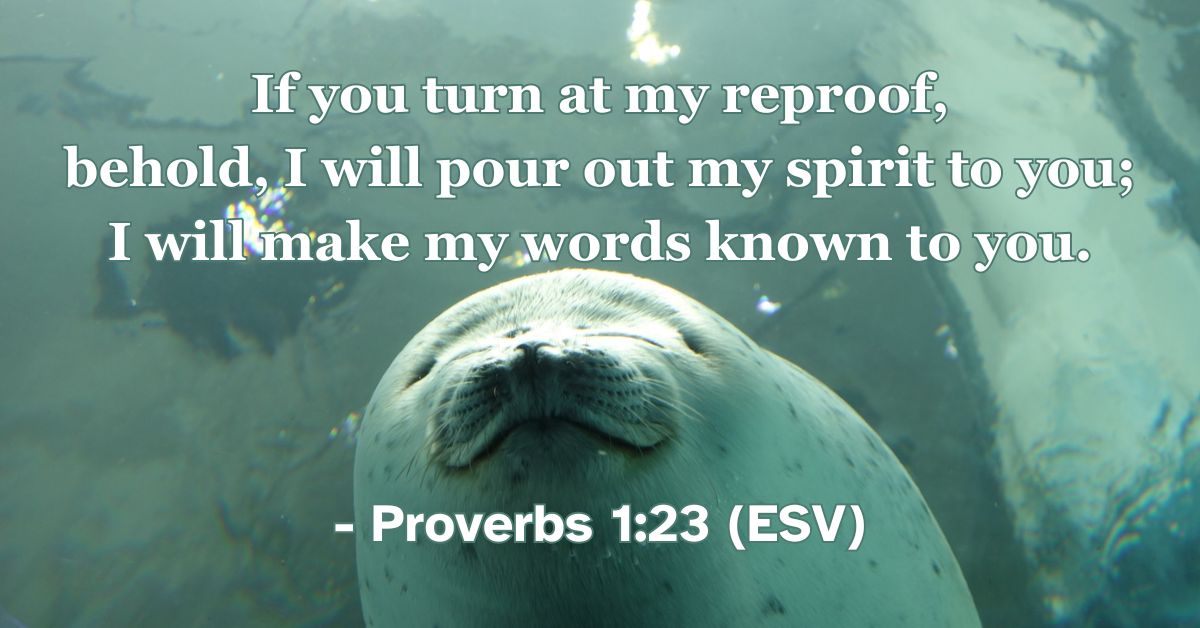
Think of the sheer magnitude of this promise. If we stop our running and make a “turn,” God promises not just a set of rules, but his very spirit. We cannot turn by our own strength or manufacture a holy heart. It is the Spirit who must take the stone out of our hearts and give us a heart of flesh that can actually hear and love the truth. When he “pours out” his spirit, it is an act of divine extravagance. He doesn’t give us wisdom in small, measured drops; he floods our parched souls with the knowledge of who he is.
This is where true joy begins to take root. It is the joy of being known and corrected by a perfect Father. It is the relief of finally stopping the exhausting flight away from him and finding that he was standing there with arms open, ready to teach us the “words” of life. This turning is an act of his grace from start to finish, working within us to will and to do according to his good pleasure.
The Consequences of Our Choices
Turning is a choice, and one that we often fail. We ignore the counsel of wisdom, then when disaster strikes, we suffer distress and anguish. There is a somber reality in the moral architecture of the universe: we eventually reap what we sow. While God is full of mercy, he also respects our choices enough to let us experience their natural ends. When we spend our lives building a foundation on the shifting sands of folly, we should not be surprised when the storm eventually makes landfall.
Because I have called and you refused to listen,
Proverbs 1:24-27 (ESV)
have stretched out my hand and no one has heeded,
because you have ignored all my counsel
and would have none of my reproof,
I also will laugh at your calamity;
I will mock when terror strikes you,
when terror strikes you like a storm
and your calamity comes like a whirlwind,
when distress and anguish come upon you.
These verses are difficult to read, but they are pastoral in their honesty. The “laugh” and “mockery” of wisdom represent the cold, hard logic of truth over falsehood. When we reject the hand that he has stretched out in mercy, we are essentially choosing a world where his protection is absent. The “storm” and “whirlwind” describe the sudden and chaotic nature of life’s consequences. We think we are in control of our sins, but sin is a master that eventually brings “distress and anguish.” He allows the terror to strike so that we might realize that our own strength is a vapor. The anguish we feel is the weight of our own autonomy coming down upon us. This is a severe mercy, designed to strip away our self-reliance and show us that he alone is the sovereign Lord of all.
When We Wait Too Long
Natural consequences are often the best medicine, but if we wait too long, there is nothing that wisdom can do to fix the situation. Sometimes the hole is simply too deep to fix in this lifetime. We must speak carefully here, for his grace was sufficient for the thief on the cross, yet Proverbs warns us of a specific type of hardening. If we continually “despise” reproof, we may reach a point where we no longer have the ears to hear or the heart to seek. Why did one thief choose repentance, while the other chose mockery? Both suffered natural consequences, but only one chose to repent.
Then they will call upon me, but I will not answer;
Proverbs 1:28-31 (ESV)
they will seek me diligently but will not find me.
Because they hated knowledge
and did not choose the fear of the Lord,
would have none of my counsel
and despised all my reproof,
therefore they shall eat the fruit of their way,
and have their fill of their own devices.
To “eat the fruit of their way” is a terrifying description of judgment. It suggests that the punishment for sin is, quite literally, being abandoned to the sin itself. If we want a life without his counsel, he may eventually grant us that wish. To have our “fill of our own devices” means to be left alone with our own cleverness, our own pride, and our own limited resources.
When calamity hits and we call out not from a heart of repentance (one thief), but from a heart of mere self-preservation (the other thief), we may find that wisdom has already departed. This reinforces that the “fear of the Lord” is the only starting point. We need to recognize that his holy authority is where we need to place our total dependence. We cannot “find” him if we are only seeking a way out of trouble rather than seeking him for his own glory.
Finding True Safety and Joy
Why is it that we sometimes wait too long to turn to him? He does promise to forgive us when we call out to him in repentance, but he doesn’t promise to take the consequences away. The tragedy of the “simple” and the “fool” is that they are destroyed by the very thing they thought would save them: their own comfort and complacency. They mistake his patience for his approval, assuming that because judgment is delayed, it will never come.
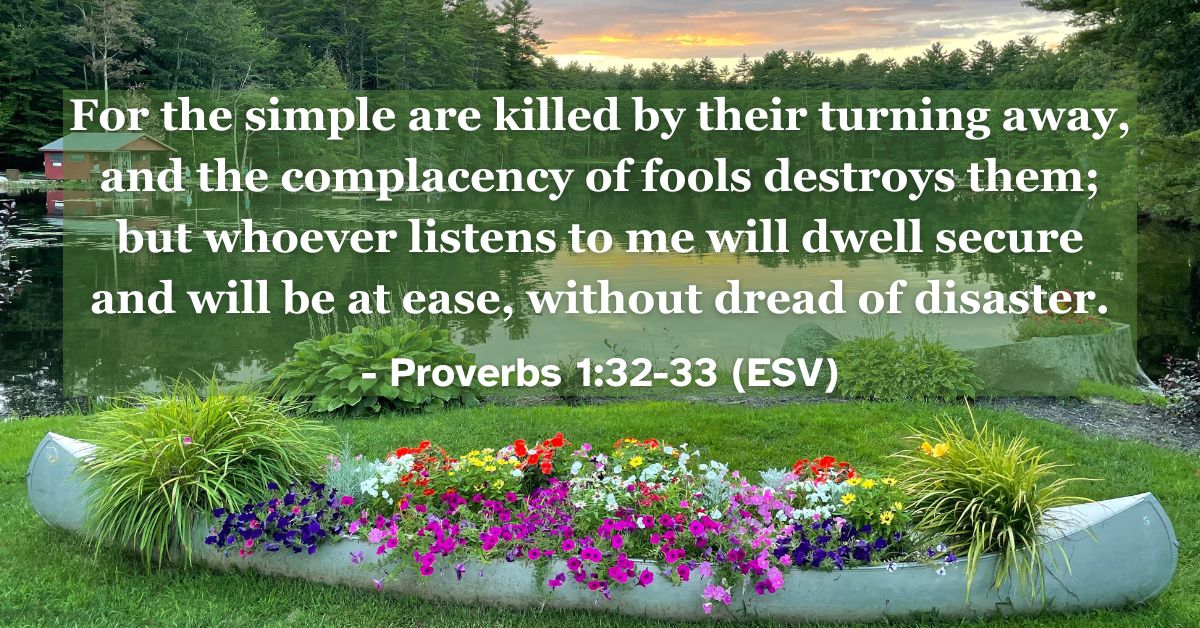
Complacency is perhaps the most dangerous state for a human soul. It is the feeling that all is well because the sun is shining today, even as the foundations of the house are rotting. But for the one who “listens” and obeys, the promise is one of ultimate peace. This “ease” is not the absence of trouble, but the absence of the “dread of disaster.” When our life is anchored in his wisdom, we know that even the whirlwind is under his control. Our security is not found in our circumstances, but in the character of the one who speaks to us. This is where true joy flourishes. It is a quiet, steady joy that comes from knowing we are no longer “turning away,” but are instead dwelling under the shadow of the Almighty.
Let’s choose to take the easy path, even if it doesn’t appear that way at first. We might want to seek out all of the pleasures that the world offers, but in the end these so-called pleasures will destroy us. By turning our back on these enticements, we will rest in the security of a good Father who will eventually lead us to a life of ease and true pleasures! The “easy path” is the path of submission to the yoke of Christ, the very wisdom of God. While the world chases shadows that lead to the whirlwind, we can walk the narrow path that leads to a joy that never fades. Let us turn at his reproof today, while he is near, and find the life that only he can give.
Reflection Questions
- Where in your life are you currently ignoring the voice of wisdom for the sake of comfort?
- How has the “fruit” of your own past choices led you to see your need for God?
- What does it look like for you to “turn at his reproof” in a specific situation today?
- In what ways can you find joy in God’s correction rather than resenting it?
- What does “dwelling secure” look like for you when life feels chaotic?
Reflective Prayer
Consider using these verses to pray using the ACTS method: Adoration, Confession, Thankfulness, and Supplication:
- Adoration: Praise God. Do these verses bring any specific characteristics of God to mind?
- Confession: Tell God that you are sorry for specific sins. Do these verses bring any specific sins to mind?
- Thankfulness: Show gratitude towards God. Does anything from these verses inspire gratitude?
- Supplication: Make requests for yourself and for others. Does anything from these verses inspire a prayer?
If helpful, you can use a prayer journal template.

Subscribe
If you enjoyed this post and wish to receive more Christian content, feel free to subscribe to my newsletters!
Related Resources
Visit the Joyful Moments in Christ homepage for all posts, or scroll through other blog posts related to wisdom and repentance:



Something went wrong. Please refresh the page and/or try again.
English Standard Version (ESV): Unless otherwise noted, scripture quotations are from the ESV® Bible (The Holy Bible, English Standard Version®), © 2001 by Crossway, a publishing ministry of Good News Publishers. Used by permission. All rights reserved. The ESV text may not be quoted in any publication made available to the public by a Creative Commons license. The ESV may not be translated in whole or in part into any other language.
 Joyful Moments in Christ