It is curious to see Christians who know that they are children of God turning back to being enslaved by the world. In Galatians, Paul spends a great deal of time explaining that salvation comes only through faith in Jesus Christ, not through human effort. Yet the Galatians, like many of us, were tempted to revert to a life of self-dependence and rule-keeping. They knew the truth, but they were drawn again to performance and appearance, as though grace were too simple to be trusted.
That same struggle persists today. Many of us begin our journey with joy and freedom, marveling at God’s grace, yet we gradually slip back into a mindset of earning. It is not that we deny the gospel outright, but we add subtle conditions to it. We tell ourselves that God’s approval depends on a more consistent quiet time, better moral discipline, or an impressive ministry record. These things are good in themselves, but when they become the measure of our worth, they cease to serve Christ and begin to replace him. The Galatians’ story becomes our own whenever we measure spiritual success by outward performance rather than inward dependence.
In Galatians 2, Paul had to learn through direct revelation from Jesus that salvation was not tied to good behavior or law-keeping. Then Peter, despite his understanding of grace, reverted back to old habits of exclusion. By Galatians 3, the believers in Galatia were doing the same, placing their confidence in the law rather than in God’s grace. Their hearts still craved something tangible to cling to: a checklist, a ritual, a way to measure their progress. Now, in Galatians 4, Paul calls this attitude what it truly is: slavery.
Paul’s choice of words is deliberate. He does not call it “weakness” or “confusion,” but “slavery.” It is the harsh reality of what happens when the heart turns from grace. To live under law is to live under a master who never stops demanding. The law exposes sin, but cannot remove it. It shows our need, but offers no remedy. Only in Christ is the chain broken. Yet, the human heart resists this kind of freedom because it requires humility. It is far easier to live under rules we can manage than to rest in mercy we cannot control.
We can choose to be enslaved by the world, or we can live as free sons and daughters of the Most High God. The question is simple but searching: why would anyone who has been freed return to slavery? Perhaps because slavery feels familiar. Self-effort gives the illusion of control, while faith asks us to rest in what Christ has already done. That rest is the very heart of the gospel.
The Illusion of Freedom
At first glance, being a child of God might look like slavery. God has rules, after all, and our sinful hearts bristle at the idea of obedience. The world tells us that true freedom is doing whatever feels right in the moment: no restrictions, no accountability, no boundaries. But that is a trick, a cruel one. The supposed freedom to follow every impulse eventually leads us into deep bondage, because our desires are not neutral. They are shaped by sin and are prone to wander.

The difference between a slave and a child lies in relationship. A slave serves out of fear and obligation. A child obeys out of love and belonging. A slave has no inheritance to anticipate, only tasks to complete. But a child has a Father whose affection is secure, whose correction is purposeful, and whose discipline is shaped by love. The world’s version of “freedom” only exchanges one kind of master for another, usually one far more demanding and far less kind.
Sin promises freedom, but delivers addiction. It offers pleasure, but hides the cost. The “freedom” of following our desires soon becomes the tyranny of serving them. The more we obey sin’s voice, the quieter God’s voice seems to become. What starts as choice turns into compulsion. This is why Paul warns so urgently: apart from Christ, even the most confident soul is still a captive one.
When we choose the world’s way, we end up bound to its ever-changing expectations. One day it tells us to seek success, the next to chase comfort or self-expression. It promises fulfillment but delivers restlessness. There is no lasting peace in serving these false masters, because each one demands more and gives less.
The irony is that the world’s slavery often disguises itself as sophistication. It praises independence, ambition, and self-definition, but all these paths lead to the same emptiness. Every new trend or philosophy becomes another “guardian,” another law that tells us what we must do to belong.
By contrast, God’s commandments are not chains, but boundaries of love. A good parent limits a child’s behavior, not to hinder growth, but to protect life. God’s commands shape us into people who know real freedom, the freedom to obey gladly, to rest deeply, and to trust fully. Real freedom is not the absence of authority; it is living under the right one. In Christ, belonging is not earned; it is received.
It takes spiritual maturity to see obedience as a gift. Each command of God guards something precious, whether truth, purity, community, or peace. What feels restrictive to the flesh becomes life-giving to the spirit. The law, when seen through the lens of grace, is not a ladder to climb, but a light to walk by. In Christ, we discover that submission is not slavery, but safety.
The Fullness of Time
When the world had long stumbled in spiritual darkness, God sent a rescuer:

Jesus came not merely to free us from sin’s punishment, but from its power to enslave. Redemption means release. Adoption means belonging. God does not save us to make us distant servants but to make us beloved children. He invites us into his family with full rights of inheritance and calls us to live in that freedom.
Notice that God’s timing was not accidental. The “fullness of time” reminds us that redemption unfolded according to divine precision. Every promise, every prophecy, every longing of the Old Testament converged in Christ. God was never late and never uncertain. In the same way, the timing of his work in our lives is also perfect. When we grow impatient and try to secure blessings by our own effort, we echo the Galatians’ mistake as well as Abraham’s before them. But faith waits, trusting that God’s plan, however slow it feels, will arrive exactly when it should.
Think of a child adopted from a harsh orphanage. For years, the child has lived under strict rules, constant fear, and the uncertainty of being loved. When that child is welcomed into a new family, the habits of fear do not disappear overnight. Even in a safe home, the child might still flinch at correction or hoard food in secret. It takes time to believe that love really means security. In the same way, we sometimes live as though we are still under the law, still unsure of our Father’s affection. But Christ has brought us home. We no longer need to earn what has already been given.
That is why Paul points to adoption. It captures both our new status and the transformation of our hearts. Adoption is a legal act, but it is also deeply relational. It says, “You belong here.” And once we belong, everything changes: the way we pray, the way we suffer, the way we obey. A slave asks, “What must I do?” A son asks, “How can I please my Father?” The difference is not in effort, but in motive. Grace changes the heart before it changes the habits.
Notice the beauty of Paul’s wording: Christ was born under the law so that we could be lifted out from under it. He perfectly fulfilled every requirement that we could never meet. His obedience secures our adoption. His righteousness becomes ours. And his Spirit works within us to make that new identity feel real in our hearts.
This is an astonishing privilege. Through Christ, we can call the Creator of the universe “Father.” The Spirit within us reminds us of this truth when our hearts grow fearful or self-reliant. He whispers the assurance that we are loved, not because we have earned it, but because we belong to Christ. We no longer serve God as trembling laborers but as beloved children who trust their Father’s care.
That cry of “Abba! Father!” is the sound of freedom. It replaces the anxious striving of the orphan with the steady confidence of the child. Every time we pray, we reaffirm this adoption. Every act of faith is a reminder that we have been welcomed, not hired. This is the life Paul longs for the Galatians to recover. A life of simple trust, joyful obedience, and deep rest in the Father’s love.
Turning Back to Slavery
Paul could hardly believe what the Galatians were doing. Having been freed by the gospel, they were walking back toward bondage.
It is possible to look religious while being enslaved. The Galatians were still attending gatherings, observing sacred days, and keeping moral codes. Outwardly, everything looked fine. But inwardly, their trust had shifted from Christ to themselves. They were keeping the law to earn approval rather than to express love. They were acting like employees trying to impress a boss, rather than children enjoying the favor of their Father.
This is a temptation that remains deeply relevant today. A person may volunteer at church, tithe faithfully, or memorize Bible verses, yet still harbor a heart of self-reliance. Outward appearances can fool others, and even ourselves, into believing we are free, when in truth we are bound to expectations we cannot fully meet. Slavery often dresses itself in virtue and religiosity. Paul is warning that the chains of legalism are often invisible until we take a step back and examine the motives of our hearts.
That same danger remains for us. Whenever we rely on our own goodness to prove our worth before God, we are walking back into chains. Religious busyness can look impressive, but it is empty when it is driven by pride instead of love. Obedience that does not flow from faith becomes a burden instead of a blessing.
Paul’s words here are full of pastoral anguish. He had poured his life into teaching and nurturing them, only to see their hearts revert to fear-driven performance. We, too, may find ourselves burdened by the weight of tasks and rituals, believing they prove our devotion, but obedience in that state is a shadow of true service, a treadmill rather than a dance of love.
Paul’s warning invites us to examine whether our own spiritual practices are producing fruit from gratitude or simply from guilt. We do not become God’s children by keeping rules. We keep God’s rules because we are already his children. That distinction makes all the difference between joyful service and joyless slavery. The first flows from gratitude; the second from fear.
Consider a child asked to clean their room. If they do it to avoid punishment, their heart is tense, and the act feels like drudgery. If the same child cleans to please a loving parent who has already affirmed their worth, the task becomes an act of delight. In the spiritual life, the difference is identical. Christ’s love frees us to obey with gladness, because obedience is no longer a means to an end, but a response to belonging.
Love, Not Law, Marks God’s Children
Paul reminds the Galatians of how warmly they once received him.
Their faith had once overflowed in love. They had cared for Paul, even when he was physically weak. Their obedience was genuine and rooted in affection, not compulsion. They were free because they loved God and his messenger sincerely.
Paul’s example shows that love always precedes obedience. The Galatians responded with generosity and concern, not because Paul forced them, but because their hearts were already engaged. Similarly, when our love for God is authentic, acts of service flow naturally. This is the distinction between performing for approval and acting out of devotion. One enslaves; the other liberates.
So, what changed? Their love had grown cold because their trust had shifted away from Christ. Rules replaced relationship. Duty replaced delight. Paul pleads with them like a spiritual parent watching beloved children drift from the truth.
This drift can happen subtly. We might start by adding “extra steps” to our faith, believing they will secure God’s favor. Over time, stricter rules and more self-imposed disciplines can displace the simple, joyful dependence on Christ that once characterized our hearts. Paul’s grief reminds us that it is possible to maintain the appearance of faith while losing the essence of it: love.
When our faith becomes mechanical, when we start serving God out of fear or self-approval, we lose the warmth of sonship. God does not want our flawless performance; he wants our faithful hearts.
Have I then become your enemy by telling you the truth? They make much of you, but for no good purpose. They want to shut you out, that you may make much of them. It is always good to be made much of for a good purpose, and not only when I am present with you, my little children, for whom I am again in the anguish of childbirth until Christ is formed in you! I wish I could be present with you now and change my tone, for I am perplexed about you.
Galatians 4:16-20 (ESV)
Paul’s anguish and perplexity is pastoral. He longs to see Christ formed in them, to see genuine transformation, not shallow compliance. The Christian life is not about polishing the exterior but about the Spirit shaping our hearts into the likeness of Christ.
His imagery of childbirth emphasizes the intensity of his care. Spiritual formation is not convenient or easy; it involves pain, effort, and patience. The life of faith requires growth that may be uncomfortable, yet the end result is authentic transformation. Just as a mother labors for a child’s birth, God’s Spirit works deeply within us to produce true freedom and love, even when it is difficult or countercultural.
The Example of Abraham, Sarah, and Hagar
To drive home his point, Paul reaches back into Israel’s history (also see Genesis 15-16 and Genesis 21):
Abraham and Sarah grew impatient waiting for God’s promise. Instead of trusting his timing, they took matters into their own hands. The result was heartbreak, jealousy, and division. Their attempt to secure God’s blessing by human means led only to trouble and pain.
This story is striking because it illustrates a pattern we often repeat. Like Abraham and Sarah, we can become anxious when God’s promises seem delayed. We might try to “help” God by creating our own solutions, solutions that include shortcuts, compromises, or self-reliant plans. What looks clever to us often results in unforeseen complications, confusion, and long-term consequences. The lesson is clear: impatience with God’s timing can lead to spiritual and relational slavery.
Now this may be interpreted allegorically: these women are two covenants. One is from Mount Sinai, bearing children for slavery; she is Hagar. Now Hagar is Mount Sinai in Arabia; she corresponds to the present Jerusalem, for she is in slavery with her children. But the Jerusalem above is free, and she is our mother.
Galatians 4:24-26 (ESV)
Paul uses this story to contrast two ways of living: striving by human effort (Hagar) and resting in God’s promise (Sarah). Hagar’s son represents slavery to the law. Sarah’s son represents freedom through faith. One life depends on what we can produce; the other depends on what God has promised.
We can imagine this with a simple object lesson: Picture two gardeners. One tries to grow a tree by forcing water, fertilizer, and constant pruning, anxious at every leaf. The other plants the tree, waters it responsibly, and trusts the seasons to nurture growth. The first gardener mirrors Hagar and legalism: effort without trust, bondage masked as action. The second mirrors Sarah and grace: patient dependence on God, producing true fruit.
Whenever we try to earn God’s favor, we are acting like Abraham and Sarah in their impatience. We are saying, “God, I’ll take it from here.” But God’s blessings do not come by manipulation or merit, but by grace through faith.
The Children of Promise
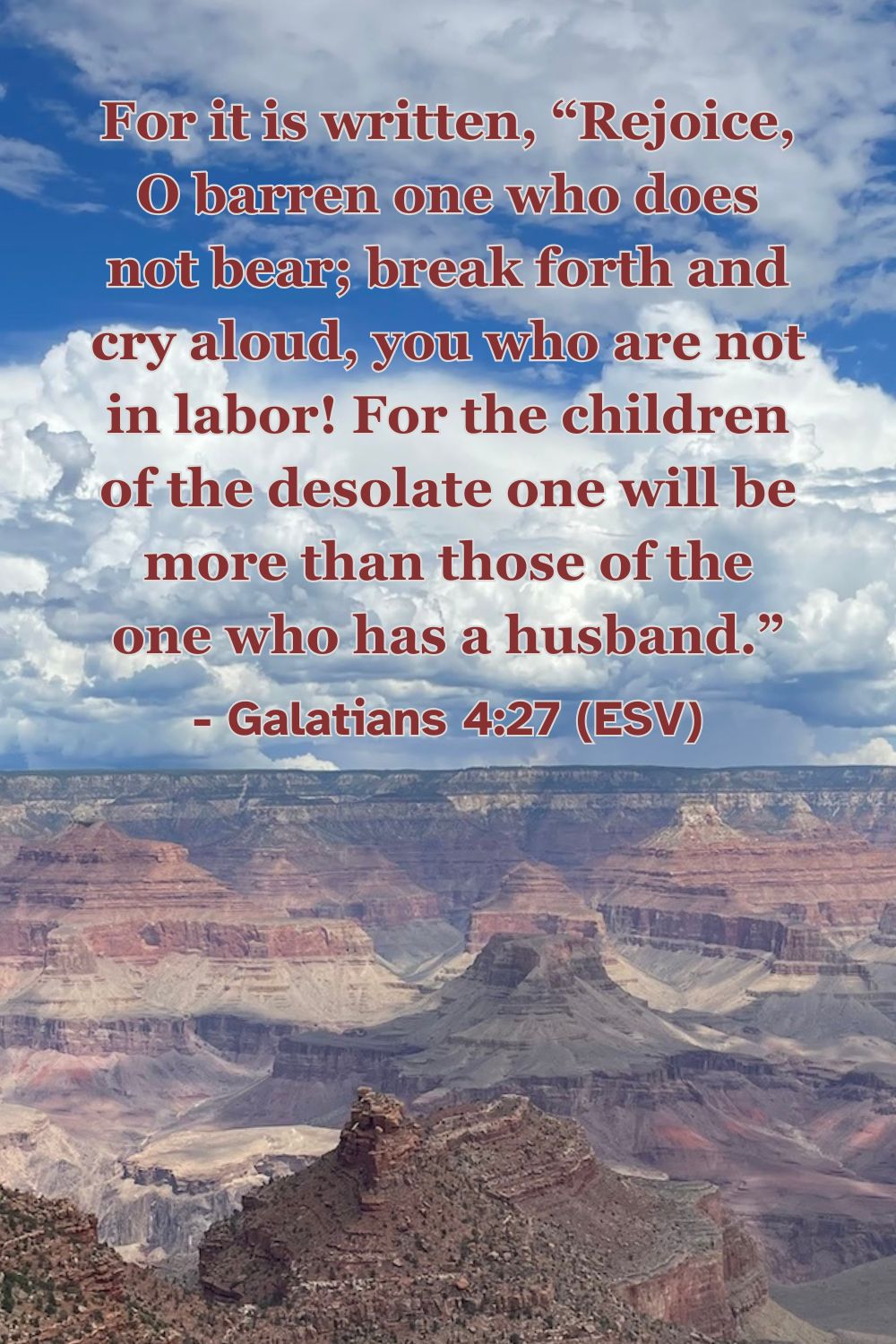
Paul then quotes Isaiah to show that God’s plan has always been about grace, not human performance:
Sarah’s barrenness seemed like the end of her story, but God was writing something better. Her emptiness became the place where his promise shone brightest. In the same way, our weaknesses often become the stage for God’s strength. What the world calls limitation, God calls opportunity.
We might relate this to a modern example: A student feels unprepared for a challenge or a promotion, yet God uses that very limitation to cultivate patience, perseverance, and humility. What seems like a dead end becomes the platform for God’s promise to flourish. Like Sarah, we must trust that God is writing a larger story than we can see.
For us, being asked to reject a few activities that the world values is not the end of the story. Our story is greater than this. The path to that story is complete dependence on God. Children are never perfect, but they are loved. We will make mistakes, but we are loved by our wonderful Father. He is not looking for instantaneous perfection, but for genuine devotion.
We have been given the privilege of being called children of promise. That identity defines how we live, suffer, and hope. It is more than a title; it is a lens through which we see the world and understand our place in it. Being a child of promise means that our value is not dependent on our performance, our wealth, or our achievements, but on God’s faithfulness and love. Our inheritance is secure because it rests on his character, not ours.
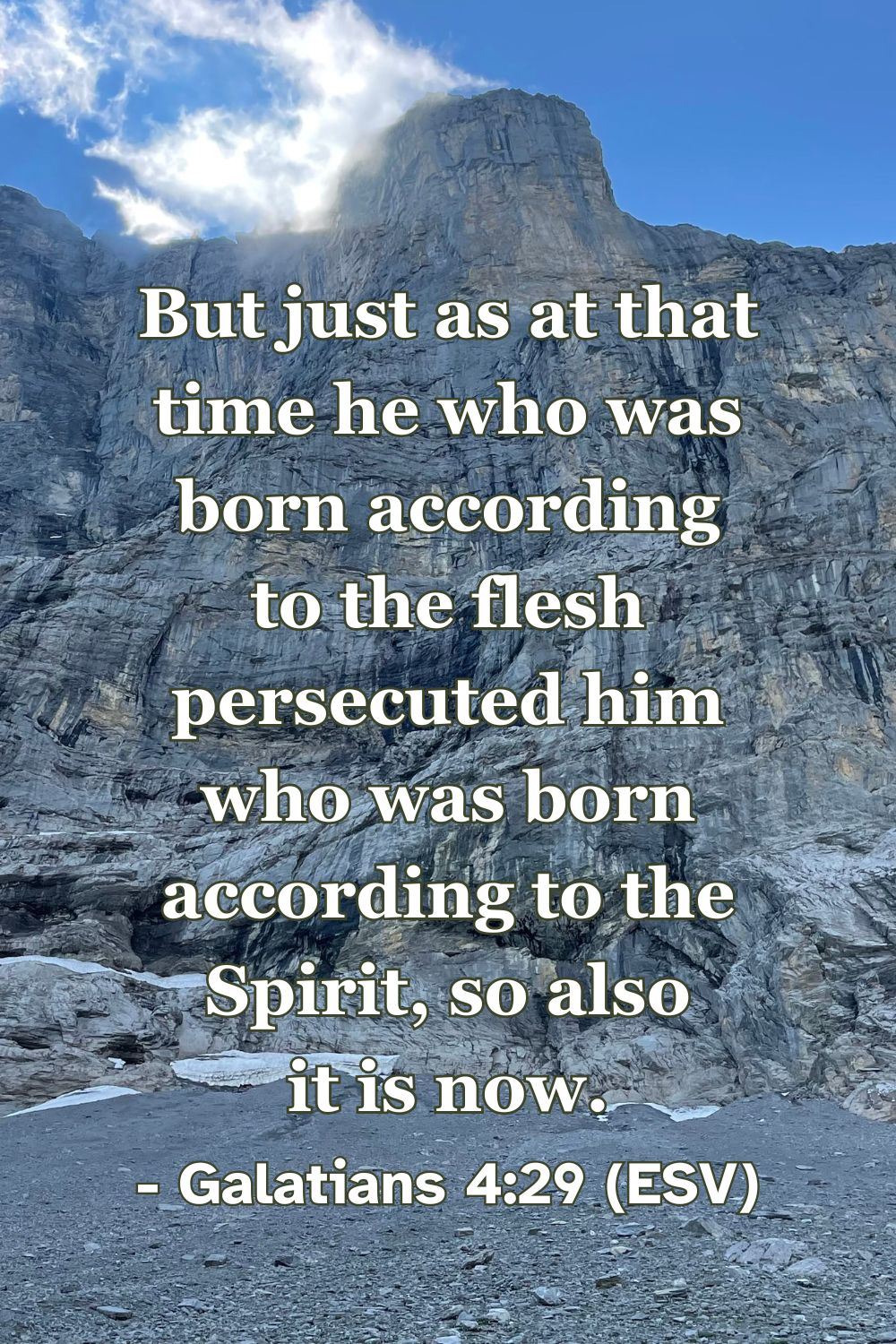
Yet Paul reminds us that this calling will not always be comfortable:
Faithful living will often meet resistance. The world, with its false promises and competing allegiances, will sometimes oppose our faith, ridicule our devotion, or tempt us back into old patterns of self-reliance. Like Isaac, we may face opposition even from unexpected sources like family, friends, or societal pressures. This is not a sign of failure, but an inevitable aspect of walking in God’s promises.
But what does the Scripture say? “Cast out the slave woman and her son, for the son of the slave woman shall not inherit with the son of the free woman.”
Galatians 4:30 (ESV)
Abraham’s choice to take a concubine was not the plan for the child of promise. In the end, Abraham had to separate himself from that unwise decision and the horrific consequences it produced. This illustrates a crucial truth for us: freedom in Christ requires discernment and sometimes difficult choices. We must separate ourselves from influences, habits, or ways of thinking that belong to the “slave woman,” to legalism, self-reliance, or worldly approval, so that we can fully inherit the blessings of God.
If Abraham had trusted God fully, he would never have taken Hagar as a concubine and would have avoided years of sorrow. This is a vivid reminder that impatience and self-reliance have long-term consequences, and that God’s design, though sometimes slower or more difficult, is always better. When we trust ourselves more than we trust God, the consequences are far-reaching.
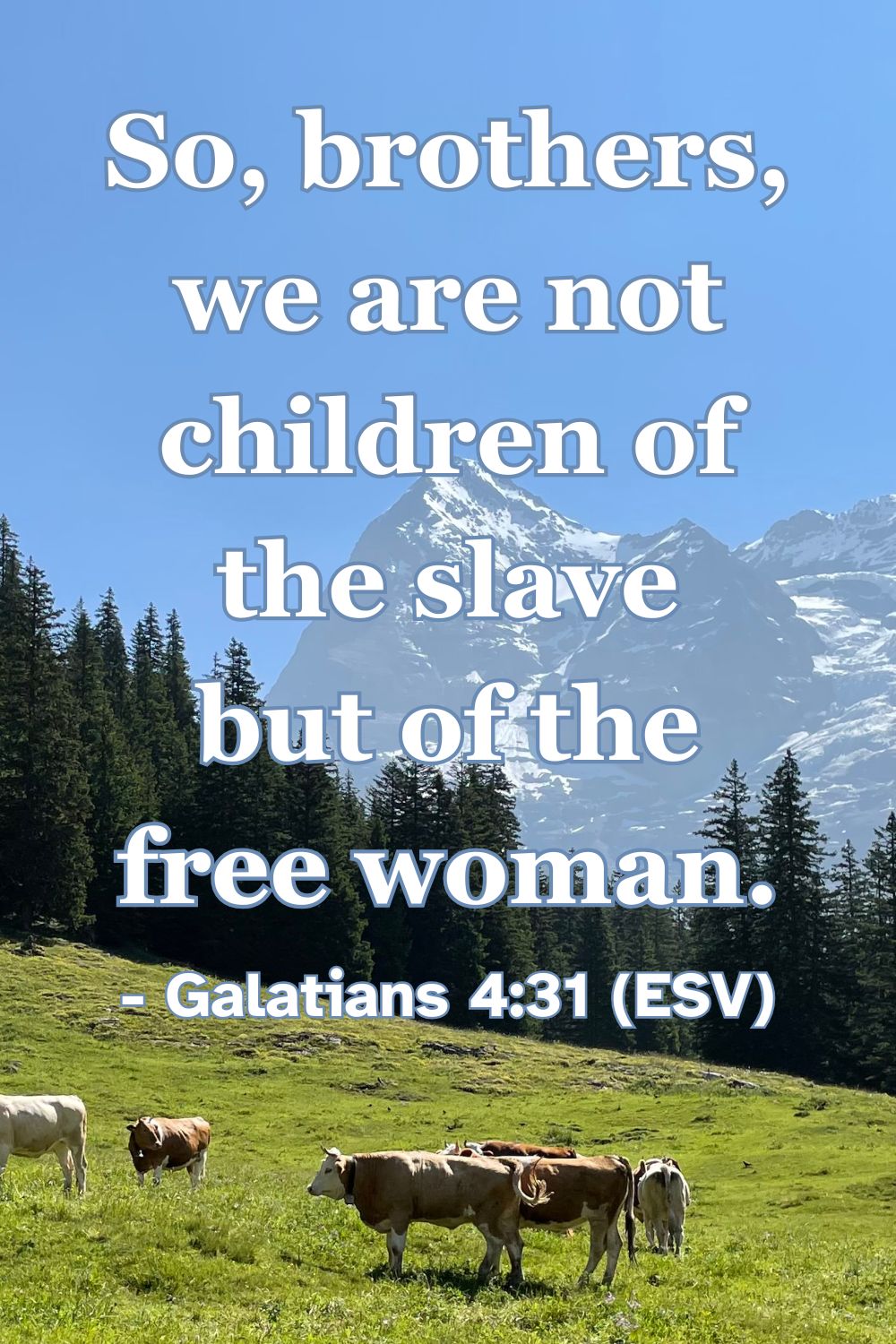
This is the heart of Paul’s message: our identity in Christ brings freedom, inheritance, and hope. To live as children of promise means rejecting the chains of the world and law-keeping for the sake of relationship with God. It is a daily choice to embrace grace rather than striving, trust rather than fear, and love rather than duty.
Consider a child holding tightly to a toy from the past, afraid to let it go. Even though the parent offers something far greater, a gift meant to bring lasting joy, the child hesitates. Many of us are like that child, clinging to familiar patterns of self-effort or worldly approval. God invites us to open our hands and receive the inheritance he has prepared. The freedom and joy on the other side of trust are worth it.
As we go forward, let us consider where we are placing our trust. Are we leaning on our own wisdom, our schedules, or our performance? Or are we resting fully in the promises of God, who calls us beloved children? Every act of faith, every surrender of self, is a step toward living as heirs of grace, filled with joy and peace.
The invitation of Galatians 4 is clear: leave the chains behind, and live as free children of the King. Let’s learn from Abraham, Sarah, and Hagar, that true freedom comes not from striving or control, but from trusting God’s promises and living as his beloved children.
Reflection Questions
- Where in your life are you most tempted to rely on your own effort rather than on God’s promise?
- In what practical ways can you cultivate the Spirit’s “Abba! Father!” cry in your daily routine?
- How would your worship, relationships, and service change if you truly believed you are an heir and not a hireling?
- Who in your life needs to hear about freedom from enslavement to performance, and how might you speak that truth in love?
Reflective Prayer
Consider using these verses to pray using the ACTS method: Adoration, Confession, Thankfulness, and Supplication:
- Adoration: Praise God. Do these verses bring any specific characteristics of God to mind?
- Confession: Tell God that you are sorry for specific sins. Do these verses bring any specific sins to mind?
- Thankfulness: Show gratitude towards God. Does anything from these verses inspire gratitude?
- Supplication: Make requests for yourself and for others. Does anything from these verses inspire a prayer?
If helpful, you can use a prayer journal template.


Subscribe
If you enjoyed this post and wish to receive more Christian content, feel free to subscribe to my newsletters!
Related Resources
Visit the Joyful Moments in Christ homepage for all posts, or scroll through other blog posts related to <topic>:




Something went wrong. Please refresh the page and/or try again.
English Standard Version (ESV): Unless otherwise noted, scripture quotations are from the ESV® Bible (The Holy Bible, English Standard Version®), © 2001 by Crossway, a publishing ministry of Good News Publishers. Used by permission. All rights reserved. The ESV text may not be quoted in any publication made available to the public by a Creative Commons license. The ESV may not be translated in whole or in part into any other language.

 Joyful Moments in Christ