Why is it that we resist God so vehemently? Most of us are not prophets, and it is rare that we hear the audible voice of God, yet we often sense his leading. Whether it is a persistent tug at the heart, the wise counsel of others, or the quiet conviction of the Holy Spirit, we often know deep down what God is asking of us. Even so, like Jonah, we go the other way.
Sometimes we run because we feel inadequate. Moses tried to dodge God’s call by saying he was not eloquent. Jeremiah objected that he was too young. We may think, “Surely someone else would be better at this,” or “God must have made a mistake choosing me.” But God’s call is rarely about our qualifications, but rather about his purposes and his strength made perfect in our weakness.
Other times we run because obedience is costly. Forgiving someone who has wounded us may feel like giving up justice. Confessing sin may feel like handing over our reputation. Sacrificing our time, money, or comfort may seem unreasonable. But behind each of these callings is the heart of a Father who loves us enough to challenge us, both for our good and his glory.
Perhaps God is nudging us to forgive someone who hurt us deeply, and instead we hold onto bitterness. Maybe we feel prompted to speak a word of encouragement to a struggling coworker, but we remain silent out of fear. At times, we know what is right, but doing it feels inconvenient, costly, or uncomfortable.
Jonah was not unsure of what God wanted; he simply did not want to do it. The call was clear: go to Nineveh and preach. But Jonah went the opposite direction, literally and spiritually. Tarshish was west, Nineveh was east. God said “go,” and Jonah said “no.”
Jonah’s story holds up a mirror to our own hearts. How often do we board our own ships to Tarshish, looking for ways of escape, avoidance, or rebellion, thinking we can outrun the will of God?
God’s Warning Signs
Imagine driving down the highway and seeing a bright red sign: “WRONG WAY.” You know what it means. If you keep going, you may end up in a dangerous situation. And yet, in our spiritual lives, we sometimes barrel past God’s warning signs. Like Jonah, we “pay the fare” and willingly hop on a path that leads away from God’s presence.
It is easy to condemn Jonah from the safety of our pews or Bible study groups, but the truth is, his story feels quite familiar. It is not that we always outright rebel. Sometimes we just delay obedience. We rationalize. We procrastinate. We convince ourselves that God surely must have someone else in mind.
And sometimes, like Jonah, we are angry at what God might do. Jonah feared that the Ninevites, violent, pagan enemies of Israel, might actually repent and be spared. His disobedience was not just about fear but about justice. He could not imagine God showing mercy to people he thought deserved wrath. But God’s mercy often reaches those we least expect, and that includes us.
Fortunately, God is not in the business of giving up on his people.
4 But the Lord hurled a great wind upon the sea, and there was a mighty tempest on the sea, so that the ship threatened to break up.
Jonah 1:4 (ESV)
God pursued Jonah. While at first glance it looked like it was to destroy him, the true end game was to redeem him. This is good news for us! When we run, God often responds not with immediate punishment, but with purposeful intervention.
The Consequences of Disobedience
Sometimes we believe that choosing our own path is fairly harmless, that our decisions will only affect us. However, we can see that Jonah’s rebellion endangered everyone on that ship. Disobedience has a ripple effect. Our decisions rarely stay confined to ourselves.
Many of us have had a close friend (or maybe it was us) who ignored wise counsel and dated someone who did not share their faith. At first, everything seemed fine. But over time, that person began to drift from church, prayer, and Christian community. Their faith weakened, and eventually, the relationship ended painfully. They had seen the red flags early on but chose the “Tarshish” route. Often, God uses that season to draw the person back, but not without scars.
Sometimes the cost of disobedience shows up in subtle ways: emotional unrest, spiritual dryness, broken relationships, or missed opportunities to bless others. Like Jonah, we may find ourselves in a storm we did not expect, only to realize we charted its course ourselves.
Jonah’s story reminds us that God does not always allow us to wander without consequence. Sometimes he sends storms, but this is not out of cruelty, rather out of long game mercy.
5 Then the mariners were afraid, and each cried out to his god. And they hurled the cargo that was in the ship into the sea to lighten it for them. But Jonah had gone down into the inner part of the ship and had lain down and was fast asleep.
Jonah 1:5 (ESV)
In the midst of chaos, Jonah was asleep. Spiritually numb. Oblivious to the panic he had caused. This is often the case with sin, dulling our sensitivity, putting us to sleep, and lulling us into a false sense of security. Meanwhile, others are bailing water.
Sometimes, our disobedience makes life harder for the people around us. Our families, friends, or coworkers may feel the consequences of our choices long before we do.
The captain’s question pierces:
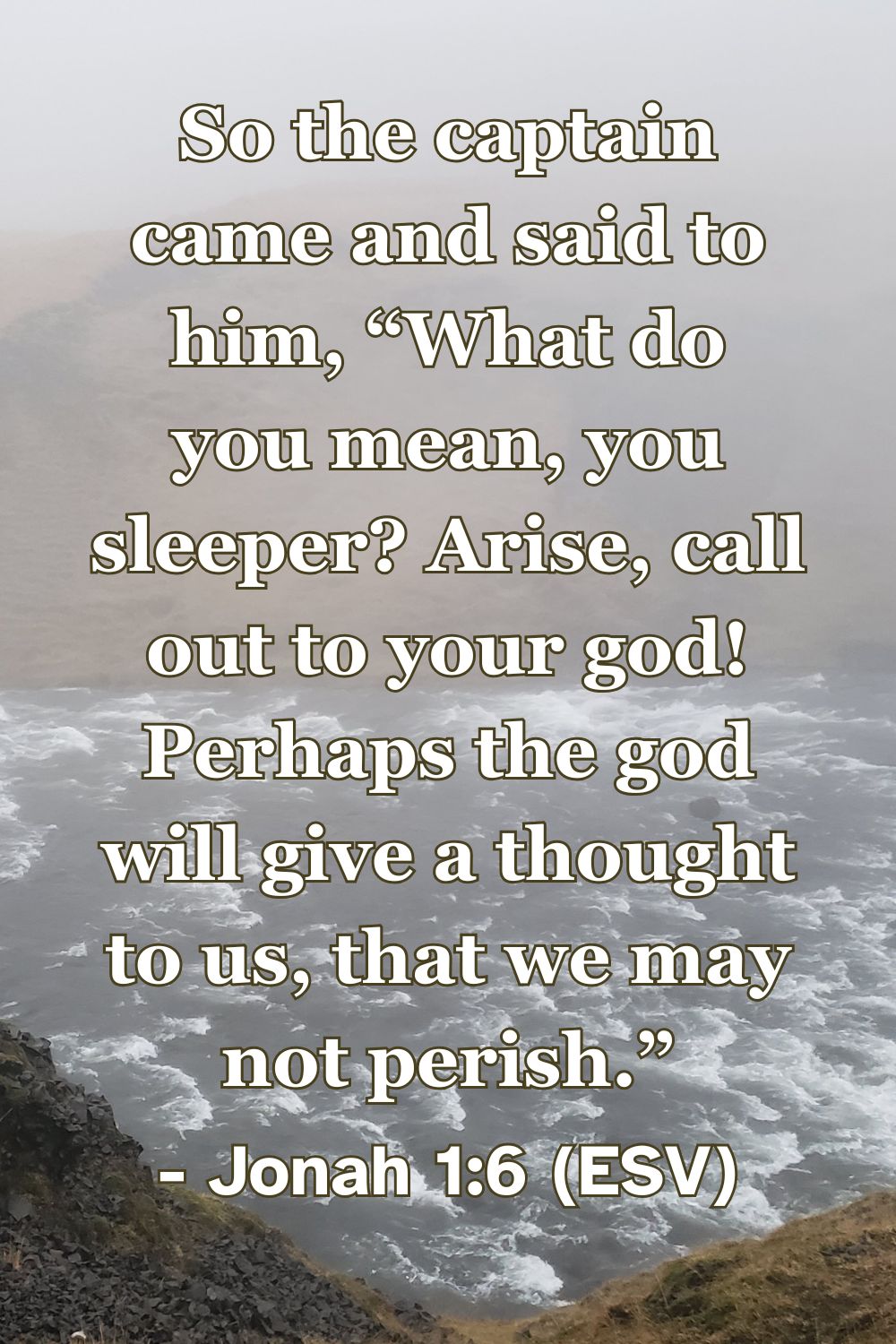
6 So the captain came and said to him, “What do you mean, you sleeper? Arise, call out to your god! Perhaps the god will give a thought to us, that we may not perish.”
Jonah 1:6 (ESV)
It echoes God’s original command in verse 2: “Arise, go to Nineveh…” Now it comes from the mouth of a pagan captain. Even unbelievers can see when something is off!
The Search for the Guilty Party
In this case, both the captain and Jonah’s fellow passengers knew that something was amiss.
7 And they said to one another, “Come, let us cast lots, that we may know on whose account this evil has come upon us.” So they cast lots, and the lot fell on Jonah.
Jonah 1:7 (ESV)
Using a common method of discerning God’s will during that time period, they cast lots, which was similar to drawing straws. The lot fell on Jonah. This was not bad luck or random misfortune; it was God’s way of revealing the source of the problem. Jonah’s situation was the direct result of running from God.
Casting lots appears in several other places in Scripture. The high priest used the Urim and Thummim to discern God’s will (Exodus 28:30), and in the New Testament, the apostles cast lots to determine who would replace Judas (Acts 1:26). Though this practice is not normative today, it shows us that God’s hand was sovereign even in methods that seem random to us.
8 Then they said to him, “Tell us on whose account this evil has come upon us. What is your occupation? And where do you come from? What is your country? And of what people are you?” 9 And he said to them, “I am a Hebrew, and I fear the Lord, the God of heaven, who made the sea and the dry land.”
Jonah 1:8-9 (ESV)
Now we see something remarkable. Jonah does not deny God. He acknowledges who God is, even calling him the maker of sea and land, as if to admit: “Yes, I know I cannot really escape him.”
But here is the irony: Jonah says he “fears the Lord,” even while running away from him. How often do we do the same? We profess our faith on Sunday but flee from obedience on Monday. We affirm that God is sovereign, yet resist his rule in our daily decisions.
When the Storm Grows Worse
10 Then the men were exceedingly afraid and said to him, “What is this that you have done!” For the men knew that he was fleeing from the presence of the Lord, because he had told them. 11 Then they said to him, “What shall we do to you, that the sea may quiet down for us?” For the sea grew more and more tempestuous. 12 He said to them, “Pick me up and hurl me into the sea; then the sea will quiet down for you, for I know it is because of me that this great tempest has come upon you.”
Jonah 1:10-12 (ESV)
When Jonah told the men to throw him overboard, it is hard to say whether Jonah was being self-sacrificial or simply giving up. Was he repentant, or resigned? Regardless, he understood that obedience, even painful obedience, was the only path to peace.
However, rather than taking the first suggestion presented to them, the sailors tried to row harder. They wanted another way. They were not eager to throw a man overboard. Like us, they tried human solutions first.
Is that not the story of our lives? We try harder. We row against God’s will with sheer determination, thinking that if we just do a bit more, if we work more, fix it ourselves, avoid confrontation, that we can make the storm stop. But effort without obedience is never enough.
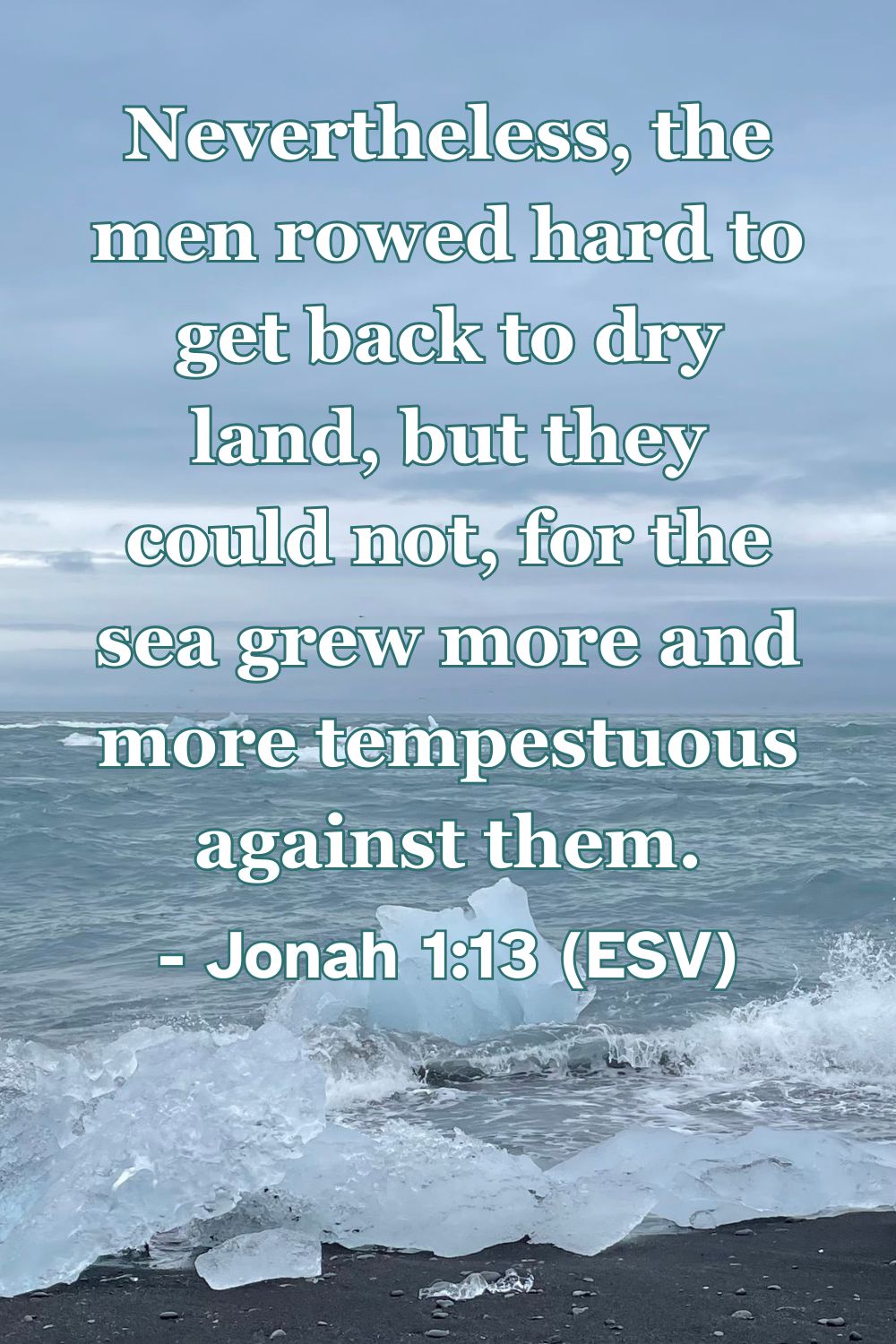
13 Nevertheless, the men rowed hard to get back to dry land, but they could not, for the sea grew more and more tempestuous against them. 14 Therefore they called out to the Lord, “O Lord, let us not perish for this man’s life, and lay not on us innocent blood, for you, O Lord, have done as it pleased you.”
Jonah 1:13-14 (ESV)
When they finally gave up and obeyed, peace came instantly. God responded to their obedience in a clear and unmistakable way. The sea grew calm. And the men feared the Lord exceedingly.
15 So they picked up Jonah and hurled him into the sea, and the sea ceased from its raging. 16 Then the men feared the Lord exceedingly, and they offered a sacrifice to the Lord and made vows.
Jonah 1:15-16 (ESV)
God’s Strange Rescue Missions
Imagine someone drowning, flailing in the water. A rescuer throws them a life preserver, but the person refuses it. They try to swim to shore on their own. That is what these sailors were doing! They tried to row to safety instead of accepting God’s appointed solution.
When we rely on our own efforts to fix spiritual problems, we often end up exhausted, frustrated, and no closer to peace. God’s way may seem drastic, but it is always effective.
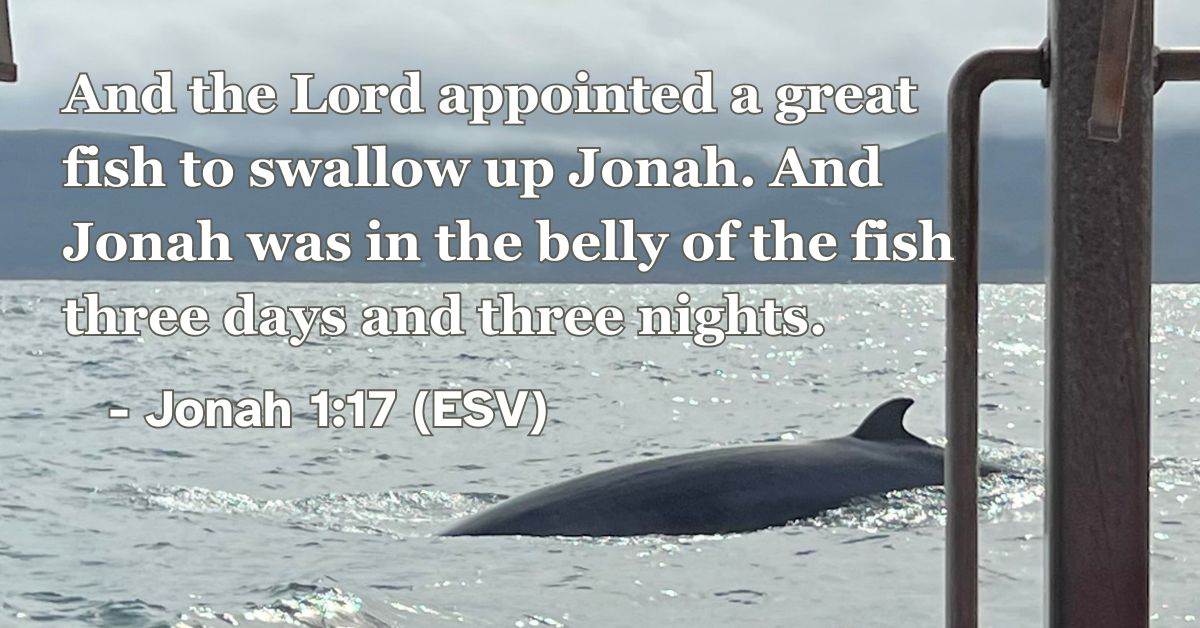
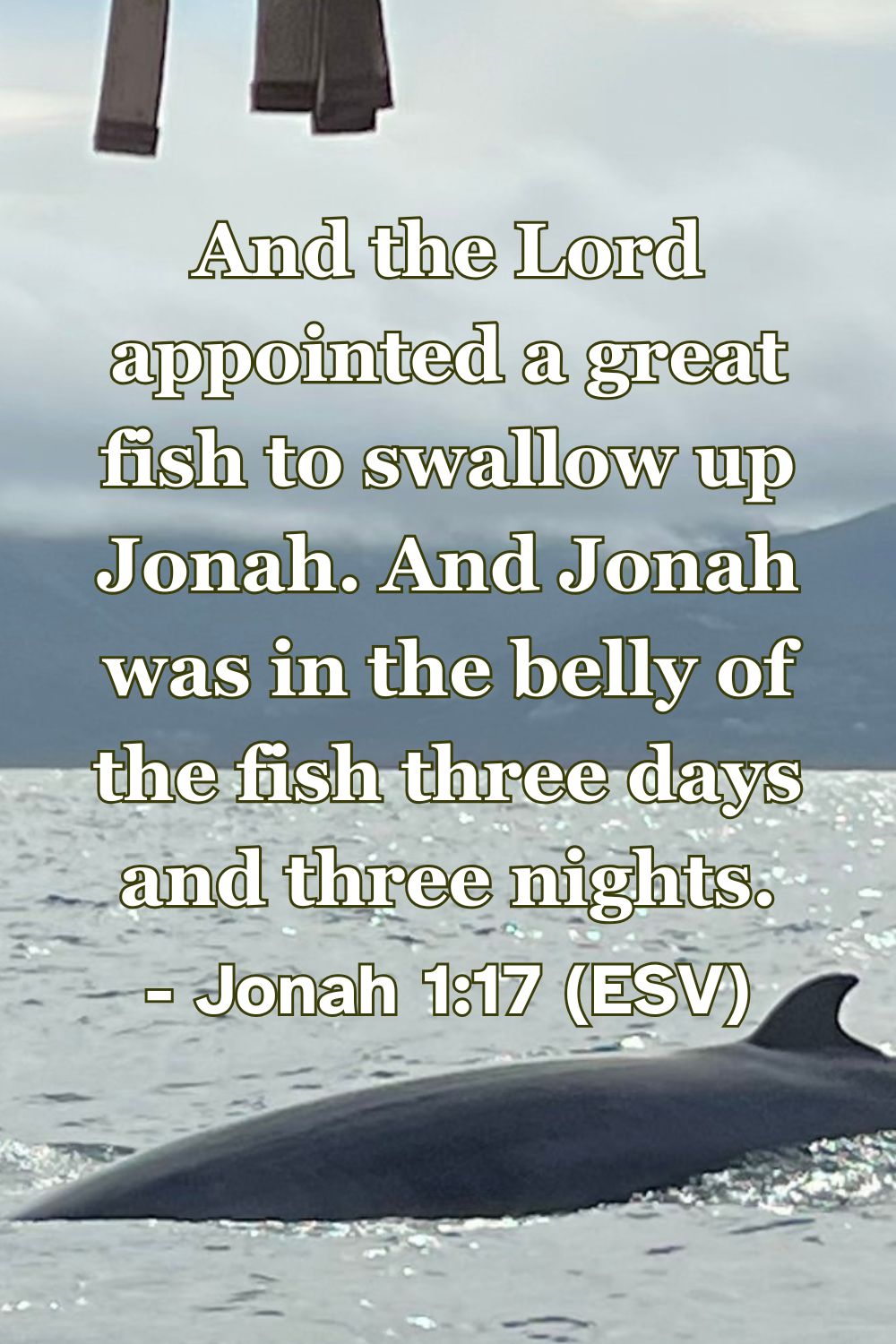
17 And the Lord appointed a great fish to swallow up Jonah. And Jonah was in the belly of the fish three days and three nights.
Jonah 1:17 (ESV)
In the end, the fish was not punishment; it was provision. Salvation in strange packaging.
Sometimes God’s deliverance comes in ways we never expected. A job loss that leads us to a healthier career. A breakup that leads to healing. A closed door that redirects us to better opportunities.
God’s provision may not always be comfortable, but it is always kind. The belly of the fish was dark, smelly, and lonely, but it was much safer than the bottom of the sea. When we are in seasons of correction, it is not because God is done with us. It is because he is not.
For Jonah, his rescue was a giant fish. Uncomfortable, yes. But life-saving.
How Does This Apply to Us?
Jonah’s story raises honest questions we all must face:
- What has God asked me to do that I am currently resisting?
- What “ship to Tarshish” have I boarded in hopes of avoiding God’s will?
- Am I asleep in the middle of a storm of my own making?
- How am I trying to solve spiritual problems with human solutions?
- What unexpected rescues might God have provided that I have overlooked?
God’s mercy does not always feel gentle. Sometimes it comes through storms, wake-up calls, and belly-of-the-fish moments. But it is always aimed at restoration.
As Christians, we believe that the greatest example of this strange mercy is the cross. Jesus took on the storm of God’s wrath, but this was for our disobedience, not his. Like Jonah, he spent three days and three nights in the heart of the earth. But unlike Jonah, he was sinless. And he rose to offer us peace with God.
A Final Word of Hope
If you find yourself running from God today, know this: you can stop running. The same God who pursued Jonah is pursuing you. This pursuit is not with condemnation, but with love. He does not give up easily. He has good purposes for your life, even if they take you to places as unlikely as Nineveh or as uncomfortable as the belly of a fish.
You do not need to fix everything before turning back. Just stop rowing in your own strength. Call out to him. Acknowledge where you have been asleep. Trust that even if the rescue looks strange, it is mercy nonetheless.
God does not abandon his people. Even through storms, ships, and sea creatures, he pursues them until they come home.
Reflective Prayer


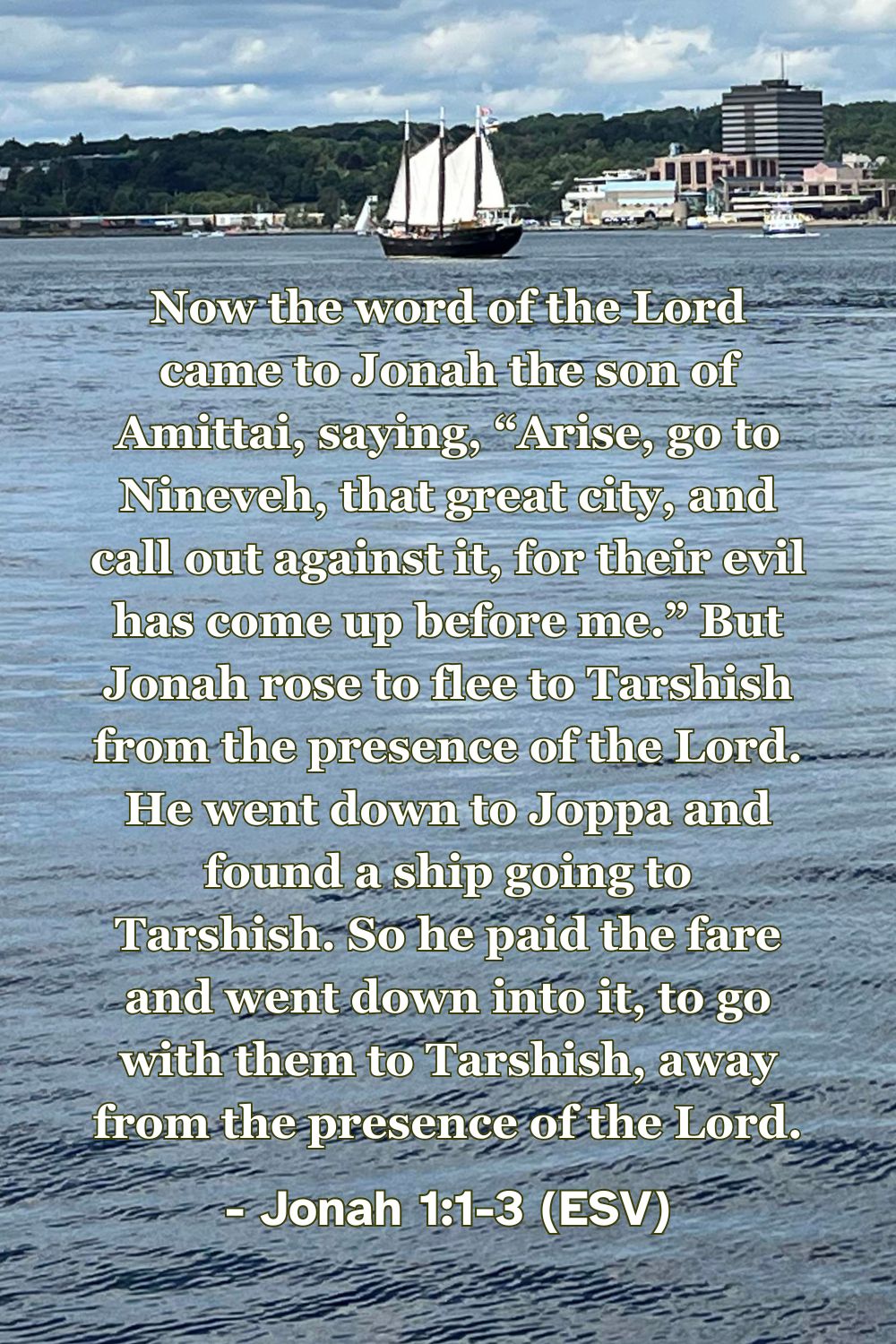
Consider using these verses to pray using the ACTS method: Adoration, Confession, Thankfulness, and Supplication:
- Adoration: Praise God. Do these verses bring any specific characteristics of God to mind?
- Confession: Tell God that you are sorry for specific sins. Do these verses bring any specific sins to mind?
- Thankfulness: Show gratitude towards God. Does anything from these verses inspire gratitude?
- Supplication: Make requests for yourself and for others. Does anything from these verses inspire a prayer?
If helpful, you can use a prayer journal template.
Subscribe
If you enjoyed this post and wish to receive more Christian content, feel free to subscribe to my newsletters!
Related Resources
Visit the Joyful Moments in Christ homepage for all posts, or scroll through other blog posts related to Jonah and obedience:




Something went wrong. Please refresh the page and/or try again.
English Standard Version (ESV): Unless otherwise noted, scripture quotations are from the ESV® Bible (The Holy Bible, English Standard Version®), © 2001 by Crossway, a publishing ministry of Good News Publishers. Used by permission. All rights reserved. The ESV text may not be quoted in any publication made available to the public by a Creative Commons license. The ESV may not be translated in whole or in part into any other language.



 Joyful Moments in Christ