Jesus the Powerful Healer and Teacher
This Sunday School lesson is intended for upper elementary students. All lessons on this website are protected by copyright, but you can use them for free in small groups or Sunday School classes. You may share a link to this page, but please do not copy these pages and put them on other websites.
The Big Idea
Jesus proclaims the good news, heals the sick, and casts out demons to reveal his divine authority and compassion.
Lesson Objectives
- Understand that Jesus has power over sickness, demons, and all creation.
- Recognize that Jesus teaches with authority because he is the Son of God.
- See how Jesus uses his power to help, heal, and restore people.
- Reflect on why Jesus came to preach the good news to all people.
Class Setting Notes
- Recommended for upper elementary Sunday School.
- Lesson length: 45–60 minutes. Can be shortened or extended based on activities selected.
Opening Activity
Power in Words
- Gather two jars: one labeled “Faith” and the other labeled “Fear.”
- Cut slips of paper and write various scenarios on them (e.g., “Sick grandma,” “Scary dream,” “Jesus heals a boy,” “Stormy night”).
- Read each slip aloud. As a group, decide whether the situation shows faith or fear. Place each slip into the corresponding jar.
- After all slips are sorted, discuss the difference between the two categories.
This activity helps introduce the idea that Jesus’ words carry power, authority, and peace—and his presence replaces fear with faith.
Bible Reading
Ask the class to read Luke 4:31–44 aloud together or have one person read it.
- Very Easy: Easy-to-Read Version: Luke 4:31-44 (ERV)
- Very Easy: New International Reader’s Version: Luke 4:31-44 (NIRV)
- Easy: Good News Translation: Luke 4:31-44 (GNT)
- Medium: New Living Translation: Luke 4:31-44 (NLT)
- Hard: New International Version: Luke 4:31-44 (NIV)
- Very Hard: English Standard Version: Luke 4:31-44 (ESV)
Additional Reading: Choosing the Right Bible Translation
Suggested prompts:
As the class reads aloud, consider asking some of these prompts:
- What do you notice about how people respond to Jesus’ teaching?
- How does Jesus deal with sickness and evil spirits?
- What does this passage tell us about why Jesus came?
Teacher Background Notes
- Capernaum was a key town in Jesus’ early ministry, located in Galilee near the Sea of Galilee.
- Synagogues were central to Jewish community life—used for worship and teaching.
- Authority in Jewish teaching was traditionally based on citing rabbis or Scripture. Jesus’ authority came from himself.
- Jewish understanding of demons included unclean spirits opposed to God’s purposes.
- Jesus’ healing ministry not only demonstrated compassion but confirmed his identity as the promised Messiah.
- The “Kingdom of God” refers to God’s sovereign reign and redemptive presence among his people—present now through Christ, and fully realized in eternity.
- Jesus withdrew to pray regularly, modeling communion with the Father amid active ministry.
Theological Insights
- Jesus teaches with divine authority, not as a mere man or prophet.
- Demons recognize Jesus as the Holy One of God, yet Jesus silences them, showing he controls the message of his identity.
- Jesus heals to show his power, compassion, and mission to restore what is broken by sin.
- Jesus’ mission is not limited to one town or group; he was sent to proclaim the gospel to all.
- The Kingdom of God is both already present in Jesus and still coming in fullness.
Discussion Questions
Understanding the Text
- Where did Jesus go to teach? What day was it?
- How did the people respond to Jesus’ teaching?
- What happened when Jesus spoke to the demon?
- What did Jesus do at Simon’s house?
- Why did Jesus leave town the next morning?
Personal Reflection and Application
- How does it make you feel to know that Jesus has power over sickness and evil?
- When have you needed Jesus’ help in your own life?
- Why do you think Jesus made time to be alone and pray?
- How can you share the good news of Jesus with someone this week?
Suggested Activities
Jesus’ Power Storyboard
- Provide students with blank paper divided into four sections.
- Have them draw scenes from today’s lesson: (1) Jesus teaching, (2) healing the man with the demon, (3) healing Simon’s mother-in-law, (4) leaving to preach in other towns.
- Ask students to explain what Jesus did in each scene.
This activity reinforces key events in the story and highlights Jesus’ power in action.
Healing Hands Craft
- Trace each child’s hand on paper and cut it out.
- On each finger, have students write someone who needs Jesus’ healing or help (someone who is sick, lonely, scared, etc.).
- On the palm, write: “Jesus heals and helps with love.”
- Close with prayer over those listed.
This activity encourages children to think of others and connect prayer with Jesus’ healing power.
Role Play and Freeze
- Assign simple roles (Jesus, man with demon, crowd, Simon’s family).
- Read sections of Luke 4:31–44 aloud as the children act out the scene. At key moments, freeze the scene and ask: “What is Jesus doing here?” “How do the people feel?” “What would you say if you were in this story?”
This activity helps students engage emotionally and imaginatively with the passage.
Memory Verse
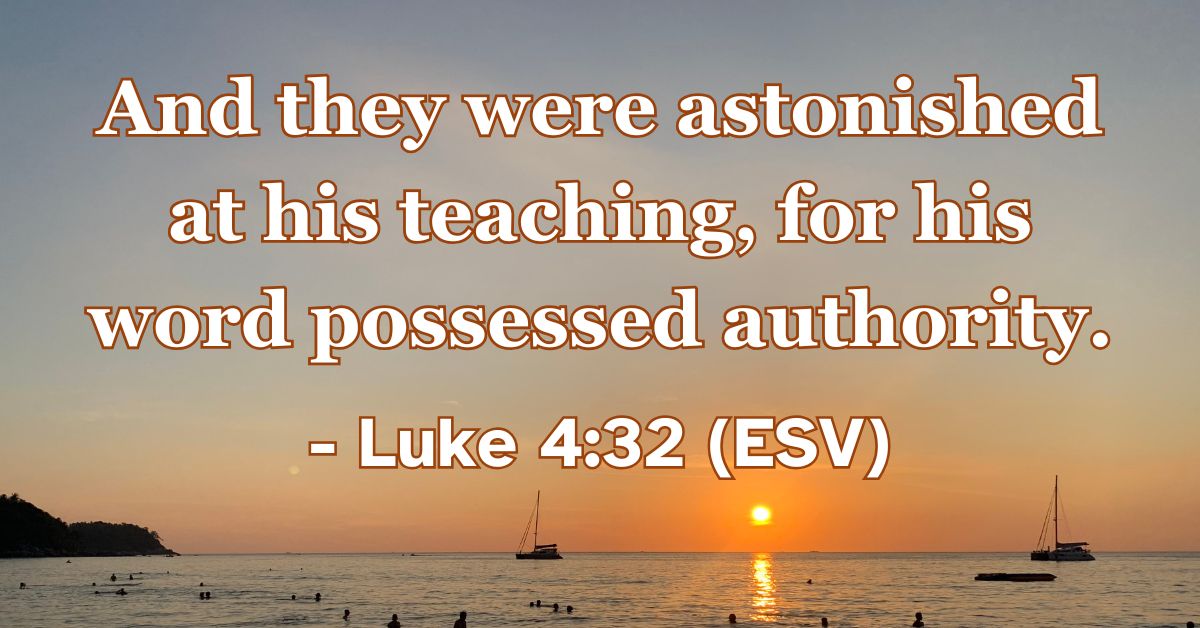
And they were astonished at his teaching, for his word possessed authority.
Luke 4:32 (ESV)
Closing Prayer
Father,
Thank you for sending Jesus to teach us and show us your power and love. Help us to trust him when we are afraid, to come to him when we are hurting, and to share his good news with others.
In Jesus’ name we pray. Amen.
The ESL Version
I also create materials for adult English Language Learners (ELLs) and ESL students. You can find my ELL Bible Studies based on Luke 4:31–44 here:
- ELL Bible Study: Luke 4:31-37 — Jesus Heals a Man
- ELL Bible Study: Luke 4:38-41 — Jesus Heals Many People
- ELL Bible Study: Luke 4:42-44 — Jesus Preaches the Good News
Subscribe
If you enjoyed this post and wish to receive more Christian content, consider subscribing to my newsletters!
Related Resources
Visit the Joyful Moments in Christ homepage for all posts, or scroll through other blog posts related to Sunday School:
Something went wrong. Please refresh the page and/or try again.
English Standard Version (ESV): Unless otherwise noted, scripture quotations are from the ESV® Bible (The Holy Bible, English Standard Version®), © 2001 by Crossway, a publishing ministry of Good News Publishers. Used by permission. All rights reserved. The ESV text may not be quoted in any publication made available to the public by a Creative Commons license. The ESV may not be translated in whole or in part into any other language.

 Joyful Moments in Christ