
In the letter to the Philippians, Paul presents a powerful blueprint for cultivating a mindset that mirrors Christ’s own. As he encourages the believers to embrace humility, unity, and love, Paul urges them to look beyond their own interests and consider the needs of others. His words challenge us to examine not just our actions, but the attitudes that shape those actions, calling us to live in a way that reflects the gospel in every area of our lives. The verses in this post highlight key aspects of the Christian life that Paul emphasized, encouraging us to focus on humility, selflessness, and a mindset centered on Christ.
These principles are not just ideals but practical applications that influence how we live day-to-day. From cultivating love that abounds in knowledge and discernment, to striving toward unity in the faith, Paul provides a vision for a life marked by spiritual maturity and Christlike humility. As we reflect on these verses, we are invited to adopt the mindset of Christ and to live in such a way that our actions align with the gospel we profess. This collection of Bible verses from Philippians offers both guidance and conviction for anyone seeking to live a life worthy of the calling they have received in Christ.
Abounding Love and Discernment
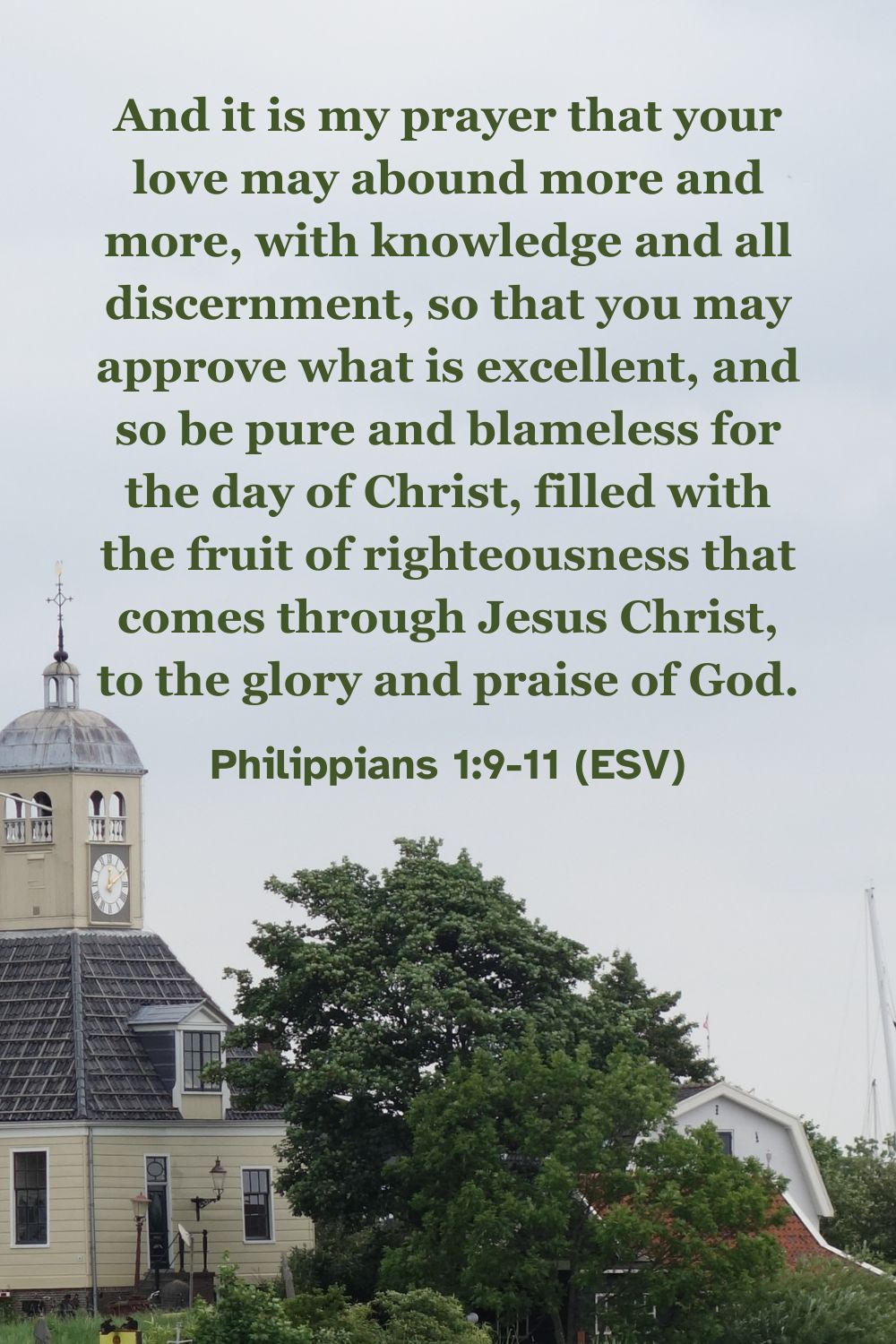
And it is my prayer that your love may abound more and more, with knowledge and all discernment, so that you may approve what is excellent, and so be pure and blameless for the day of Christ, filled with the fruit of righteousness that comes through Jesus Christ, to the glory and praise of God.
Philippians 1:9-11 (ESV)
Paul’s prayer for the Philippians focuses on a love that grows in both depth and understanding. He desires that their love is not just emotional but rooted in wisdom and discernment. The surrounding context emphasizes that love, when paired with knowledge, leads to purity and blamelessness. This isn’t just about loving others—it’s about discerning what is best for them and living with integrity as we wait for Christ’s return.
This love is meant to be practical, guiding believers toward the righteousness that reflects Christ. As we cultivate this kind of love, we are challenged to examine the depth of our relationships—are we loving with wisdom and discernment, or just feeling good emotions? Our love must be directed toward what is excellent, reflecting God’s standards, not just our own desires. This verse reminds us that love should lead to spiritual maturity and a life that honors God.
Reflection question: How can you make sure that your love for others is rooted in wisdom and discernment?
Practical Application: Reflect on your relationships and pray for the ability to love others wisely, seeking what is best for them.
Living Worthy of the Gospel
Only let your manner of life be worthy of the gospel of Christ, so that whether I come and see you or am absent, I may hear of you that you are standing firm in one spirit, with one mind striving side by side for the faith of the gospel.
Philippians 1:27 (ESV)
Paul calls the Philippians to live in a way that reflects the gospel in all circumstances. The larger context of Philippians reveals that the gospel is not just a set of beliefs, but a truth that transforms the way we live. Paul is concerned with the Philippians’ conduct, urging them to live in a manner worthy of their calling as followers of Christ, united in purpose and steadfast in faith.
This call challenges us to examine our own lives. Are our actions worthy of the gospel we claim to believe? Are we united in purpose with other believers, striving together to advance the gospel? Paul encourages the Philippians to live with integrity and unity, whether he is present or not. As we reflect on this passage, we are reminded that our witness is not just in our words but in how we live and work together as the body of Christ.
Reflection question: How does your life reflect the gospel in your everyday actions?
Practical Application: Look for opportunities to support your fellow believers in their faith and unite in purpose for the gospel.
Humility and Selflessness

Do nothing from selfish ambition or conceit, but in humility count others more significant than yourselves. Let each of you look not only to his own interests, but also to the interests of others.
Philippians 2:3-4 (ESV)
In this passage, Paul urges the Philippians to live with an attitude of humility and selflessness. The surrounding verses focus on how Christ demonstrated humility through his incarnation and sacrifice, so Paul challenges believers to follow Jesus’ example. These verses specifically warn against selfish ambition and encourage believers to prioritize the needs of others. The broader context emphasizes that unity in the church comes through mutual humility.
This teaching directly confronts our natural tendency toward self-interest and pride. It asks us to reflect on how we view others—do we elevate ourselves and dismiss their needs, or do we genuinely consider their interests as more important than our own? By following Christ’s example of self-giving love, we can foster stronger unity and deeper relationships within the body of Christ.
Reflection question: In what areas of your life do you struggle with selfish ambition, and how can you shift toward a mindset of humility?
Practical Application: Look for opportunities to serve someone this week, focusing on their needs rather than your own.
The Mind of Christ
Have this mind among yourselves, which is yours in Christ Jesus.
Philippians 2:5 (ESV)
In this verse, Paul calls believers to adopt the mindset of Christ. In the subsequent verses, he explains the humility of Christ, who, though in the form of God, did not cling to his divine privileges but emptied himself for the sake of humanity. The context is clear—Paul urges the Philippians to imitate Christ’s self-sacrificial attitude, which should shape the way they treat one another.
This verse serves as a reminder that our thinking must be transformed to mirror Christ’s thinking. The humility and selflessness of Christ should characterize our relationships and actions. It’s easy to be caught up in worldly values like success, power, and recognition, but the mindset of Christ calls us to prioritize others and live for God’s glory. This transformation is possible only by the grace of God, and Paul reminds the Philippians—and us—that we already have the mind of Christ through the Holy Spirit.
Reflection question: How can you cultivate the mind of Christ in your relationships with others?
Practical Application: Take time to reflect on your attitudes and ask God to transform your thinking to be more like Christ’s.
Christ’s Humility and Obedience
Who, though he was in the form of God, did not count equality with God a thing to be grasped, but emptied himself, by taking the form of a servant… he humbled himself by becoming obedient to the point of death, even death on a cross.
Philippians 2:6-8 (ESV)
In these verses, Paul emphasizes the ultimate act of humility demonstrated by Christ. Although Jesus was fully God, he did not cling to his divine privileges but chose to humble himself, even to the point of death on a cross. This self-emptying (kenosis) is the core of the Christian gospel—Jesus willingly gave up his divine rights to serve humanity. The surrounding context highlights how this humility is the model for how we should live.
Christ’s humility isn’t just an example; it is the foundation of our salvation. He became a servant and suffered for our sake. This radical humility challenges us to reflect on how we approach service and obedience. Are we willing to give up our rights and comforts to follow God’s call, even when it costs us? This passage calls us to live humbly and to serve others selflessly, as Christ did for us.
Reflection question: How can you follow Christ’s example of humility in your daily life?
Practical Application: Reflect on areas where you are holding onto your rights or privileges and ask God to help you serve others selflessly.
Living Without Complaints

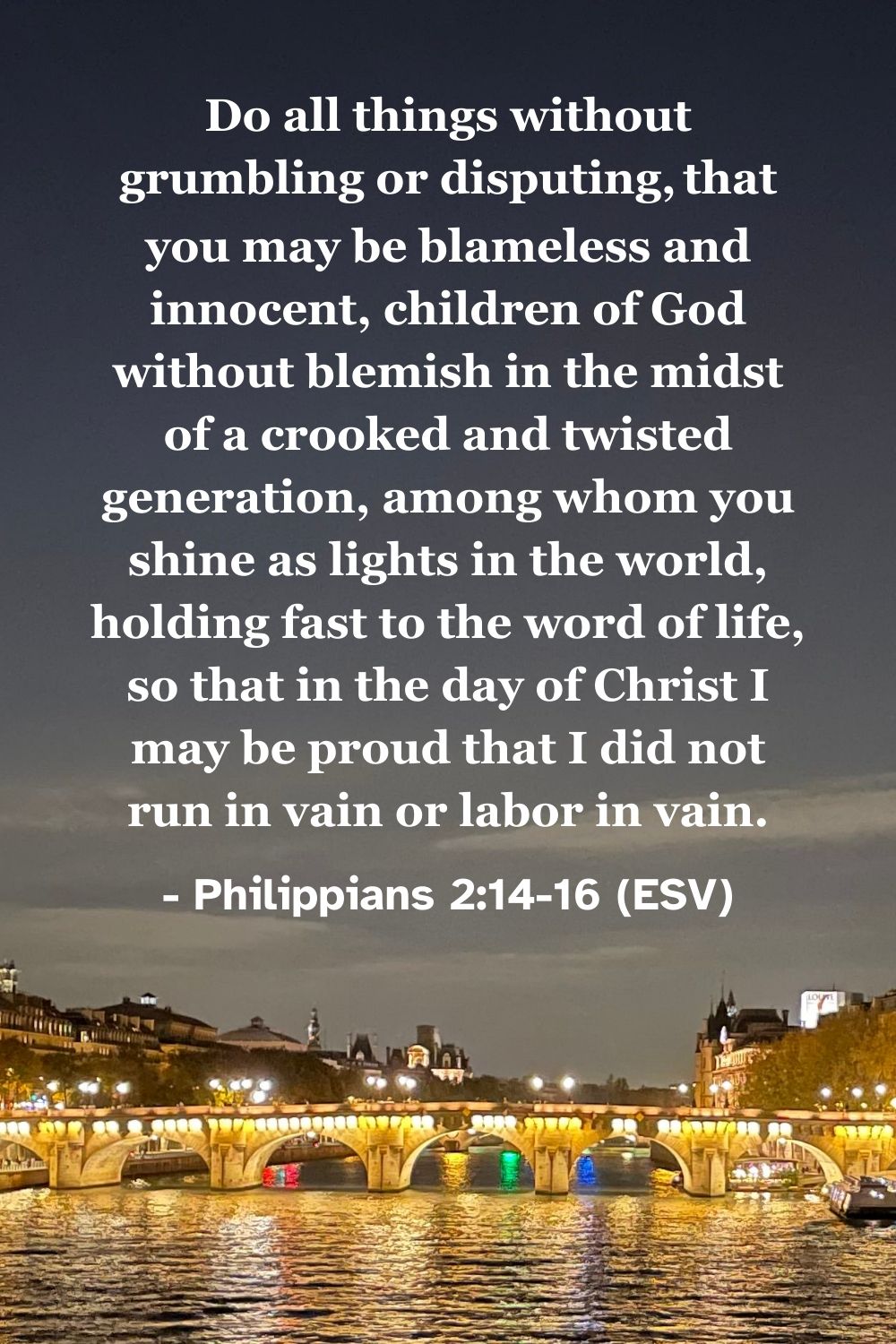
Do all things without grumbling or disputing, that you may be blameless and innocent, children of God without blemish in the midst of a crooked and twisted generation, among whom you shine as lights in the world, holding fast to the word of life, so that in the day of Christ I may be proud that I did not run in vain or labor in vain.
Philippians 2:14-16 (ESV)
Paul’s command to live without complaining comes in the context of a life transformed by the gospel. In the preceding verses, he encourages the Philippians to live in humility and obedience, and here, he emphasizes that even in difficult circumstances, they should maintain a spirit of gratitude. The larger context speaks to the importance of living as a witness to the world, and a grumbling spirit contradicts that witness.
This passage speaks to the way we respond to life’s challenges. Complaints and disputes often reveal a heart that is not content with God’s provisions. Paul calls believers to shine as lights in the world by living blameless lives, characterized by peace and joy in the midst of difficulty. This isn’t just about avoiding complaints; it’s about cultivating a heart that trusts God’s sovereignty in all things, reflecting his goodness and peace to a watching world.
Reflection question: In what situations do you tend to complain, and how can you replace that with gratitude?
Practical Application: When you feel tempted to grumble or argue, pause and reflect on God’s faithfulness and choose to respond with a spirit of gratitude.
Counting All as Loss for Christ


But whatever gain I had, I counted as loss for the sake of Christ. Indeed, I count everything as loss because of the surpassing worth of knowing Christ Jesus my Lord.
Philippians 3:7-8a (ESV)
Paul’s declaration that he counts all his previous achievements and status as loss reveals the radical transformation the gospel brings. In the context of Philippians 3, Paul contrasts his former life as a Pharisee—full of religious accolades and worldly accomplishments—with the surpassing worth of knowing Christ. He recognizes that everything else pales in comparison to the joy of being united with Christ.
This passage calls us to examine what we value. Are there things in our lives—achievements, possessions, or relationships—that we hold more dearly than Christ? Paul’s words remind us that following Christ often requires us to let go of worldly ambitions and to reorient our lives around him. When we truly understand the value of knowing Christ, everything else fades into insignificance.
Reflection question: What things might you be holding onto that are hindering your full devotion to Christ?
Practical Application: Spend time reflecting on your priorities and ask God to help you value Christ above all else.
Pressing On Toward the Goal
Not that I have already obtained this or am already perfect, but I press on to make it my own, because Christ Jesus has made me his own. Brothers, I do not consider that I have made it my own. But one thing I do: forgetting what lies behind and straining forward to what lies ahead, I press on toward the goal for the prize of the upward call of God in Christ Jesus.
Philippians 3:12-14 (ESV)
Paul’s words here reflect his relentless pursuit of Christlikeness, despite his recognition that he has not yet attained perfection. The context leading up to this passage emphasizes Paul’s radical shift in priorities, as he counts his past accomplishments as loss in comparison to knowing Christ. Paul’s focus is on the future goal—being fully conformed to Christ, which is the ultimate prize.
This passage speaks to the ongoing journey of sanctification in the Christian life. Even though we may have setbacks or past failures, we are called to press forward toward the goal of spiritual maturity. The key here is forgetting what lies behind and focusing on the future with an unwavering determination to live for Christ. This attitude should inspire us to keep going in our faith, trusting that God will continue his work in us.
Reflection question: How can you move forward in your faith, forgetting past mistakes and focusing on what God has ahead for you?
Practical Application: Commit to taking one step forward in your spiritual growth this week, no matter how small.
Reasonableness in Christ

Let your reasonableness be known to everyone. The Lord is at hand.
Philippians 4:5 (ESV)
In this verse, Paul encourages the Philippians to exhibit reasonableness in their dealings with others, a characteristic that reflects Christ’s own attitude. The context points to the need for peace, unity, and patience within the body of Christ, particularly as believers face struggles. The reminder that “the Lord is at hand” urges a sense of urgency in living out these virtues, knowing that Christ’s return is imminent.
This command speaks to how we treat others in everyday situations. It challenges us to be gentle, considerate, and forgiving, especially when we’re under pressure. Reflecting Christ’s gentleness in our lives will demonstrate his presence and peace to the world.
Reflection question: How can you be more gentle or reasonable in your interactions today, knowing that the Lord is near?
Practical Application: In a stressful situation this week, pause and respond with gentleness, showing Christ’s love and peace.
Thinking on What is Excellent
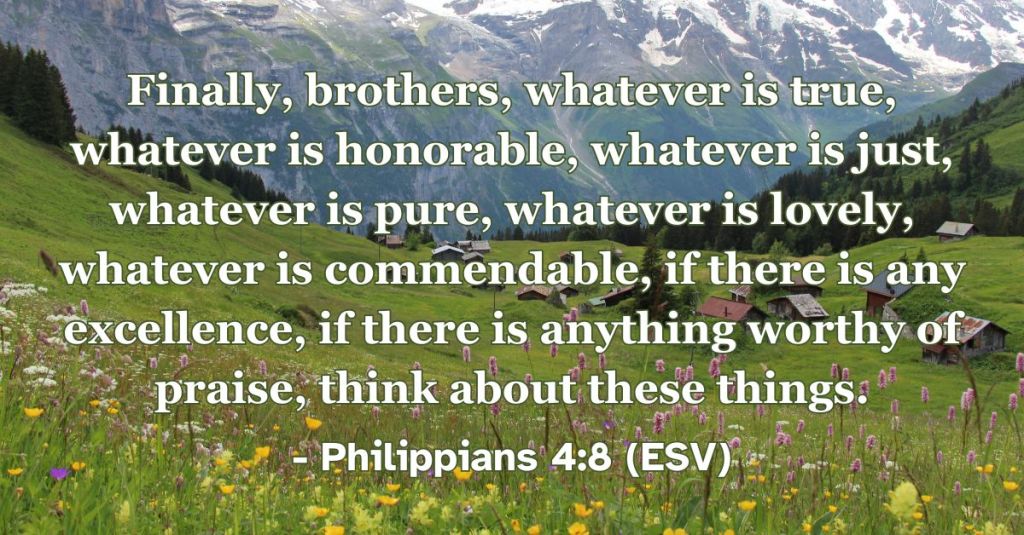
Finally, brothers, whatever is true, whatever is honorable, whatever is just, whatever is pure, whatever is lovely, whatever is commendable, if there is any excellence, if there is anything worthy of praise, think about these things.
Philippians 4:8 (ESV)
Paul ends his instructions to the Philippians by directing their focus toward what is virtuous. He lists qualities that reflect the character of God, urging them to fix their thoughts on these virtues rather than on negative or sinful thoughts. The broader context emphasizes the importance of peace and contentment, and Paul connects the Philippians’ thought life with their ability to experience the peace of God.
This verse calls us to cultivate a mindset focused on what is good, true, and holy. In a world full of distractions and negativity, we are challenged to choose where we place our attention. By filling our minds with the things of God, we are equipped to live out his peace and holiness in our daily lives.
Reflection question: Which of these virtues do you find most challenging to focus on, and why?
Practical Application: Set aside time this week to reflect on these qualities and evaluate how they can shape your thoughts and actions.
Final Thoughts
The call to cultivate the mindset of Christ is not just for the Philippians of Paul’s day—it is for every believer who seeks to follow Christ. The teachings in Philippians challenge us to examine our hearts and our relationships, urging us to live in humility, love, and unity. As we seek to embody the mind of Christ in our daily lives, we are reminded that this transformation is only possible through the work of the Holy Spirit. Our journey toward spiritual maturity is not without its struggles, but Paul’s words offer encouragement that, with God’s help, we can press on toward the goal. May we continue to grow in love and discernment, striving together for the gospel, and reflecting Christ in all we do.
Reflective Prayer
Consider using these verses to pray using the ACTS method: Adoration, Confession, Thankfulness, and Supplication:
- Adoration: Praise God. Do these verses bring any specific characteristics of God to mind?
- Confession: Tell God that you are sorry for specific sins. Do these verses bring any specific sins to mind?
- Thankfulness: Show gratitude towards God. Does anything from these verses inspire gratitude?
- Supplication: Make requests for yourself and for others. Does anything from these verses inspire a prayer?
If helpful, you can use a prayer journal template.


Subscribe
If you enjoyed this post and wish to receive more Christian content, feel free to subscribe to my newsletters!
Related Resources
Visit the Joyful Moments in Christ homepage for all posts, or scroll through other blog posts related to Philippians:








Something went wrong. Please refresh the page and/or try again.
English Standard Version (ESV): Unless otherwise noted, scripture quotations are from the ESV® Bible (The Holy Bible, English Standard Version®), © 2001 by Crossway, a publishing ministry of Good News Publishers. Used by permission. All rights reserved. The ESV text may not be quoted in any publication made available to the public by a Creative Commons license. The ESV may not be translated in whole or in part into any other language.



 Joyful Moments in Christ