God’s Promises Are Greater Than Our Fears
This Sunday School lesson is intended for upper elementary students. All lessons on this website are protected by copyright, but you can use them for free in small groups or Sunday School classes. You may share a link to this page, but please do not copy these pages and put them on other websites.
The Big Idea
God calls his people to trust him, even when his plans seem impossible.
Lesson Objectives
- Understand that God sent the angel Gabriel to announce the birth of Jesus.
- Recognize that Jesus is the promised Son of God and forever king.
- See how Mary responded with humble trust and obedience.
- Reflect on how we can trust God when we feel afraid or unsure.
- Learn that nothing is impossible with God.
Class Setting Notes
- Recommended for upper elementary Sunday School.
- Lesson length: 35–45 minutes. Can be shortened or extended based on activities selected.
Opening Activity
“Surprising News” Reaction Game
- Write short “surprising announcements” on slips of paper (e.g., “You just won a trip to space!” or “Your favorite animal can talk!”).
- Let each student pick one and act out how they would react—without using words.
- Other students guess what the news might be.
- Repeat with a few rounds to build energy and laughter.
This activity helps introduce the idea of receiving unexpected news and sets the stage for Mary’s surprising encounter with the angel.
Bible Reading
Ask the class to read Luke 1:26-38 aloud together or have one person read it. You may want to read it slowly more than once.
- Very Easy: Easy-to-Read Version: Luke 1:26–38 (ERV)
- Very Easy: New International Reader’s Version: Luke 1:26–38 (NIRV)
- Easy: Good News Translation: Luke 1:26–38 (GNT)
- Medium: New Living Translation: Luke 1:26–38 (NLT)
- Hard: New International Version: Luke 1:26–38 (NIV)
- Very Hard: English Standard Version: Luke 1:26–38 (ESV)
Additional Reading: Choosing the Right Bible Translation
Suggested prompts:
As the class reads aloud, consider asking some of these prompts:
- What do you notice about how the angel speaks to Mary?
- How does Mary respond to what the angel says?
- What does this passage teach us about who Jesus is?
- Why do you think the angel reminds Mary about Elizabeth?
- What is one word you would use to describe Mary’s response?
Teacher Background Notes
- This event takes place during the sixth month of Elizabeth’s pregnancy with John the Baptist.
- Mary lived in Nazareth, a small and humble village in Galilee, and was engaged to Joseph, a descendant of King David.
- The angel Gabriel had already appeared to Zechariah (Luke 1:11–20) and now brings God’s message to Mary.
- The announcement affirms Jesus as the fulfillment of God’s covenant promises, especially the promise to David of an eternal king (2 Samuel 7).
- Mary’s virginity and her question highlight the miraculous nature of Jesus’ conception through the Holy Spirit.
- Gabriel reminds Mary that God is already doing the impossible—her relative Elizabeth is pregnant in old age.
- Mary’s final response, “I am the Lord’s servant,” models humble submission to God’s will, even without full understanding.
Theological Insights
- God’s plans often involve ordinary people, like Mary, to accomplish extraordinary purposes.
- Jesus is the Son of the Most High and the eternal King promised in Scripture.
- The virgin birth points to Jesus’ divine nature and fulfillment of prophecy (Isaiah 7:14).
- God’s power makes all things possible, even when they seem humanly impossible.
- Mary’s response is an example of faithful trust and surrender to God’s will.
- God shows grace to the humble and uses them to fulfill his redemptive purposes.
Discussion Questions
Understanding the Text
- Who sent the angel Gabriel, and where did he go?
- What message did the angel give Mary?
- How did Mary respond to the angel’s greeting and message?
- What name did Gabriel say to give the baby, and what would he become?
- Why did Mary ask how this could happen?
- How did Gabriel explain what God would do through the Holy Spirit?
- What example did the angel give to help Mary trust God’s power?
- What did Mary say at the end of the story?
Personal Reflection and Application
- How do you think Mary felt when she heard this news?
- When have you felt unsure or afraid about something in your life?
- What helps you trust God when his plans feel confusing?
- How can you be like Mary in saying “yes” to God?
- Who can you encourage this week by sharing what you learned?
Suggested Activities
Angel Visit Art
- Provide students with paper and drawing materials.
- Invite them to draw a picture of the angel visiting Mary, including Mary’s expression and the setting.
- Let students explain what they drew and why.
This activity gives students a chance to reflect visually on the wonder and emotion of this moment in God’s plan.
Faith vs. Fear Object Lesson
- Prepare two clear jars or containers and label one “Faith” and the other “Fear.”
- Give each student two slips of paper and a pencil.
- Ask students to quietly think of something in their life that makes them feel afraid, worried, or unsure—something they have a hard time trusting God with.
- On one slip, have them write that situation or fear (they may keep it general if they prefer).
- Then, invite students to think about how they could respond with trust in God instead. On the second slip, have them write a short sentence or phrase that shows a faithful response (e.g., “I will pray and wait,” “God is in control,” or “I can trust God even when I do not understand”).
- One at a time, students will walk to the jars. They will place the fear-related slip in the “Fear” jar and the trust-related slip in the “Faith” jar.
This activity helps students reflect on their personal fears and intentionally choose to respond with faith in God, just as Mary did when she trusted God’s word through the angel.
Trust Statement Craft
- Give students paper strips or cardstock.
- Have them write Mary’s words: “I am the Lord’s servant; may it happen to me as you have said.”
- Let them decorate and take it home as a reminder of what trusting God looks like.
This activity helps students remember Mary’s humble response and apply it to their own lives.
Memory Verse
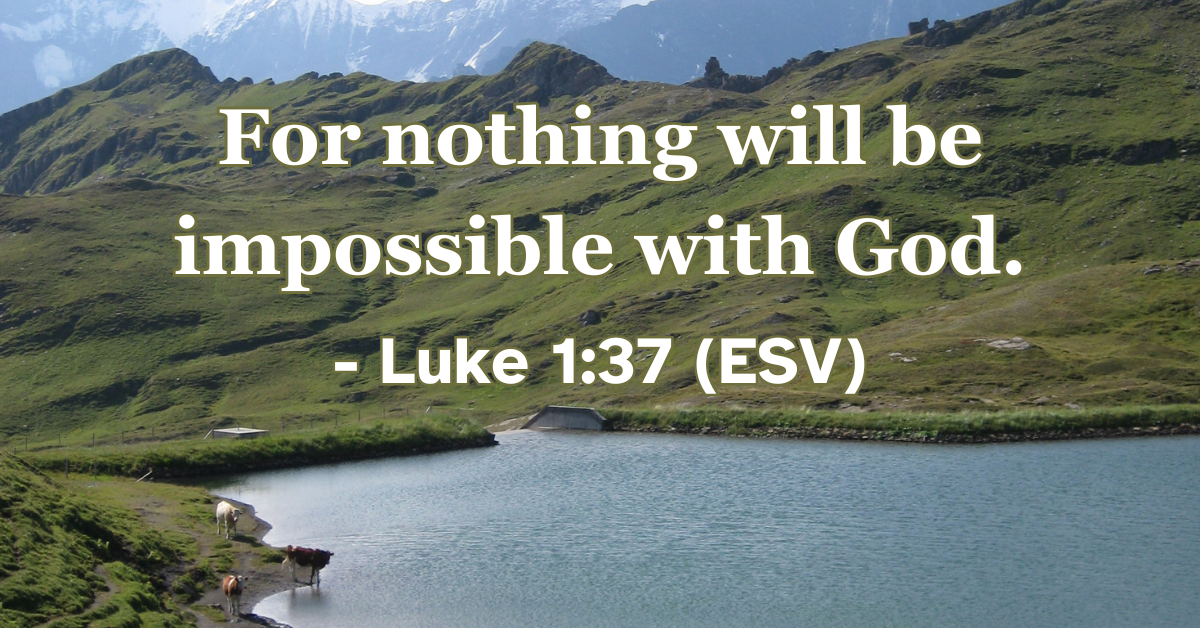
For nothing will be impossible with God.
Luke 1:37 (ESV)
Closing Prayer
Father,
Thank you for showing your grace to Mary and for sending your Son, Jesus. Help us to trust you like Mary did, especially when we feel afraid or confused. Teach us to say “yes” to your plans and believe that nothing is too hard for you.
In Jesus’ name we pray. Amen.

The ESL Version
I also create materials for adult English Language Learners (ELLs) and ESL students. You can find my ELL Bible Study on Luke 1:26-38 here:
ELL Bible Study: Luke 1:26-38 — God’s Message to Mary
Subscribe
If you enjoyed this post and wish to receive more Christian content, consider subscribing to my newsletters!
Related Resources
Visit the Joyful Moments in Christ homepage for all posts, or scroll through other blog posts related to Sunday School:
Something went wrong. Please refresh the page and/or try again.
English Standard Version (ESV): Unless otherwise noted, scripture quotations are from the ESV® Bible (The Holy Bible, English Standard Version®), © 2001 by Crossway, a publishing ministry of Good News Publishers. Used by permission. All rights reserved. The ESV text may not be quoted in any publication made available to the public by a Creative Commons license. The ESV may not be translated in whole or in part into any other language.


 Joyful Moments in Christ