Luke’s Purpose for Writing: Why the Story Matters
This Sunday School lesson is intended for upper elementary students. All lessons on this website are protected by copyright, but you can use them for free in small groups or Sunday School classes. You may share a link to this page, but please do not copy these pages and put them on other websites.
The Big Idea
Luke wrote his Gospel so that believers might know with certainty the truth about Jesus Christ.
Lesson Objectives
- Understand Luke’s purpose in writing the Gospel
- Appreciate the role of eyewitnesses in preserving Jesus’ life and teaching
- Grow in confidence that Scripture is reliable and God-breathed
Class Setting Notes
- Recommended for upper elementary Sunday School
- Lesson length: 30–45 minutes. Can be shortened or extended based on activities selected.
Opening Activity
Memory Story Game
- Invite students to play a short game of telephone—whisper a simple sentence from one person to the next and see how it changes.
- Then ask, “Why do you think details matter when we share stories?”
- Follow up by asking, “Can you remember a time someone told you an important family story? What made it memorable or meaningful?”
This activity helps introduce the idea that Luke wanted to preserve the truth about Jesus clearly and carefully.
Bible Reading
Ask the class to read Luke 1:1–4 aloud together or have one person read it. You may want to read it slowly more than once. Encourage students to listen for how Luke describes his process of writing and why he did it.
- Very Easy: Easy-to-Read Version: Luke 1:1-4 (ERV)
- Very Easy: New International Reader’s Version: Luke 1:1-4 (NIRV)
- Easy: Good News Translation: Luke 1:1-4 (GNT)
- Medium: New Living Translation: Luke 1:1-4 (NLT)
- Hard: New International Version: Luke 1:1-4 (NIV)
- Very Hard: English Standard Version: Luke 1:1-4 (ESV)
Additional Reading: Choosing the Right Bible Translation
Suggested prompts:
- Who is Luke writing to?
- What is his goal?
- What do you notice about the words “carefully,” “orderly,” or “eyewitness”?
Teacher Background Notes
- Luke was a physician and a close companion of the apostle Paul.
- He was not one of Jesus’ twelve disciples.
- He gathered his information from eyewitnesses and those who ministered the word.
- Luke is the author of both the Gospel of Luke and the book of Acts.
- Theophilus, whose name means “friend of God,” may have been a Roman official, a patron of Luke’s writing, or a newer believer seeking clarity.
- Luke’s introduction shows that he took great care in presenting an accurate, well-ordered account of Jesus’ life and ministry.
- This passage reminds us that the Christian faith is based on historical truth, not speculation.
Theological Insights
- God desires that his people know the truth, not guess at it.
- The Gospel is not based on myth, imagination, or tradition—it is grounded in historical fact.
- Luke’s Gospel is based on eyewitness testimony and careful investigation.
- Scripture is both fully human and fully divine, written by men but inspired by God.
- Because of this, Christians can have deep confidence in what the Bible teaches about Jesus.
- God’s Word is not only true—it is good, reliable, and given for our certainty and growth.
Discussion Questions
Understanding the Text
- Why does Luke explain his purpose for writing?
- What does this introduction tell us about Luke’s character?
- How does Luke’s method—careful study, eyewitness sources, orderly writing—help us trust what he says?
- Why do you think Theophilus needed to be reassured?
Personal Reflection and Application
- Have you ever struggled to believe something about Jesus? How does this passage help you?
- What does it look like to grow in “certainty” in the Christian life?
- Who in your life needs to hear the good news of Jesus shared clearly and faithfully, like Luke did?
Suggested Activities
Timeline Challenge
- Prepare simple cards with major events in Jesus’ life.
- Have students put them in order.
- Discuss why Luke wanted to write an “orderly account.”
Eyewitness Exercise
- Have a volunteer describe something they saw recently—a funny moment, a surprising event, a church memory.
- Then ask a few others to retell it.
- Discuss how even small details can be remembered differently unless we write things down carefully.
Draw It Out
Ask students to draw or write symbols for each part of Luke’s introduction:
- A scroll (writing)
- An eye (eyewitness)
- A magnifying glass (careful study)
- An arrow or numbered list (order)
- A heart (certainty in faith).
Memory Verse
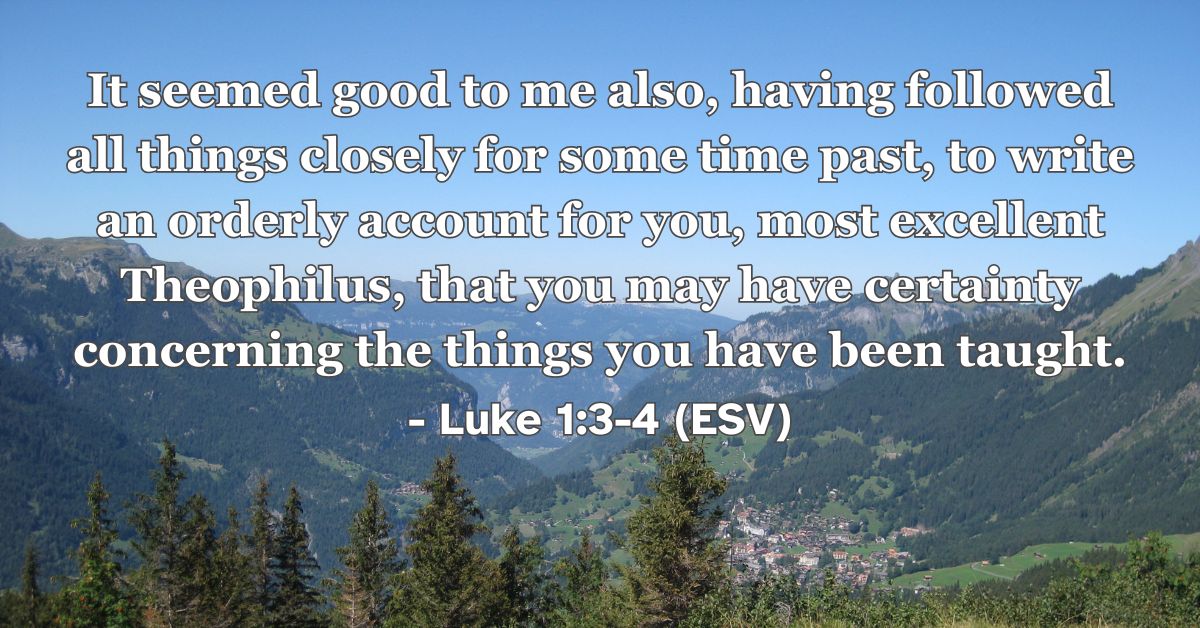
It seemed good to me also, having followed all things closely for some time past, to write an orderly account for you, most excellent Theophilus, that you may have certainty concerning the things you have been taught.
Luke 1:3-4 (ESV)
Closing Prayer
Father,
Thank you for giving us your Word through faithful servants like Luke. Thank you that the Gospel is not a rumor, but truth rooted in history and confirmed by many witnesses. Help us to grow in confidence and joy as we learn more about your Son. May we, like Luke, be faithful to share your truth with others.
In Jesus’ name we pray. Amen.


The ESL Version
I also create materials for adult English Language Learners (ELLs) and ESL students. You can find my ELL Bible Study on Luke 1:1-4 here:
ELL Bible Study: Luke 1:1-4 — Luke’s Purpose for Writing
Subscribe
If you enjoyed this post and wish to receive more Christian content, consider subscribing to my newsletters!
Related Resources
Visit the Joyful Moments in Christ homepage for all posts, or scroll through other blog posts related to Sunday School:

Something went wrong. Please refresh the page and/or try again.
English Standard Version (ESV): Unless otherwise noted, scripture quotations are from the ESV® Bible (The Holy Bible, English Standard Version®), © 2001 by Crossway, a publishing ministry of Good News Publishers. Used by permission. All rights reserved. The ESV text may not be quoted in any publication made available to the public by a Creative Commons license. The ESV may not be translated in whole or in part into any other language.


 Joyful Moments in Christ