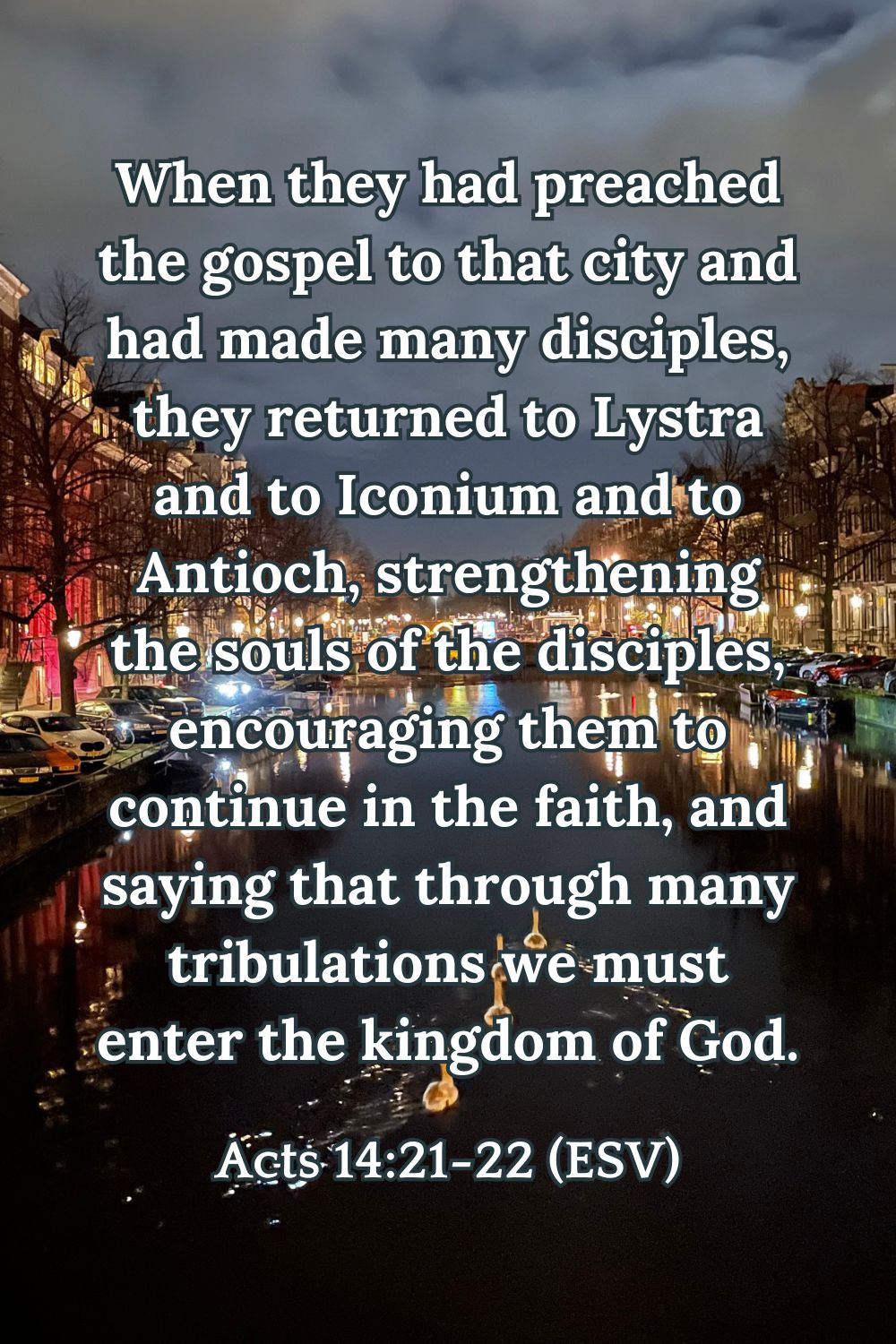
When they had preached the gospel to that city and had made many disciples, they returned to Lystra and to Iconium and to Antioch, strengthening the souls of the disciples, encouraging them to continue in the faith, and saying that through many tribulations we must enter the kingdom of God.
Acts 14:21-22 (ESV)
At first glance, this verse might seem like it applies to any modern-day preacher, but when we consider the context, it reveals a much deeper meaning. The key phrase is: “through many tribulations we must enter the kingdom of God.”
Earlier in the chapter, Paul had fled from Iconium to Lystra after facing intense persecution. In Lystra, after a miraculous healing of a local man, the people mistook Paul for a god, despite his efforts to correct them. Their admiration quickly turned to hostility when Jewish leaders from Iconium arrived, stirring up the crowd against him.
The mob responded by stoning Paul and leaving him for dead. If anyone understood tribulation, it was Paul! Remarkably, after this near-death experience, Paul continued his journey to Derbe, where he experienced great success in spreading the gospel.
Instead of retreating, Paul chose to return to the very cities—Iconium and Lystra—where he had faced severe persecution, to strengthen and encourage the believers there. What kind of faith and love for Christ would drive someone to risk their life again for the sake of others?
When we consider the types of tribulations American Christians face today, they seem mild compared to the physical persecution Paul endured. Most of us don’t face life-threatening opposition for proclaiming our faith. How many people do we know who have been beaten for following Jesus? Although our struggles may be less extreme, they are still real. For example, I have often felt discomfort when others judge me for rejecting modern attitudes about purity or morality. While this may not compare to stoning, it still challenges us to remain faithful in a world that doesn’t always share our values.
Recently, I was asked about my beliefs on raising teenagers, and other parents were shocked when I said I discouraged my children from engaging in alcohol consumption and premarital sex. When I explained that I hold my kids to high moral standards, they found it hard to believe that teenagers would respect such rules. Some even argued that allowing, or even encouraging, minor deviations from the law—both God’s and society’s—might prevent more serious rebellion. The conversation quickly spiraled into shocking confessions about their own children’s behavior. This made me wonder why we sometimes expect leniency to result in better outcomes.
My children may not always follow my rules or God’s, but I believe that lowering expectations often leads to worse outcomes. Paul’s experience in Acts illustrates the dangers of ignoring moral boundaries. Just as the people in Lystra allowed their admiration to turn into violence, disregarding God’s laws can lead to greater rebellion. This principle extends beyond parenting. If we ignore God’s commandments in one area—whether it concerns moral purity, honesty in our workplaces, or standing firm in our faith when it’s unpopular—why should we be surprised when our overall faith weakens? Like Paul, we’re called to stand strong, even when it’s difficult, because compromising our beliefs often leads to deeper challenges.
This pattern of compromise extends into various aspects of life. In workplaces, schools, and social settings, Christians frequently face pressure to conform to norms that contradict biblical teachings. Whether it’s the urge to remain silent about faith, to overlook moral integrity for career advancement, or to follow cultural trends that oppose Christian values, these modern tribulations require discernment. Just as Paul faced hostility for standing firm, so do Christians today. The challenge is not always physical persecution; it often lies in the daily choice to uphold God’s truth in environments that resist it.
Ultimately, when we choose to make Jesus our Lord and stand firm in our faith, the final outcome far exceeds any temporary pleasure. Holding fast to moral standards may not always be easy, but the long-term benefits outweigh the challenges we face along the way. In choosing to stand firm, we not only honor our faith but also cultivate resilience and deepen our relationship with Christ.
Reflection Questions
- What does the phrase “through many tribulations we must enter the kingdom of God” mean to you in the context of your own faith journey?
- How can Paul’s willingness to return to the cities where he faced persecution inspire you to confront challenges in your own life?
- In what ways do you perceive the tribulations faced by Christians in your community as similar to or different from the persecution Paul experienced?
- Reflect on a time when you felt judged or uncomfortable for upholding your moral beliefs. How did you respond, and what did you learn from that experience?
- What are some potential consequences of lowering moral expectations in parenting or in other areas of life? How can you apply this understanding in your own decisions?
- How do you navigate situations in your workplace, school, or social settings where your faith might be challenged or pressured to conform? What strategies can help you stand firm in your beliefs?
- In what specific ways can you cultivate resilience and deepen your relationship with Christ amidst the challenges you face in your daily life?
Reflective Prayer
Use Acts 14:21-22 to pray using the ACTS method: Adoration, Confession, Thankfulness, Supplication
- Adoration: Praise God. Do these verses bring any specific characteristics of God to mind?
- Confession: Tell God that you are sorry for specific sins. Does these verses bring any specific sins to mind?
- Thankfulness: Show gratitude towards God. Does anything from these verses inspire gratitude?
- Supplication: Make requests for yourself and for others. Does anything from these verses inspire a prayer?
If helpful, you can use a prayer journal template.
Subscribe
If you enjoyed this post and wish to receive more Christian content, feel free to subscribe to my newsletters!
Related Resources
Visit the Joyful Moments in Christ homepage for all posts, or scroll through other blog posts related to persecution and perseverance:
Something went wrong. Please refresh the page and/or try again.
English Standard Version (ESV): Unless otherwise noted, scripture quotations are from the ESV® Bible (The Holy Bible, English Standard Version®), © 2001 by Crossway, a publishing ministry of Good News Publishers. Used by permission. All rights reserved. The ESV text may not be quoted in any publication made available to the public by a Creative Commons license. The ESV may not be translated in whole or in part into any other language.
 Joyful Moments in Christ