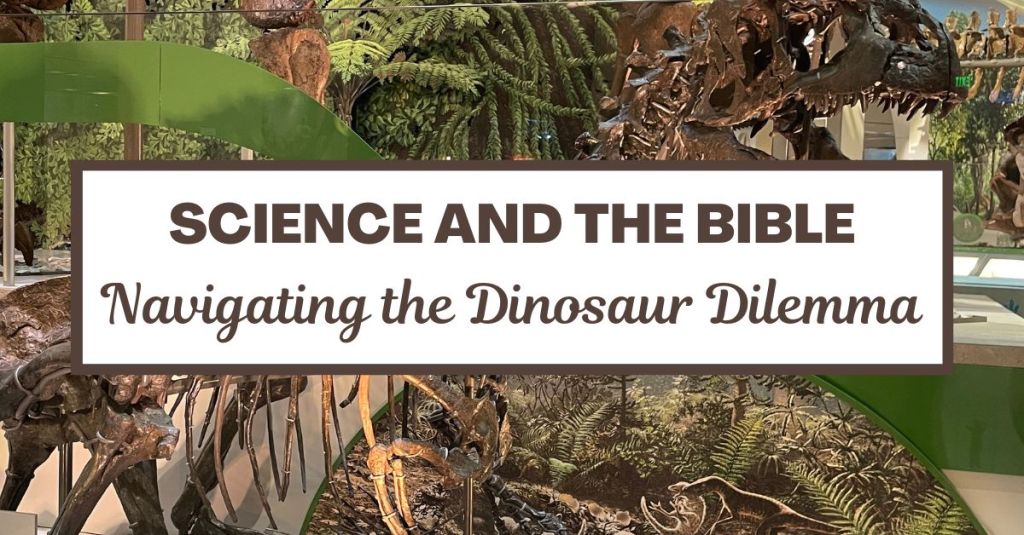
The Dinosaur Dilemma
When conversing about the Bible, navigating topics of science, evolution, and dinosaurs can be quite tricky. Many Christians insist on a literal interpretation of Genesis 1, asserting that the world was created in six days, and humans were brought into existence on the last day. This literal stance seemingly contradicts widely accepted scientific facts, leaving some Christians with only the option of embracing Young Earth Creationism.
Read: Science and the Bible: Exploring Literary Devices in Genesis
As discussions about faith and science unfold, they often take a really peculiar turn when dinosaurs enter the scene. In high school, my youth group leader showed us a “scientific” video purporting evidence that humans and dinosaurs coexisted. While I dismissed it as nonsense, the lack of evolution education at the time led some to accept it as fact. These experiences resurfaced in college when, among friends, I encountered stories like one where a pastor claimed dinosaurs never existed and their bones were planted by God to test our faith.
The unfortunate truth is that these types of experiences rarely lead to positive outcomes. Either the person is ridiculed for holding to Christian views that completely contradict scientific evidence, or the person decides to abandon the faith. Despite these challenges, I firmly believe in fostering understanding and open dialogue between faith and science.
Theistic Evolution
As an adamant Old Earth/Theistic Evolutionist, I believe in a God who is both a master scientist and engineer. My theory is that God designed a beautiful scientific system when creating the world, one that we are only beginning to comprehend. My favorite contemplation revolves around the role of dinosaurs in God’s grand scheme. I envision them as God’s “fun project,” akin to how children delight in playing with dinosaur toys.
Read: Science and the Bible: An Theistic Evolutionist’s Introduction to the Creation Story
Consider this hypothetical timeline: God begins with cells and microorganisms, progressing to plants and small animals, eventually culminating in the creation of dinosaurs. Picture the joy God might derive from crafting these fascinating creatures. However, confronted with the potential chaos of humans living in a world with roaming dinosaurs, God decides to send a giant asteroid to Earth, initiating an ice age and wiping out these colossal beings. Doesn’t this image resembles a common scenario played out by children with their dinosaur toys?
Read: Science and the Bible: Made in the Image of God
Continuing this divine creative process, humans emerge, and God ensures that the science is set up to preserve at least a few dinosaur bones for us to discover and piece together his master plan. In an ideal world, this scientific evidence should strengthen our relationship with God, and not divide us. Faith and science can coexist harmoniously, enriching our understanding of both the natural world and our spiritual beliefs. Can we embrace a perspective where the wonders of science enhance, rather than diminish, our faith?
Respond
What do you think? Possible or not? Kind responses matter! We should recognize the diversity of beliefs among Christians, as well as the impact our conversations have on those exploring Christianity.
Subscribe
If you enjoyed this post and wish to receive more Christian content, feel free to subscribe to my newsletters!
Related Resources
If you liked this post, the Biologos website has many articles that you may find both interesting and helpful!
Visit the Joyful Moments in Christ homepage for all posts, or scroll through other blog posts related to science:






English Standard Version (ESV): Scripture quotations marked (ESV) are taken from the ESV® Bible (The Holy Bible, English Standard Version®), © 2001 by Crossway, a publishing ministry of Good News Publishers. Used by permission. All rights reserved. The ESV text may not be quoted in any publication made available to the public by a Creative Commons license. The ESV may not be translated in whole or in part into any other language.




 Joyful Moments in Christ