As the early church started exploding in number, there were a few logistical problems that cropped up. In the sixth chapter of Acts, the apostles were trying to teach thousands of new converts about Jesus, but they found themselves swamped with requests to deal with everyday problems. Just as Moses was instructed by his father-in-law to delegate authority when it became too much (Exodus 18:21-22), the apostles had to make a similar wise decision.
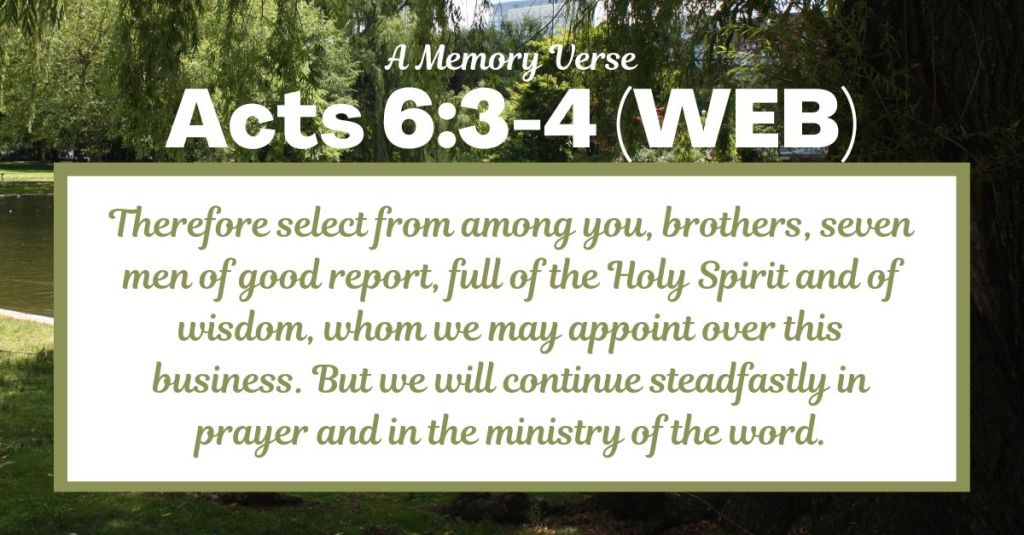
A Memory Verse
In the case in Acts, the widows of Hebraic Jews that followed Israelite culture and traditions were being cared for, while the widows of the Hellenistic Jews that followed Greek culture and traditions were not. Of course, the Hellenistic Jews were upset about this unfair treatment and went to the church leadership to fix the problem. Here is the solution that is worthy of being a memory verse:
Therefore select from among you, brothers, seven men of good report, full of the Holy Spirit and of wisdom, whom we may appoint over this business. But we will continue steadfastly in prayer and in the ministry of the word.
Acts 6:3-4 (WEB)
Fortunately, the apostles realized that solving this type of problem themselves would take way too much of their time that was supposed to be devoted to teaching, so they decided to delegate the responsibility of caring for the widows to some capable church members. This division of labor defines the primary difference between elders and deacons in the modern church. Elders are responsible for the spiritual health of the church’s members, while deacons are responsible for the physical health.
It is important to note that the apostles did not simply hand off these tasks to the first person that volunteered. First, they considered their audience and realized that the Hellenistic Jews needed the opportunity to be in a position of authority for this particular task. Next, they put a limit on who could be nominated; the people needed to be “full of the Spirit and wisdom.” Finally, they made sure the group was the right size. One person might have been too few to oversee the problem, but fifty people would have been too many. Seven was just right.
As we consider our role in life, do we try to do everything, or do we delegate when things become too much? In positions of authority, the problem becomes very obvious very quickly. Managing 10 people is much easier than managing 100. If a person tries to directly manage 1000 people, there is very little chance of succeeding.
When the scale becomes smaller, the temptation is to do more, but we will quickly become exhausted and lose our joy. At home, I am responsible for grocery shopping, cooking, and laundry, while my husband handles the day-to-day finances and keeps our floors clean. This division works well for us and plays to each of our strengths. I get very upset when my clothes are dried on high heat, while my husband gets very upset when there are crumbs on the floor. By doing the things that we care about, it can be assured that the job will be done well and that the other person won’t get upset.
Division of labor is good and right. When a person can’t divide and conquer, quality of life significantly diminishes. There is little wonder that single parents spend most of their time being completely exhausted; most of the time there is simply no one else to share the load. The good news is that while a sole provider may struggle quite significantly with babies, these babies will eventually get older and be able to help around the house. Even a 3 year old can do some basic chores like matching socks, folding underwear, setting the table, and doing some simple dusting.
Please consider different areas of your life and see if you can strategize a way to divide your labors and delegate. The goal is to stay joyful as we conquer the many tasks that life demands of us!
Reflection Questions
- In which areas of your life do you try to do too much?
- Which tasks do you enjoy the most? Care about the most? Get annoyed about the most?
- Which responsibilities might make sense to divide or delegate? Who could you trust to manage these things?
- What safeguards do you need to put in place to make sure that this area of your life still operates smoothly?
Reflective Prayer
Use this memory verse to pray using the ACTS method: Adoration, Confession, Thankfulness, Supplication
- Adoration: Praise God. Does this verse bring any specific characteristics of God to mind?
- Confession: Tell God that you are sorry for specific sins. Does this verse bring any specific sins to mind?
- Thankfulness: Show gratitude towards God. Does anything from this verse inspire gratitude?
- Supplication: Make requests for yourself and for others. Does anything from this verse inspire a prayer?
If helpful, you can use a prayer journal template.
Respond
As you consider the themes of division of labor and delegation, are there any Bible verses that came to mind? If so, add a comment at the end of this post!
Related Resources
Visit the Joyful Moments in Christ homepage for all posts, or scroll through other memory verses from Acts:




Something went wrong. Please refresh the page and/or try again.
English Standard Version (ESV): Unless otherwise noted, scripture quotations are from the ESV® Bible (The Holy Bible, English Standard Version®), © 2001 by Crossway, a publishing ministry of Good News Publishers. Used by permission. All rights reserved. The ESV text may not be quoted in any publication made available to the public by a Creative Commons license. The ESV may not be translated in whole or in part into any other language.



 Joyful Moments in Christ