One of the best ways to draw closer to Jesus is to make a habit of reading your Bible daily. For some reason, this is a spiritual practice that is REALLY HARD for some Christians, myself included. Part of the reason I started this blog was to encourage myself to be more disciplined in my Bible reading and study. Even if I never get more than a couple of readers, the time spent in study and meditation of scriptures is worth it simply for personal gain. Every time I pick up my Bible I am spending time with Jesus, drawing near to him, and making him my best friend. He is worth the time!
Why Is It So Hard to Read the Bible?
An interesting fact to consider is that the typical Bible is 1500 pages. If you divide this by 365 days in the year, you only need to read 4.1 pages per day to read the entire Bible in a year. I think that many Christians are lucky if they read 4 pages per week! Why do we resist this practice so much? The answer may be found in the book of Amos:
“Behold, the days are coming,” declares the Lord God,
Amos 8:11-12 (ESV)
“when I will send a famine on the land—
not a famine of bread, nor a thirst for water,
but of hearing the words of the Lord.
They shall wander from sea to sea,
and from north to east;
they shall run to and fro, to seek the word of the Lord,
but they shall not find it.”
In this verse, we see that Amos predicts that people will stop reading their Bibles, and the scary thing is that there will be a few who want to read it, but will not be able to find a Bible. As a society, we are definitely losing interest in reading our Bibles, but at least we can still find a Bible if we want to read it! Let’s try to reengage with this practice and make a community of people who delight in reading God’s word!
Jeremiah found delight in God’s word, even in the midst of severe difficulty:
Your words were found, and I ate them,
Jeremiah 15:16 (ESV)
and your words became to me a joy
and the delight of my heart,
for I am called by your name,
O Lord, God of hosts.
And when Beth is trying to seek the path of purity in Psalm 119, she concludes that the answer is in studying the word of God:
I will delight myself in your statutes.
Psalm 119:16 (ESV)
I will not forget your word.
We need to be reading our Bibles at all times and in all circumstances. When times are good, we should have plenty of time and energy to read the word. When times are bad, we can then draw on our knowledge of God and remember that he is always with us. Without the knowledge of God, it is hard to remember why he is worth following! Read 4 pages per day, and in 5 years, you will have read the entire Bible 5 times! What kind of knowledge will you be able to draw from then?
How Can I Read the Bible in a Year?
Chronologically
The easiest way to read your Bible in a year is to simply decide how many pages you are going to read in a day or a week and start reading chronologically from Genesis to Revelation. The challenge is that when starting from the beginning of the Bible, you will quickly come to some long and difficult sections. The book of Genesis is easy; it is engaging and high energy, but when you get to the genealogies, the purification rituals, and the instructions for building the temple, the temptation is to give up.
Another strategy is to start with the New Testament, then backtrack to the Old Testament. The problem with this is that there are 4 Gospels in a row, Matthew, Mark, Luke, and John, all of which have much of the same information over and over again. Some people will get bored with this and again give up.
Interleaved
My personal preference is to mix up the order of the books of the Bible, then print off a list that I can fold up and keep in my Bible. Each time I finish a book, I consult my list for the next set of reading. If you choose this method, keep in mind that the Bible is divided into several sections: Pentateuch (first five books of the Bible), Histories, Wisdom and Poetry, Major Prophets, Minor Prophets, Gospels (stories of Jesus), Acts of the Apostles, Epistles (letters to the churches), and Apocalypse (Revelation).
If you are reading the Bible for the first time, the three best introductory books are: one of the Gospels, Genesis, and the Acts of the Apostles (Acts). If you are trying to figure out which Gospel to read, Mark or Luke is a good starting point. Mark is the shortest of the Gospels and contains all of the essential elements. Luke is a bit longer with some added detail. Genesis tells the history of how the Jewish people came into existence. Acts tells the history of what the apostles did after Jesus’ ascension and how the first churches formed and organized. From there, it is good to get a smattering of other parts of the Bible to start rounding out your knowledge.
If helpful, you can download and print my interleaved list.
A Bible App
If you prefer to read the Bible on your phone or tablet, my personal favorite app is the YouVersion Bible App. The navigation is fairly straightforward, it is easy to switch versions of the Bible, it is easy to download audio versions of the Bible, and there are plenty of reading plans to choose from.
Getting Organized
If you like the idea of reading a physical Bible, but like the organization of an app, here are some more precise guides that you can print and store inside your Bible cover:
If you like flexibility, knowing which Bible chapters you need to read each week to finish the Bible in a year can be quite helpful. Download and print the Weekly Reading Plan if you like a little flexibility.
If you need more precision, the Daily Reading Plan will give you daily assignments for 52 weeks:
For some of us, it works best to divide the assignments into five per week, rather than seven. I tend to skip reading my Bible on Sundays, and there is usually at least one other day in the week that I might feel too busy, possibly on a day when I am prepping for a Bible study class or have unexpected appointments. In any case, dividing the reading over 5 days gives more flexibility than a daily assignment, but less than a weekly assignment. If this fits your schedule, try the 5 Day/Week Reading Plan.
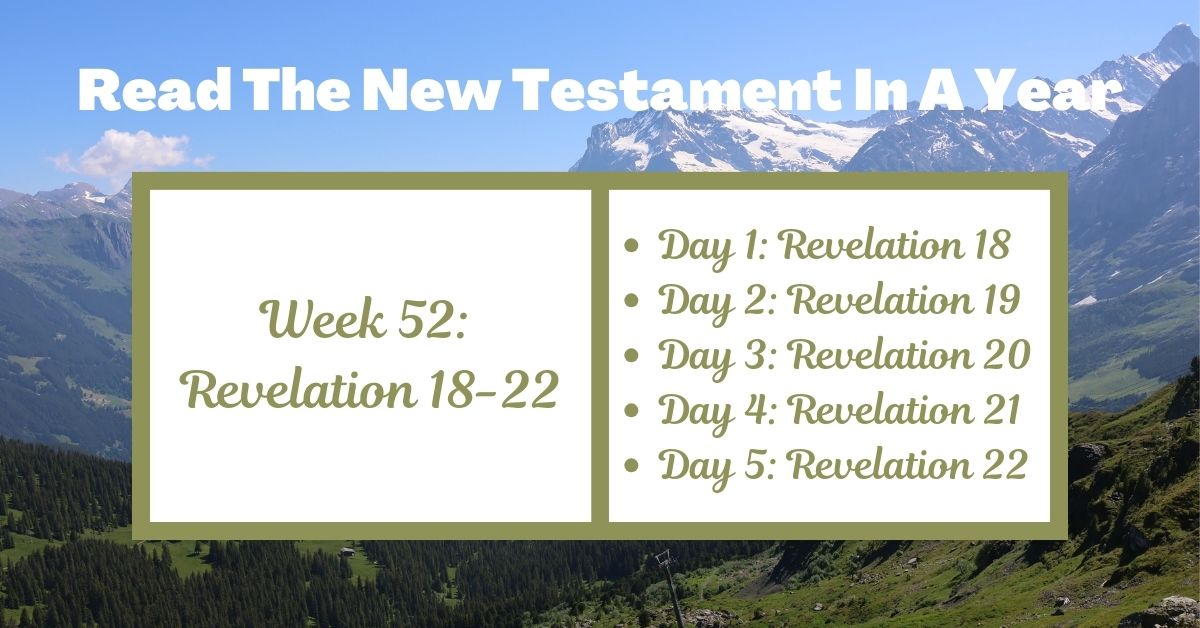
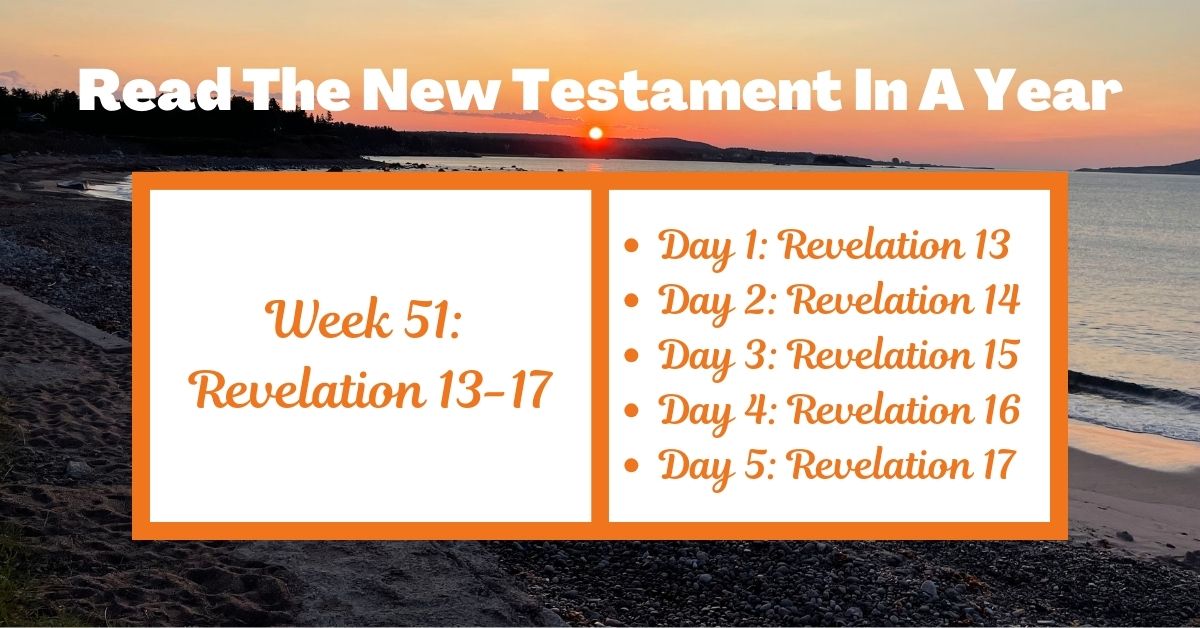
If this sounds like too much time, you can also try my plan to read the New Testament in a Year. All it takes is one chapter per day, five days per week!
Other Logistics
Timing
If you are serious about reading the Bible daily, most likely you will need to arrange your life so that the reading actually happens. First, you should set a particular time of day that works for you. When our kids were little, we did family reading time after breakfast. Now that they are older, dinner works better for us. Personal reading time is often easiest either in the mornings, in the evenings, or during your kids’ nap times. Figure out what works best for you and try to stick with it until something else makes more sense.
Bible Version
Second, you should find a version of the Bible that works for you. When our kids were little, we found that both the NIV and the ESV versions were at too high of a reading level for our them, so we switched to the Good News Translation, which is intended to be written at an elementary reading level. The NIV is at a middle school level and the ESV is at a high school grade level.
There are also stylistic differences between various translations. The NIV might be better for poetry since it tries to translate with a focus on style matching. On the other hand, the ESV tries to stay true to the literal translation, which sometimes makes poetry and songs sound a little funny.
If English is not your first language, or if you want to compare two different English language translations, consider using a side by side translation Bible. Biblica has a good website for this.
The point is to choose a Bible translation that fits both your reading level, style, and other needs. I have a full blog post about choosing the right Bible translation!
Related Resources
Visit the Joyful Moments in Christ homepage for all posts, or scroll through other blog posts related to Spiritual Practices:





Something went wrong. Please refresh the page and/or try again.
English Standard Version (ESV): Unless otherwise noted, scripture quotations are from the ESV® Bible (The Holy Bible, English Standard Version®), © 2001 by Crossway, a publishing ministry of Good News Publishers. Used by permission. All rights reserved. The ESV text may not be quoted in any publication made available to the public by a Creative Commons license. The ESV may not be translated in whole or in part into any other language.
 Joyful Moments in Christ