
With the theme of finding joy and persevering in our faith while facing difficult circumstances, the book of Ruth is a perfect place to start. This blog post can be used as a Bible Study Guide with printable discussion questions at the end.
In the first chapter of the book of Ruth, a young widow is faced with a most difficult decision: stay with her Moabite family and the god that she grew up with, or embrace the God of the Israelites and travel with her Jewish mother-in-law to Bethlehem in Judah. Ruth chooses her Jewish mother-in-law and the Jewish God. By the end of the book, she has resisted the temptation to wallow in self-pity and bitterness, and has proved to have a very strong faith. God honors the choices she had made and gives her a prominent place in the Bible.
The Introduction of Characters
The Jewish Family Temporarily Moves to Moab
At the start of the book of Ruth we see that there are food shortages in the land of Judah so Elimelek and Naomi decide to temporarily move to the pagan country of Moab with their two male children, Mahlon and Kilion.
1 In the days when the judges judged, there was a famine in the land. A certain man of Bethlehem Judah went to live in the country of Moab with his wife and his two sons. 2 The name of the man was Elimelech, and the name of his wife Naomi. The names of his two sons were Mahlon and Chilion, Ephrathites of Bethlehem Judah. They came into the country of Moab and lived there.
Ruth 1:1-2 (WEB)
Discussion Question #1: When Elimelek moved his family to Moab, what do you think was going through his head? What are the pluses and minuses of moving your family into an area that follows a different religion from your own?
While a person could argue either way whether Elimelek’s move was a good choice, sometimes a person feels backed into a corner and needs to do something they would prefer not to do in order to survive. In this case, Elimelek must have decided that the best choice for providing for his family was to move to Moab. The passage indicates that he thought it would be temporary and my guess is that that he felt like he could protect his wife and children from the influences of living in a different culture with a different religion. As we will see later, things do not go exactly as he planned.
Plans that go awry are common occurrences in life and James tells us that as we make our plans, we should also ask God to let his will reign sovereign.
13Come now, you who say, “Today or tomorrow let’s go into this city, and spend a year there, trade, and make a profit.” 14 Whereas you don’t know what your life will be like tomorrow. For what is your life? For you are a vapor that appears for a little time, and then vanishes away. 15 For you ought to say, “If the Lord wills, we will both live, and do this or that.”
James 4:13-15 (WEB)
Did Elimelek do this? Is this why Ruth ends up making the choices she did?
The Jewish Children Marry Moabite Women
The next few verses in the book of Ruth brings us to a drastic change in plans! Unfortunately Elimelek dies before returning to Bethlehem, and his two children both end up marrying local Moabite women: Orpah and Ruth.
3Elimelech, Naomi’s husband, died; and she was left with her two sons. 4a They took for themselves wives of the women of Moab. The name of the one was Orpah, and the name of the other was Ruth.
Ruth 1:3-4a (WEB)
Discussion Question #2: Why do you think Naomi’s children waited until their father died to marry Moabite women? What does the Bible say about marrying someone of a different faith?
Here, I think there are three possibilities. First, the boys may have been too young to consider marriage until after their father died. Second, they may have been of marriageable age, but simply had not found the right women yet. Or maybe they were waiting for Orpah and Ruth to convert to Judaism.
The third possibility is a little more ominous. When we consider the likely temporary living situation indicated in verses 1-2, the two sons could have wanted to get married while their father was alive, but their father may have forbade them from doing so and told them to wait to find wives until they moved back to Judah. Once Elimelek died, Naomi may have been powerless to prevent the choice.
The Choice
Naomi’s Suggestion for the Widows
At some point after the marriages occur, Mahlon and Kilion also die, leaving Naomi, Orpah, and Ruth widowed. The famine has ended and the women need to make a choice: should they stay in Moab or go back to Bethlehem?
4b They lived there about ten years. 5 Mahlon and Chilion both died, and the woman was bereaved of her two children and of her husband. 6 Then she arose with her daughters-in-law, that she might return from the country of Moab; for she had heard in the country of Moab how Yahweh[a] had visited his people in giving them bread. 7 She went out of the place where she was, and her two daughters-in-law with her. They went on the way to return to the land of Judah. 8 Naomi said to her two daughters-in-law, “Go, return each of you to her mother’s house. May Yahweh deal kindly with you, as you have dealt with the dead and with me. 9 May Yahweh grant you that you may find rest, each of you in the house of her husband.”
Ruth 1:4-9a (WEB)
Discussion Question #3: Do you agree with Naomi’s decision to leave and to urge the younger women to stay? What choice would you make if you were Naomi?
While it is possible that the famine has just ended at the time of this conversation, it is also possible that it ended earlier and Naomi’s sons were resistant to the move. It is impossible to know, but now that all of Naomi’s blood relatives in Moab are dead and the famine has ended, her desire is to go back to the original plan and return home to Bethlehem in Judah.
Did Naomi urge Ruth and Orpah to stay because Mahlon and Kilion desired to stay, because it might be easier for the women if they stay, or some other reason? If the younger women stay in Moab, they are likely to live with their relatives for a while and then will hopefully get married to Moabite men. Naomi has no relatives living in Moab and is not likely to desire marriage to a Moabite husband, so even if Orpah’s and Ruth’s families let Naomi stay with them for a while, what will she do once Orpah and Ruth get married? Would a man want his wife’s foreign mother-in-law from a previous marriage living with them? Regardless of Naomi’s wants, my guess is that Naomi’s only real choice is to return to Bethlehem.
While Naomi makes this choice to return to Judah for herself, she does not feel like she can make it for Orpah and Ruth, so she tells them that the “smart” decision is to play it safe and return to their families. Going to Bethlehem could end up meaning that the two younger would never get married. Naomi does not have close family alive in Bethlehem, so she is unlikely to be able to arrange marriages for these girls. How likely is it that a Jewish man would want to marry a Moabite woman? Jewish men were forbidden from marrying women of a different religion!
3 Do not intermarry with them. Do not give your daughters to their sons or take their daughters for your sons, 4 for they will turn your children away from following me to serve other gods, and the Lord’s anger will burn against you and will quickly destroy you.
Deuteronomy 7:3-4 (WEB)
Note that many Biblical scholars think that this passage is referring to differences in faith vs. differences in ethnicity, but that is a conversation for another time.
Orpah Chooses to Stay
At this point, both of the young women claim to want to follow Naomi to Bethlehem, but Naomi easily convinces Orpah to stay with her Moabite family.
9 May the Lord grant that each of you will find rest in the home of another husband.”
Then she kissed them goodbye and they wept aloud 10 and said to her, “We will go back with you to your people.”
11 But Naomi said, “Return home, my daughters. Why would you come with me? Am I going to have any more sons, who could become your husbands? 12 Return home, my daughters; I am too old to have another husband. Even if I thought there was still hope for me—even if I had a husband tonight and then gave birth to sons— 13 would you wait until they grew up? Would you remain unmarried for them? No, my daughters. It is more bitter for me than for you, because the Lord’s hand has turned against me!”
14 At this they wept aloud again. Then Orpah kissed her mother-in-law goodbye, but Ruth clung to her.
Ruth 1:9b-14 (WEB)
Discussion Question #4: Do you think Orpah was sincere in her first offer to return with Naomi? Do you think she made a wise decision when she decided to stay?
I think that Orpah may have initially wanted to be faithful to Naomi, but that practical concerns won out. It is also interesting to ponder what Orpah’s faith in God looked like. Did she follow the god of the Moabites, the God of her dead Jewish husband, or a little of both? How would a lack of true belief play out if she moved to Bethlehem? If she was not planning to follow the God of the Israelites, then I think she made the “smart” decision from a worldly standpoint by staying, but that choice would likely cost her eternity in heaven.
Sometimes the so-called smart choices made in this life make things more bearable in the short-term, but are disastrous from an eternal perspective.
Discussion Question #5: When looking at Orpah’s decision, what short term decisions are you making that could have disastrous eternal consequences?
Ruth Chooses to Leave with Naomi
Naomi tries one more time to convince Ruth to stay, but Ruth is determined to go.
15 “Look,” said Naomi, “your sister-in-law is going back to her people and her gods. Go back with her.”
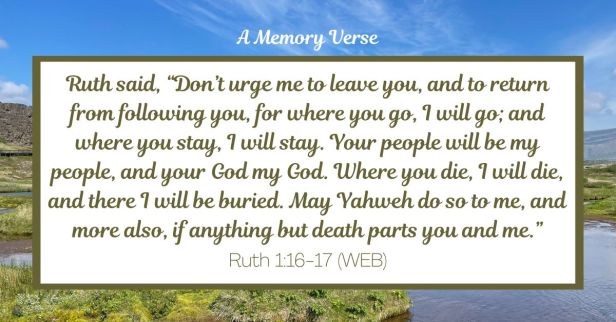
16 But Ruth replied, “Don’t urge me to leave you or to turn back from you. Where you go I will go, and where you stay I will stay. Your people will be my people and your God my God. 17 Where you die I will die, and there I will be buried. May the Lord deal with me, be it ever so severely, if even death separates you and me.” 18 When Naomi realized that Ruth was determined to go with her, she stopped urging her.
Ruth 1:15-18 (WEB)
It is important to note that in Middle Eastern culture, it is polite to make several refusals before accepting an offer. When Orpah refuses to stay in Moab the first time, she could be showing polite manners, but then when Naomi continues to follow the rules of politeness and asks Orpah the same question again, Orpah might have gratefully given her consent to stay in Moab.
Unlike Orpah, Ruth’s insistence on staying with Naomi is genuine and she gives enough refusals to convince Naomi of her sincerity.
At some point during Ruth’s marriage, she must have decided that she fully believed in the God of her Jewish husband and that she wanted that lifestyle for herself. If Ruth stayed with her Moabite family, she likely would be forced into worshiping the Moabite god and marrying a man who followed the Moabite religion. If she wanted to stay true to the Jewish God, Naomi was her best hope. Ruth clung to Naomi as if she were a lifeline. From an eternal perspective, Naomi was exactly that.
Discussion Question #6: When looking at Ruth’s decision, what decisions are you making now that could have wonderful eternal consequences?
Naomi and Ruth’s Arrival in Bethlehem
The first chapter of Ruth ends with Naomi’s and Ruth’s arrival into Bethlehem.
19 So the two women went on until they came to Bethlehem. When they arrived in Bethlehem, the whole town was stirred because of them, and the women exclaimed, “Can this be Naomi?”
20 “Don’t call me Naomi,[a]” she told them. “Call me Mara,[b] because the Almighty[c] has made my life very bitter. 21 I went away full, but the Lord has brought me back empty. Why call me Naomi? The Lord has afflicted[d] me; the Almighty has brought misfortune upon me.”
22 So Naomi returned from Moab accompanied by Ruth the Moabite, her daughter-in-law, arriving in Bethlehem as the barley harvest was beginning.
Ruth 1:19-22 (WEB)
After a ten year absence, no one was expecting Ruth to return. They were probably even more shocked that she had lost her husband and both of her children, and that she had a Moabite daughter-in-law with her. She expresses this loss with a requested name change to “Mara”, which means bitter.
Discussion Question #7: How did Naomi express the bitterness she held over her situation in life? How do you express displeasure with the circumstances you have been dealt? Do you think that Naomi was right to be bitter? What steps can you take to avoid bitterness when life doesn’t go the way you hoped?
It is very easy to become disillusioned by our circumstances and to choose self-pity and bitterness over joy. Both Naomi and Ruth lost their husbands and were left in slightly desperate circumstances. While Naomi may have felt punished by God for having left Judah for a pagan land, Ruth may have felt joy and gratitude that she would be permitted to worship her new God without restraint. Both women had reason to feel sadness and anger, but only Naomi is mentioned as having bitterness.
Ruth’s way is better and we will see that Naomi’s difficult situation led to moments of joy. One great example of this includes Ruth’s conversion and the faith that Ruth passed on to her children and grandchildren. What if Boaz would have married a woman with less faith? How would that have changed the faith of Jesus’ parents? Just because we face a couple of very difficult situations, it does not mean that God has it out for us and that everything that comes later will be bad. Sometime hard situations make both us and those around us better people, even if we don’t see it at the time.
Choose to find joy in all circumstances in life and persevere in your faith!
Downloads
Respond
As you consider the themes of choosing God and rejecting self-pity and bitterness, are there any Bible verses that came to mind? If so, add a comment at the end of this post!
And if you want to read more Bible studies and other Christian content, consider subscribing to my newsletters!
Related Resources
Read: Ruth 1:16-17 – A Memory Verse with Reflection Questions
Read: Ruth 1 – Musings about Discerning God’s Will
Read: Ruth 1 – A Prayer about Discerning the Will of God
Read: Ruth 2 – A Bible Study about Care and Compassion
Read: Ruth 3 – A Bible Study about Taking Action while Remaining Humble and Respectful
Visit the Joyful Moments in Christ homepage for all posts, or scroll through other blog posts related to the book of Ruth:




Something went wrong. Please refresh the page and/or try again.
English Standard Version (ESV): Unless otherwise noted, scripture quotations are from the ESV® Bible (The Holy Bible, English Standard Version®), © 2001 by Crossway, a publishing ministry of Good News Publishers. Used by permission. All rights reserved. The ESV text may not be quoted in any publication made available to the public by a Creative Commons license. The ESV may not be translated in whole or in part into any other language.




 Joyful Moments in Christ